In December of 1972, NASA launched Apollo 17. On their way to the Moon, the crew took a famous picture of Earth. Some 18,000 miles away, “The Blue Marble” was photographed and is one of the most reproduced pictures in history. In that picture, Earth’s spherical shape is obvious. A sphere is a round solid figure with every point on its surface the same distance from its center.
Remember that Earth rotates on its axis, the imaginary line that connects the North and South Poles. Earth’s axis is tilted at 23.5°. Earth rotates in a counterclockwise motion around its axis when viewed from above the North Pole. While Earth is in its rotation, it is also in its orbit, or revolution, around the Sun. As Earth travels around the Sun, the area of sunlight changes. We experience seasons due to the changes in the intensity of sunlight as Earth revolves around the Sun. Because of Earth’s tilted axis and its spherical shape, the intensity of the sunlight hitting the planet varies. Both the tilt of Earth’s axis and Earth’s spherical shape play a role in Earth’s changing seasons.
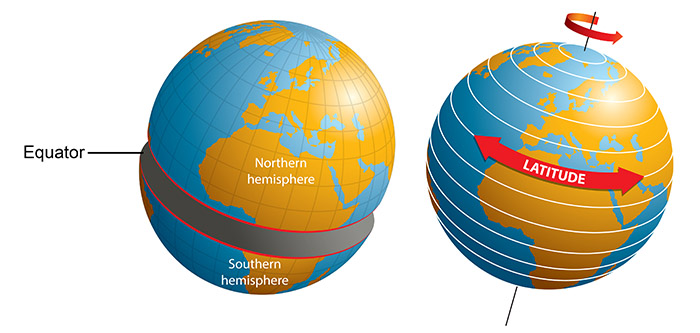
Earth has a northern half and a southern half. We call these halves the Northern Hemisphere and the Southern Hemisphere. These hemispheres are separated by the Equator. The Equator is the imaginary line that runs around the center of the Earth like a belt. ALL locations along the same lines of latitude, lines that run east to west around the planet, will experience the same season.
Question
What separates the two hemispheres?
