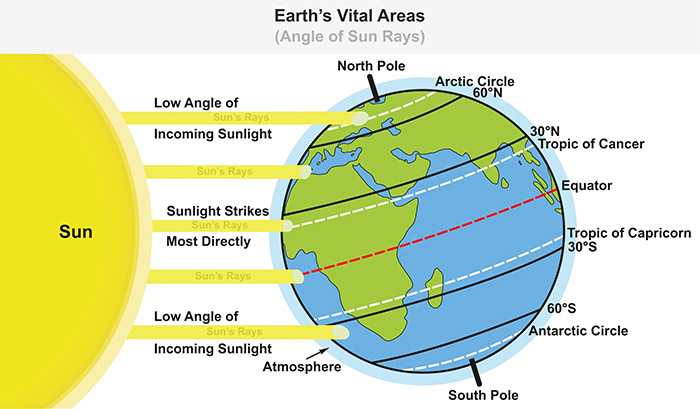
Both the North Pole (the Arctic) and the South Pole (the Antarctic) are cold because they never get any direct sunlight. Even though the North and South Poles are literal “polar opposites,” they both get the same amount of sunlight. Each area is unique, yet there are some similarities in how they experience the seasons. Because of Earth’s tilt and orbit around the Sun, the poles receive less energy and heat from the Sun. This results in only two polar seasons--summer and winter. The Sun is always low on the horizon, even in the middle of the summer. In the winter, the Sun is so far below the horizon that it doesn’t come up at all. No matter whether the season is summer or winter at the poles, it will always be cold!
When the Earth is tilted towards the Sun in its orbit, the Northern Hemisphere is experiencing summer. The Sun begins rising at the North Pole on the vernal equinox and rises higher in the sky with each passing day, reaching a maximum height at the summer solstice. It stays in full sunlight all day long throughout the entire summer. After the summer solstice, the Sun starts to sink towards the horizon. In summer at the poles, the Sun does not set, so the North Pole experiences six months of daylight. The average summer temperature at the North Pole is 32℉, not what we think of as summer! During these months, the South Pole is having the opposite experience, as it is on the side of Earth tilted away from the Sun. This causes there to be six months of darkness. This is the South Pole’s winter season, and its average temperature is -76℉.
Six months later, the Earth is on the other side of its orbit, tilted away from the Sun, and the Northern Hemisphere is experiencing winter. At the autumnal equinox, the Sun sinks below the horizon, and the North Pole is in twilight until early October, after which it is in full darkness for the winter. This darkness lasts until the beginning of dawn in early March, as the vernal equinox approaches. In winter at the poles the Sun does not rise, so the North Pole experiences darkness. The average winter temperature in the North Pole is -40℉. During these months, the South Pole is having the opposite experience once again, as it is now on the side of Earth tilted toward the Sun and has constant sunlight. This is the South Pole’s summer season, and its average temperature is -18℉.
Question
Why is the temperature at the North and South Poles so cold?
