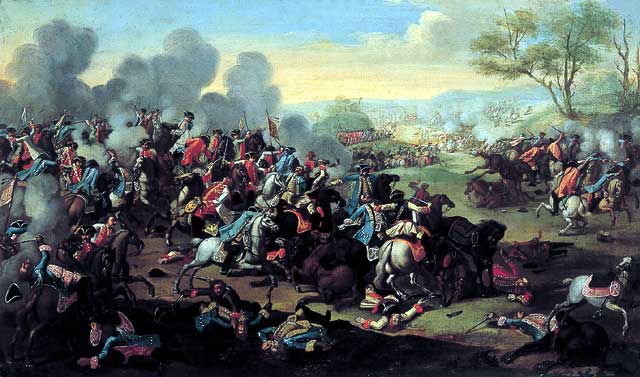
European wars were raging throughout the 17th and 18th centuries, and they had a significant impact on the American colonies. In the activity below, you will use an outline to determine how these wars influenced people in America.
Outlining is a great way to take notes from a reading or text. It teaches you how to organize and separate important information from the information you probably don't need. View the following guideline to learn how to outline a text.
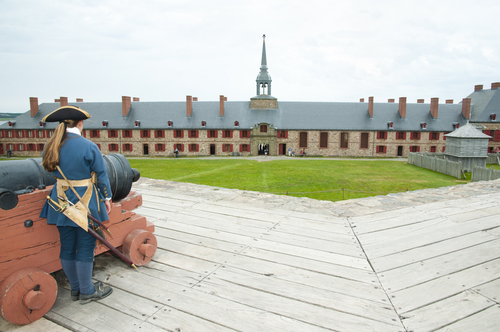
Fort Louisbourg in Nova Scotia, Canada
Britain and France had been competing for wealth for centuries. By 1700, they were two of the strongest powers in Europe. Their long rivalry caused bitter feelings between British and French colonists in North America. As the growing population of the American colonies pushed up against French territory, hostility between England and France increased. At the same time, some land companies wanted to explore opportunities in the Ohio River valley. However, the French, who traded throughout the Ohio country, regarded this territory as their own. They had no intention of letting British colonists share in their profitable fur trade.
In the 1740s, British fur traders went into the Ohio country. They built a fort deep in the territory of the Miami people at a place called Pickawillany. Acting quickly, the French attacked Pickawillany and drove the British traders out of Ohio. The French then built a string of forts along the rivers of the upper Ohio Valley, closer to the British colonies than ever before. Two mighty powers, Great Britain and France, were headed for a showdown in North America. In the early 1700s, Britain had gained control of Nova Scotia, Newfoundland, and the Hudson Bay. In the 1740s, French troops raided towns in Maine and New York. In response, a force of New Englanders went north and captured the important French fortress at Louisbourg on Cape Breton Island, north of Nova Scotia. Later Britain returned Louisbourg to France, much to the disgust of the New England colonists.

The flag of the Iroquois Confederacy, featuring the Hiawatha Belt, which symbolizes peace
The French traders and the British colonists knew that Native American help would make a difference in their struggle for North America. The side that received the best trade terms from Native Americans and the most help in the war would probably win the contest for control of North America. The French had many Native American allies. Unlike the British, the French were interested mainly in trading for furs—not in taking over Native American land. The French also had generally better relations with Native Americans. French trappers and fur traders often married Native American women and followed their customs. French missionaries traveled through the area, converting many Native Americans to Catholicism.
During the wars between Great Britain and France, Native Americans often helped the French by raiding British settlements. In 1704, for example, the Abenaki people joined the French in an attack on the British frontier outpost at Deerfield, Massachusetts, in which almost 50 settlers were killed.
The most powerful group of Native Americans in the East was the Iroquois Confederacy, based in New York. When the confederacy was first formed in about 1570, it included five nations—the Mohawk, Seneca, Cayuga, Onondaga, and Oneida. Other groups later joined or were conquered by the Iroquois.
The Iroquois managed to remain independent by trading with both the British and the French. By skillfully playing the British and French against each other, the Iroquois dominated the area around the Great Lakes. By the mid-1700s, however, the Iroquois came under greater pressure as the British moved into the Ohio Valley. Eventually the leaders of the confederacy gave certain trading rights to the British and reluctantly became their allies. By taking this step, the Iroquois upset the balance of power between the French and British that had been so difficult to establish.
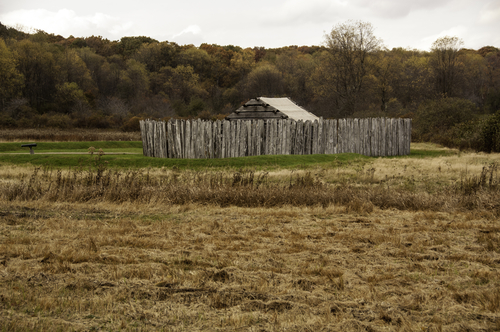
A reconstruction of Fort Necessity at Fort Necessity National Battlefield Park, near Farmington, Pennsylvania
A group of Virginians had plans for settling the Ohio Valley. In the fall of 1753 Governor Robert Dinwiddie of Virginia sent a 21-year-old planter and surveyor named George Washington into the Ohio country. Washington’s mission was to tell the French that they were trespassing on territory claimed by Great Britain and demand that they leave. Washington delivered the message, but it did no good. “The French told me,” Washington said later, “that it was their absolute design to take possession of the Ohio, and by God they would do it.”
In the spring of 1754, Dinwiddie made Washington a lieutenant colonel and sent him back to the Ohio country with a militia of 150 men. The militia had instructions to build a fort where the Allegheny and Monongahela Rivers meet to form the Ohio River, the site of present-day Pittsburgh. When Washington and his troops arrived, they found the French were already building Fort Duquesne on that spot. Washington established a small post nearby called Fort Necessity.
Although greatly outnumbered, the forces of the inexperienced Washington attacked a French scouting party. The French surrounded Washington’s soldiers and forced them to surrender, but the soldiers were later released, and they returned to Virginia. Washington’s account of his experience in the Ohio country was published, and his fame spread throughout the colonies and Europe. Despite his defeat, the colonists regarded Washington as a hero who struck the first blow against the French.
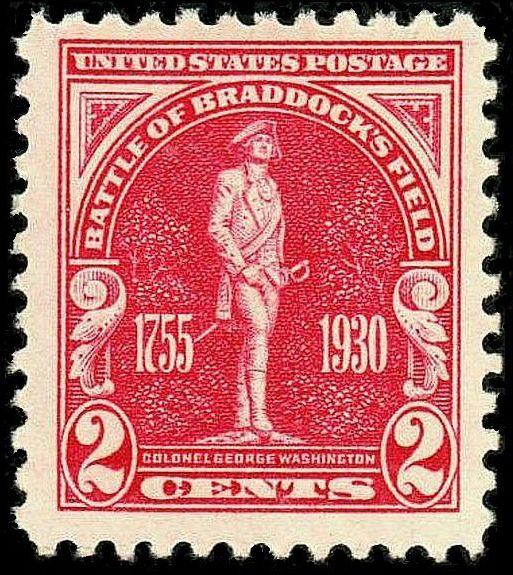
A stamp celebrating the 175th anniversary of the Battle of Braddock's Field. It was modeled after the statue of George Washington that was unveiled the same day as the stamp was released.
During the French and Indian War, some Native Americans fought on the side of the British. Many others fought against the British. The war that raged in North America through the late 1750s and early 1760s was one part of a larger struggle between England and France for control of world trade and power on the seas. The British colonists knew that the French were building well-armed forts throughout the Great Lakes region and the Ohio River valley. Their network of alliances, or unions, with Native Americans allowed the French to control large areas of land, stretching from the St. Lawrence River in Canada all the way south to New Orleans. The French and their Native American allies seemed to be winning control of the American frontier.
The final showdown was about to begin. During the early stages of the French and Indian War, the British colonists fought the French and the Native Americans with little help from Britain. In 1754, however, the government in London decided to intervene in the conflict. It was alarmed by the new forts the French were building and by George Washington’s defeat at Fort Necessity. In the fall of 1754, Great Britain appointed General Edward Braddock commander in chief of the British forces in America and sent him to drive the French out of the Ohio Valley.
In June 1755, Braddock set out from Virginia with about 1,400 red-coated British soldiers and a smaller number of blue-coated colonial militia. George Washington served as one of his aides. It took Braddock’s army several weeks to trek through the dense forest to Fort Duquesne. Washington tried to tell Braddock that his army’s style of marching was not well suited to fighting in frontier country. Lined up in columns and rows, the troops made easy targets. Braddock ignored the advice. On July 9, a combined force of Native American warriors and French troops ambushed the British. The French and Native Americans were hidden, firing from behind trees and aiming at the bright uniforms. The British, confused and frightened, could not even see their attackers. Braddock was killed, and the battle ended in a bitter defeat for the British, who suffered nearly 1,000 casualties. Washington led the survivors back to Virginia.
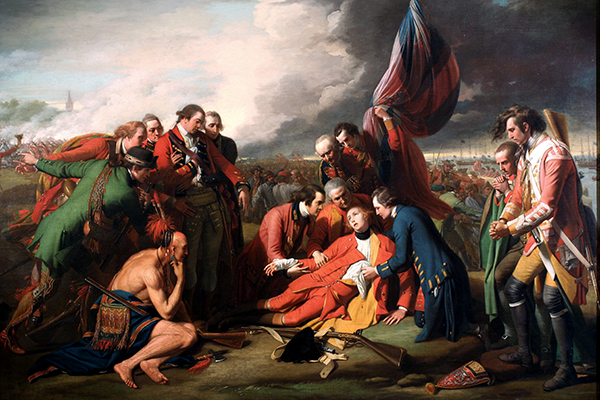
This painting by Benjamin West depicts the death of British general James Wolfe at the Plains of Abraham in Quebec.
The fighting in America helped start a new war in Europe, known as the Seven Years’ War. After arranging an alliance with Prussia, Britain declared war on France in 1756. Prussia fought France and its allies in Europe while Britain fought France in the Caribbean, India, and North America. The first years of the war were disastrous for the British and their American colonies. French troops captured several British forts, and their Native American allies began staging raids on frontier farms from New York to Pennsylvania. They killed settlers, burned farmhouses and crops, and drove many families back toward the coast.
Great Britain’s prospects in America improved after William Pitt came to power as secretary of state and then as prime minister. A strong military planner, Pitt knew how to pick skilled commanders. He oversaw the war effort from London. To avoid having to deal with constant arguments from the colonies about the cost of the war, Pitt decided that Great Britain would pay for supplies needed in the war, no matter the cost. In doing so Pitt ran up an enormous debt. After the French and Indian War, the British raised the colonists’ taxes to help pay this debt. Pitt had only delayed the moment when the colonists had to pay their share of the bill.
Pitt wanted more than just a clear path to the Western territories. He also intended to conquer French Canada. He sent British troops to North America under the command of such energetic officers as Jeffrey Amherst and James Wolfe. In 1758, Amherst and Wolfe led a British assault that recaptured the fortress at Louisbourg. That same year a group of New Englanders, led by British officers, captured Fort Frontenac at Lake Ontario. Another British force marched across Pennsylvania and forced the French to abandon Fort Duquesne, which was renamed Fort Pitt.
By 1759, the British captured several French islands in the West Indies and the city of Havana in Cuba. They defeated the French in India and destroyed a French fleet that had been sent to reinforce Canada. The greatest victory of the year, though, took place in the heart of New France. Perched high on a cliff overlooking the St. Lawrence River, Quebec, the capital of New France, was thought to be impossible to attack. In September 1759, British general James Wolfe’s soldiers overwhelmed the guards and assembled outside the fortress of Quebec on a field called the Plains of Abraham. There they surprised and defeated the French army. Wolfe died in the battle. The French commander, the Marquis de Montcalm, was wounded and died the next day.
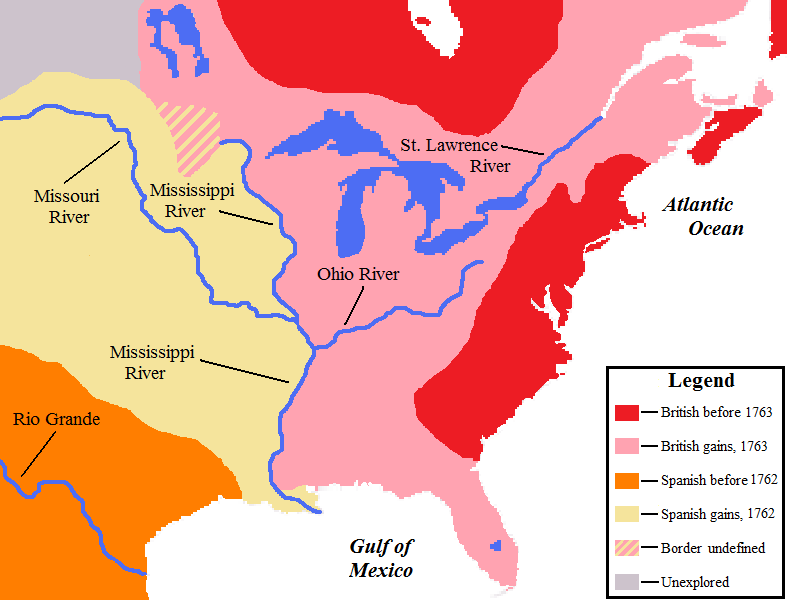
A map showing the North American territorial gains of Spain in 1762 and Britain in 1763
The fall of Quebec and General Amherst’s capture of Montreal the following year brought the fighting in North America to an end. In the Treaty of Paris of 1763, France was permitted to keep some of its sugar-producing islands in the West Indies, but it was forced to give Canada and most of its lands east of the Mississippi River to Great Britain. From Spain, France’s ally, Great Britain gained Florida. In return, Spain received French lands west of the Mississippi River—the Louisiana Territory—as well as the port of New Orleans.
The Treaty of Paris marked the end of France as a power in North America. The continent was now divided between Great Britain and Spain, with the Mississippi River marking the boundary. While the Spanish and British were working out a plan for the future of North America, many Native Americans still lived on the lands covered by the European agreement.
When you have completed your outline, submit it to your teacher for review.
| 5 points |
Outline is in proper format. |
| 5 points |
Outline includes proper content. |
