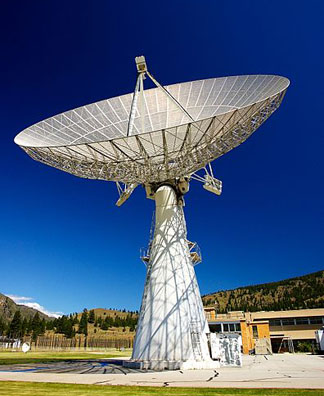
 Below infrared waves are microwaves. These have longer wavelengths, which can get to several inches long. Microwaves are used to cook food by vibrating the molecules of food to heat it up. They are used extensively in satellite communications (have you ever seen a microwave tower?), in radiotelescopes, and in radar. Microwaves and radio waves are also reflected off of the ionosphere (a part of the atmosphere) and off of satellites that orbit the earth and literally wash the earth in seas of radiation.
 Moving to even longer wavelengths and lower frequencies (lower energy) now, we have the radio waves. The shorter radio waves are used in cell phones and televisions. FM radio waves are longer, and AM radio waves have the longest wavelengths, up to a mile in length! There is a very broad range of frequencies that fall under this category. Look at your radio dial and you can see how many stations (frequencies) there are!
Waves of energy, including light energy, are bombarding us every moment of every day. We notice some of these waves with our senses: we feel heat waves with our skin, hear sound waves with our ears, and see visible light waves with our eyes. But most of the waves of energy that reach us we do not sense at all. Scientists are now asking questions about how all these waves of the electromagnetic spectrum that we do not sense affect matter and living things. Some are known to be beneficial and some are known to have some harmful effects, but most of them still pose riddles yet to be solved.
