
Let's Break it Down
You know that a line's \( y \)-intercept is the location where the line crosses the \( y \)-axis. Similar to the \( y \)-intercept, a line's \( x \)-intercept is the place where the line crosses the \( x \)-axis. This location is expressed as an ordered pair, \( (x,\ 0) \). The \( y \)-coordinate of the ordered pair that represents a line's \( x \)-intercept is always \( 0 \).

You can read the value of a line's \( x \)-intercept from its graph or from a table of values. You can also use the equation of a line to calculate the value of the \( x \)-intercept.
Read the tabs below to learn how to find the value of the \( x \)-intercept using a graph, table of values, or an equation.
A line's \( x \)-intercept is the location where the line crosses the \( x \)-axis.
The graph below shows the equation \( y = - \frac{1}{4}x - 3 \).
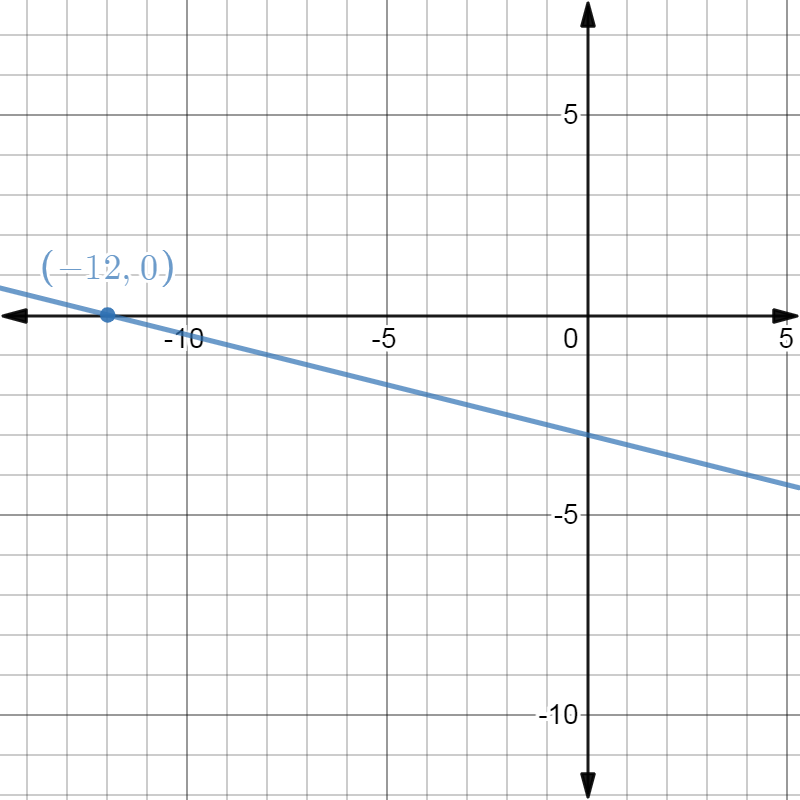
Graph of \( y = - \frac{1}{4}x - 3 \).
Name the ordered pair that represents this line's \( x \)-intercept.
You can read the graph to find the location of the \( x \)-intercept. It is \( ( - 12,\ 0) \).
The given table of values represents a line. Remember that in a table of values, the columns labeled \( x \) and \( y \) correspond to the ordered pair notation \( (x,\ y) \).
| \( x \) |
\( y \) |
|---|---|
\( - 16 \) |
\( 1 \) |
\( - 12 \) |
\( 0 \) |
\( - 4 \) |
\( - 2 \) |
\( 0 \) |
\( - 3 \) |
\( 4 \) |
\( - 4 \) |
At the \( x \)-intercept, the value of the \( y \)-coordinate is always \( 0 \). Use this information to find the value of the \( x \)-intercept in the table of values.
Read the table of values. When \( y = 0 \), \( x = - 12 \). This means that the ordered pair \( ( - 12,\ 0) \) is the \( x \)-intercept.
| \( x \) |
\( y \) |
|---|---|
\( - 16 \) |
\( 1 \) |
\( \require{color}\colorbox{yellow}{$ - 12 $} \) |
\( \require{color}\colorbox{yellow}{$ 0 $} \) |
\( - 4 \) |
\( - 2 \) |
\( 0 \) |
\( - 3 \) |
\( 4 \) |
\( - 4 \) |
When an equation is written in slope-intercept form, you can read the value of the \( y \)-intercept directly from the equation. To use the equation to find the value of the \( x \)-intercept, you must substitute \( y = 0 \) into the equation and solve for \( x \). For example:
What are the coordinates of the \( x \)-intercept for the equation \( y = - \frac{1}{4}x - 3 \)?
Substitute \( y = 0 \) into the equation. |
\( (0) = - \frac{1}{4}x - 3 \) |
Use inverse operations and the properties of equality to solve for \( x \). |
\( \left( 0 \right) = - \frac{1}{4}x - 3 \) \( 0 {\color{#A80000}{\ +\ 3}} = - \frac{1}{4}x - 3 {\color{#A80000}{\ +\ 3}} \) \( 3 = - \frac{1}{4}x \) \( {\color{#A80000}{( - 4)}}3 = - \frac{1}{4}x {\color{#A80000}{( - 4)}} \) \( - 12 = x \) |
The coordinates of the \( x \)-intercept are \( ( - 12,\ 0) \). |
|

Think you got it?
How well can you use graphs, tables of values, and equations to locate the \( x \)-intercept of a line? Use the activity below to practice. Match the graph, table of values, or equation on the left to its \( x \)-intercept on the right.
