
Let's Review
You have learned that if the equation of a line is expressed in point-slope form, you can rewrite it in slope-intercept form. Once the line is written in slope-intercept form, you can name its \( y \)-intercept. You can also solve for the location of the \( x \)-intercept. For example:

Rewrite the equation \( y - \left( - 3 \right) = \frac{1}{2}(x - 4) \) in slope-intercept form. Give the coordinates of both its \( x \)- and \( y \)-intercepts.
Step 1: Simplify any double negatives. |
There is a double negative on the left-hand side of the equation. \( y \ \require{color}\colorbox{yellow}{$ - \left( - 3 \right) $} = \frac{1}{2}\left( x - 4 \right) \) \( y \ \require{color}\colorbox{yellow}{$ + 3 $} = \frac{1}{2}\left( x - 4 \right) \) |
Step 2: Distribute on the right-hand side of the equation. |
\( y + 3 = \frac{1}{2}\left( x - 4 \right) \) \( y + 3 = \frac{1}{2}x - 2 \) |
Step 3: Collect the like terms. |
\( y + 3 = \frac{1}{2}x - 2 \) \( y + 3 {\color{#A80000}{\ - 3}} = \frac{1}{2}x - 2 {\color{#A80000}{\ - 3}} \) \( y = \frac{1}{2}x - 5 \) |
Step 4: Read the location of the \( y \)-intercept from the equation. |
\( \left( 0, - 5 \right) \) |
Step 5: Solve for the location of the \( x \)-intercept. |
Substitute \( y = 0 \) into the slope-intercept form of the equation. \( (0) = \frac{1}{2}x - 5 \) \( 0 {\color{#A80000}{\ +\ 5}} = \frac{1}{2}x - 5 {\color{#A80000}{\ +\ 5}} \) \( {\color{#A80000}{(2)}}5 = \frac{1}{2}x {\color{#A80000}{(2)}} \) \( 10 = x \) The \( x \)-intercept is \( (10,\ 0) \). |
In the example above, the equation \( y - \left( - 3 \right) = \frac{1}{2}(x - 4) \) converted to \( y = \frac{1}{2}x - 5 \) when it was rewritten in slope-intercept form.
Remember that in the point-slope form of an equation, \( y - y_{1} = m(x - x_{1}) \), any ordered pair on the line can be substituted for \( (x_{1},\ y_{1}) \). Since there are an infinite number of ordered pairs on every line, each line has an infinite number of point-slope equations.
Multiple point-slope equations can simplify to a single slope-intercept equation. All of the equations below represent the same line, shown on the graph, with the known ordered pairs marked:
\( y - \left( - 3 \right) = \frac{1}{2}(x - 4) \)
\( y - ( - 2) = \frac{1}{2}(x - 6) \)
\( y = \frac{1}{2}x - 5 \)
Note that a line has only one slope-intercept equation because it has only one slope value and only one \( y \)-intercept.
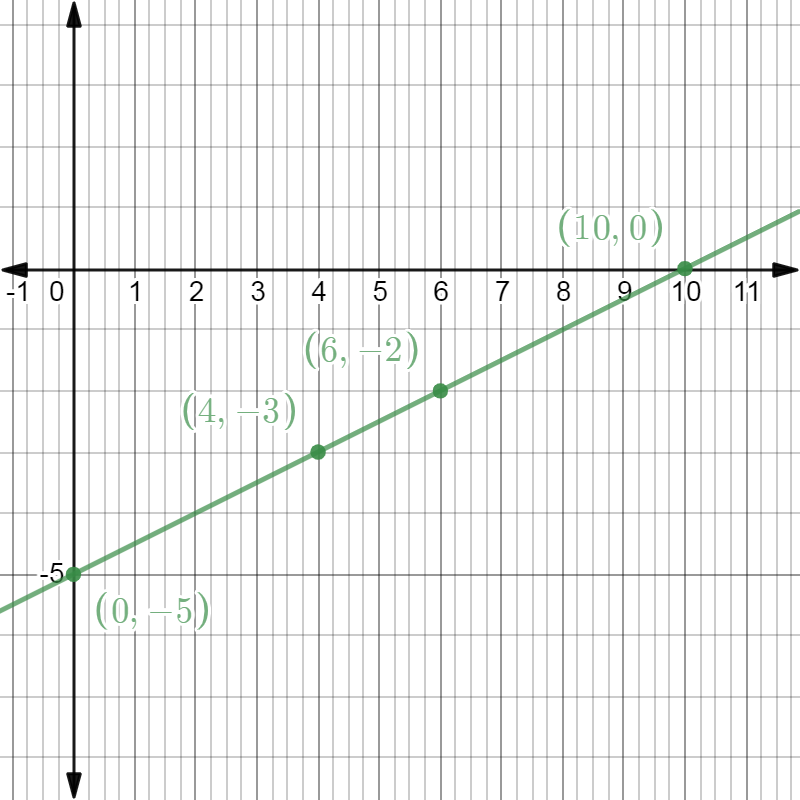
The ordered pairs \( (0, - 5), \) \( \left( 4, - 3 \right), \) (6, -2), and (10, 0), labelled on a line.
Question
The equations \( y - \left( - 3 \right) = \frac{1}{2}(x - 4) \) and \( y - ( - 2) = \frac{1}{2}(x - 6) \) represent the same line. Keeping in mind what you have learned about the point-slope form of the equation, use these equations to name two ordered pairs that lie on this line. Explain how you know these ordered pairs are on the line.
Two ordered pairs that lie on this line are \( (4, - 3) \) and \( (6, - 2) \). You know these lie on the line because they are the \( (x_{1},\ y_{1}) \) ordered pairs in each of the equations listed in the question.
