There are two more areas of science that may interest you now, and perhaps you may want to pursue them as your profession. While Earth science limits itself to study of Earth's structure, properties, processes, and evolution, space science extends beyond Earth and applies all scientific knowledge in understanding cosmic bodies in space.
Follow the tab set to learn more about these two sciences.
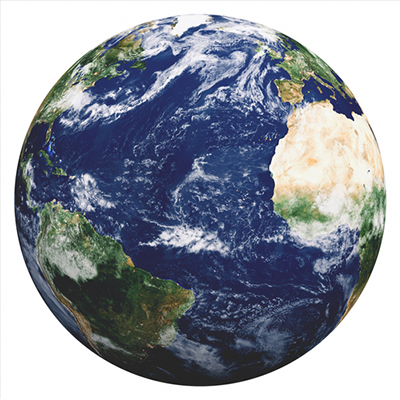 Earth science deals with everything related to study of solid Earth, its various features, and its water, air, and evolution. There are four main branches of study in Earth science. Look through the table below to learn about some of the distinct areas you might pursue within Earth science. Click the profession to see what it studies.
|
"Geo" stands for Earth and "logy" means study. So, study of Earth, its compositions, materials, structures, and processes are all part of geology. Geologists search for fossil fuels and minerals, study natural hazards, and help protect Earth’s environment. |
|
|
Meteorology is all about study of weather and climate. This branch of science studies Earth’s atmosphere and how it impacts weather changes on a day-to-day basis. Meteorologists not only help predict weather but also have an important role in issuing advisories to fishery, aviation, and shipping industries. |
|
|
As the name suggests, this field is all about study of oceans. Oceans cover most of Earth and have an important role as resources for food, minerals, and determining climate. Oceanographers not only discover more and more about oceans, but they also protect oceans from human impact. |
|
|
Astronomy is the study of the universe. There are several elements in the universe, like the Sun, the Moon, and asteroids, which impact Earth in many ways. Astronomers use scientific knowledge to study these interstellar objects in space and their relationship with Earth. |
 Space science covers science conducted from vehicles or spacecraft that travel beyond Earth’s atmosphere. Space science deals with applying all science concepts and scientific knowledge to celestial bodies apart from Earth.
Astronomy is a major part or branch of study in Earth sciences. It is a natural science that studies celestial objects: stars, planets, comets, nebulae (gas clouds), star clusters and other phenomena that exist in space. Astronomers study a variety of areas such as evolution, physics, chemistry, meteorology, and motions of celestial bodies and the formation and development of the universe.
Like all the sciences, the study of advanced mathematics and physics is an essential requirement to pursue astronomy. Optics is the study of the properties and behavior of light. It is a major area to be mastered in astronomy, since we cannot physically reach all cosmic bodies but can study by observing them from Earth.
