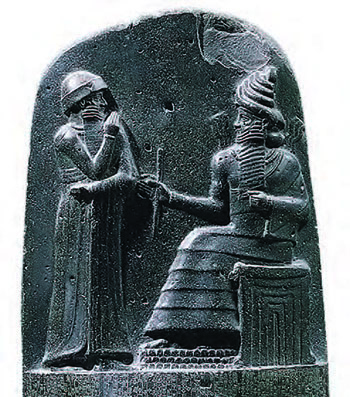
The Babylonians also lived along the Euphrates River. The city of Babylon was settled about 2000 B.C., and is located near Baghdad in what is now Iraq. One of the great kings of Babylon was Hammurabi. Hammurabi ruled for more than forty years. He is the first known king to have a recorded code of laws, which are now known as the "Code of Hammurabi." There were nearly 300 laws, and they were based on the principle that the strong should not injure the weak. The laws protected everyone in Babylonian society; it protected the weak and the poor, including women, children, and slaves, from injustice from rich and powerful. The laws were displayed in every town, so everyone would know about them.
Hammurabi’s laws dealt with everything that affected the community, including religion, family relations, business and crime. They included strong punishments for those found guilty of a crime. Sometimes a guilty person would be required to pay a fine or become a slave, but sometimes he was put to death.
The following statements are adapted from Hammurabi’s Code:
|
“If a man stole an ox, a sheep, a pig, or a goat that belonged to the state, he shall repay thirty times its cost. If it belonged to a private citizen, he shall repay ten times its cost. If the thief does not have sufficient means to make repayment, he shall be put to death . . . If a man was too lazy to make the dike of his field strong and a break has opened up in his dike and he has accordingly let the water ravage the farmland, the man in whose dike the break was opened shall make good the grain that he let get destroyed . . . If a son has struck his father, they shall cut off his hand. If a man has destroyed the eye of a member of the aristocracy, they shall destroy his eye . . . If a man has knocked out a tooth of a man of his own rank, they shall knock out his tooth.” |
Sometimes an argument between two people was so bitter and difficult that even a judge couldn’t resolve it. In this case the accused person had to jump into the river to be judged by the river god. It was believed that if he was guilty, the river god would drown him. If the accused person survived the river, he was believed innocent, and the person who had accused him was the guilty one. The guilty accuser would then be put to death. If the one who was tested by the river god drowned, then he was believed to be guilty, and all his possessions were given to the person he had wronged.
