
Let's Listen
Your community may have a wide variety of people and places in it, or it might have relatively few. Read and listen to the words in the chart to see some of the things you might find in a community. Try saying each French term out loud.
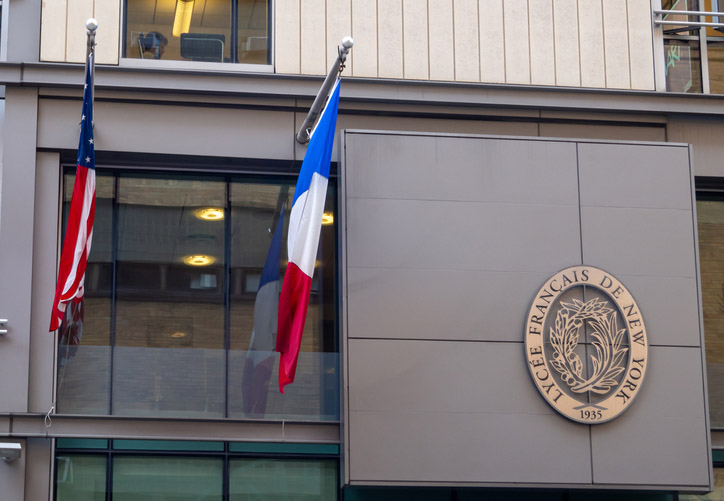
| une église | a church |
| une mosquée | a mosque |
| un temple | a temple |
| une école | a school |
| le quartier | the neighborhood |
| la mairie | the city hall |
| le terrain (de foot) | (soccer) field |
| la boulangerie | the bakery |
| la pâtisserie | the pastry shop |
| la boucherie | the butcher shop |
| la fromagerie | the cheese shop |
| le supermarché | the supermarket |
| le magasin | the shop/store |
| le musée | the museum |
| le prêtre | the priest |
| l’imam | the imam |
| le rabbin | the rabbi |
| un instituteur | une institutrice | a teacher |
| le voisin | la voisine | the neighbor |
| un ami | une amie | a friend |
| une équipe | a team |
| un boulanger | une boulangère | a baker |
| un fromager | une fromagère | a cheese maker/seller |
| un boucher | une bouchère | a butcher |
| un pâtissier | une pâtissière | a pastry chef |

Let's Practice...
Test your skills by working your way through each activity on the tabs below.
Are you ready for some practice? Read aloud the French term on each flash card and determine its meaning. Then, click to check your understanding.
une église
a church
une mosquée
a mosque
une école
a school
un quartier
a neighborhood
une mairie
a city hall
un terrain
a field (for sports)
une boulangerie
a bakery
une pâtisserie
a pastry shop
une bouchère
a (female) butcher
une fromagerie
a cheese shop
un supermarché
a supermarket
un magasin
a store or shop
un musée
a museum
un voisin
a (male) neighbor
une équipe
a team
Look and listen to some ways to use this vocabulary in sentences about a community.
| Je vais chaque dimanche à l’église. | I go to church every Sunday. |
| Mon ami va au temple le samedi. | My friend goes to temple on Saturdays. |
| Nous allons ensemble à la même (the same) école. | We go together to the same school. |
| Un autre ami et sa famille vont au supermarché samedi. | Another friend and his family go to the supermarket on Saturdays. |
| Allez-vous la boucherie? | Are you going to the butcher shop? |
| Avez-vous une fromagerie dans votre ville? | Do you have a cheese shop in your town? |
Most professions in French have different masculine and feminine forms. Sometimes, the feminine form of a profession adds an -e to the masculine form, as in avocat/avocate. Sometimes, the feminine form changes the -eur ending of the masculine form to -rice, as in tuteur/tutrice. And sometimes the word doesn’t change at all. Even though you cannot always tell how a word will change, there are some general rules. Let’s take a closer look at one of them below:
Whenever a word adds an -e to the end and
-er precedes it, the first -e will take an accent
ague.
fromager = fromagère
premier = première
boucher = bouchère
François est pâtissier, mais Marie est pâtissière.
Ahmed est boulanger, mais Anissa est boulangère.
Are you ready for some listening practice? Listen to the following paragraph about Jacqueline and her shopping trip. You can listen as many times as you would like. Then, answer the comprehension questions afterward.
Jacqueline habite dans un appartement à Paris. Elle a une voisine, et sa voisine a besoin de faire des courses. Mais elle est malade, alors Jacqueline fait des courses pour elle. Premièrement, elle va à un petit supermarché. Après, elle va à la boulangerie. Sa voisine voudrait une baguette. Elle parle avec le boulanger et elle achète la baguette. Ensuite, elle va à la fromagerie et elle achète du fromage. Après ça, elle va à la pâtisserie et elle parle avec la pâtissière. Elle achète un éclair pour la voisine, et elle mange un éclair. Elle est contente parce qu’elle fait des courses pour sa voisine.
Pourquoi Jacqueline fait des courses?
- Sa voisine est malade.
- Sa mère a besoin d’une baguette.
- Elle voudrait manger un éclair.
What is the reason for this shopping trip?
What is the reason for this shopping trip?
What is the reason for this shopping trip?
Jacqueline ne va pas _____.
- à la fromagerie
- à la boucherie
- à la pâtisserie
She goes several places, but one.
She goes several places, but one.
She goes several places, but one.
Qu’est-ce que sa voisine voudrait?
- un supermarché
- un éclair
- une baguette
The neighbor would like one thing.
The neighbor would like one thing.
The neighbor would like one thing.
Qu’est-ce qui est le premier magasin que Jacqueline visite?
- la fromagerie
- le supermarché
- la boucherie
Remember that magasin is any kind of shop or store.
Remember that magasin is any kind of shop or store.
Remember that magasin is any kind of shop or store.
Qu’est-ce que Jacqueline mange?
- un éclair
- du fromage
- un gâteau
Listen for the verb manger instead of acheter.
Listen for the verb manger instead ofacheter.
Listen for the verb manger instead ofacheter.
Summary
Questions answered correctly:
Questions answered incorrectly:
How did you do? Is your listening comprehension getting better? Click to the next screen to see how to use aller and forms of transportation so that you can discuss how you get to places.
