When Franklin D. Roosevelt began his run for the presidency in 1932, some Americans had lost faith in the political system. It had failed to help them between 1929 and 1933, and the Depression had taken a terrible toll during those years. What was the point of voting for another president? How could any one person do anything to stop the Depression? What could another president offer that President Hoover (1929-1933) had not?
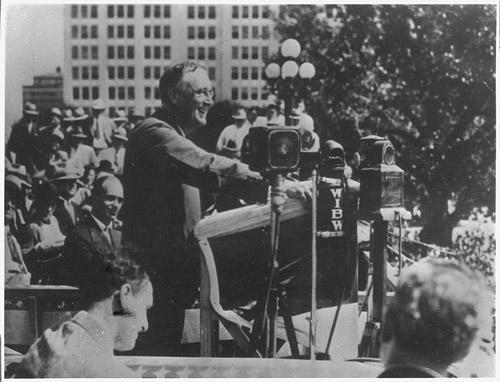 |
| FDR on the campaign trail in 1932. |
FDR knew this was on people's minds as he ran for office. In 1932, he tried to give people an answer to the question "What can the president do for us?" when he said:
Throughout the nation men and women, forgotten in the political philosophy of the Government, look to us here for guidance and for more equitable opportunity to share in the distribution of national wealth... I pledge myself to a new deal for the American people. This is more than a political campaign. It is a call to arms.
A call to arms--now that was something new. And that was what people remembered from the speech. Few people really noticed the less dramatic phrase "a new deal" at the time. They were more focused on Roosevelt's promise to end the poverty of the Depression ("more equitable opportunity to share in the distribution of national wealth"). But the phrase "New Deal" would quickly come to dominate U. S. society, business, and politics as the name for the dozens of programs created by the Roosevelt Administration to try to end the Depression.
In this lesson, you will learn about just some of the many programs of the New Deal. Some were successful, and some were not. Some were temporary, and some New Deal programs affect your life today, including Social Security and the FDIC. The New Deal not only attacked the Great Depression, it changed the way the American people thought about government and what they expected from government.
