 |
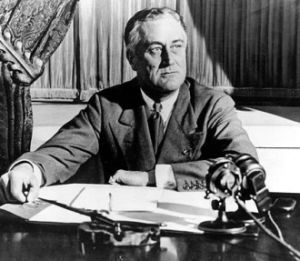
| FDR after giving a fireside chat. |
Banks had been failing since the Stock Market Crash of 1929, and a new string of bank failures had begun while FDR was running for president in the summer of 1932. The only way to stop these bank failures was to reform the banking system in the U.S. To do this, FDR called for a "bank holiday"—a short period when banks would be closed. What was the plan for reform, and how long would it be before Americans could be sure their banks--and their money--were okay? Read the questions in the table below, then click each one to learn more.
| How was a bank holiday different from a bank failure? | The bank holiday was temporary. Each bank that was closed still had all its customers' money. Nobody had gone bankrupt. Each would be able to re-open with all that money intact and available to customers after the closure. |
| How long would the bank holiday last? | Four days. That's how long it would take to put the Emergency Banking Relief Act into effect. On March 9, three days before the fireside chat on banking, FDR sent this Act to Congress, and it was passed that same day. |
| What did the Emergency Banking Relief Act do? | It created a new banking system where the Federal Reserve would supervise banks and back them with federal money. That is, if a bank started to run out of money, rather than let it fail, the Federal Reserve would lend it money until it re-stabilized. |
| What happened when the banks re-opened? | Americans who had been hiding cash under mattresses and in attics because they didn't trust banks stood in long lines to deposit their money in the new, federally backed banks. Very few people withdrew their money from the banks. Between the federal guaranty and public faith, bank failures went down from over 500 each year to fewer than 10 after 1933. |
Two things helped make the bank holiday a success. First, FDR took the U.S. off the gold standard, which meant that the dollar no longer had to be backed by gold. Going off the gold standard meant the federal government could print money to give to a bank that was in danger of failing. Second, over 4,000 small, local banks that were most in danger of failing were permanently closed and merged with larger, more stable banks. Customers of the banks that were closed lost a small percentage of their money, but at least the money they had left was safe.
!['Matthew G. Bisanz [GFDL (http://www.gnu.org/copyleft/fdl.html), CC-BY-SA-3.0-2.5-2.0-1.0 (http://creativecommons.org/licenses/by-sa/3.0), GPL (http://www.gnu.org/licenses/gpl.html), LGPL (http://www.gnu.org/licenses/lgpl.html) or FAL], via Wikimedia Commons](https://s3.amazonaws.com/cms.accelerate-ed.com/image/67c8cc9c-425b-4f3e-9d14-22d19803ba4c.jpg)
A long-term banking reform FDR introduced in June 1933 was the Federal Deposit Insurance Corporation (FDIC), which made the federal guaranty of bank customers' deposits permanent. The FDIC became a permanent feature of American banking. The next time you go to a bank, look around, and you will see a sign like this one posted somewhere in it that says that the money you deposit is guaranteed by the FDIC. That means that if the bank you use suddenly goes out of business, the federal government will pay you the money that is in your bank account, up to a certain amount.
Question
What made the FDIC a reform program rather than a relief or recovery program, like the Emergency Banking Relief Act?
