Americans waited impatiently through January and February 1933 for the new president to be inaugurated and get to work. FDR was just as impatient to get started, and in roughly his first three months he presented a remarkable series of economic programs to end the Depression. This period became known as the "First Hundred Days." FDR was so popular and so energetic and the country's situation was so desperate that in those First Hundred Days, Congress approved every program the President presented it with. Ever since this period, presidents have been judged against FDR for what they accomplish in their first 100 days in office.
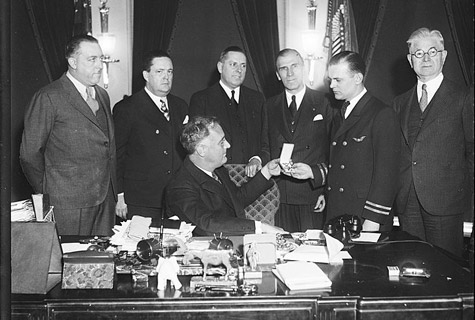 |
| FDR and his advisers got to work quickly in 1933 to end the Depression. |
Americans responded enthusiastically. Nothing had changed--yet. But the President seemed to be putting them on the road to recovery. Morale lifted, and national confidence rose. The political and social commentator Walter Lippmann summed it up this way:
At the end of February we were a [mass] of disorderly panic-stricken mobs and factions. In the hundred days from March to June, we became again an organized nation confident of our power to provide for our own security and to control our own destiny.
All the programs FDR presented to the nation focused on the "3 R's": Relief, Recovery, and Reform. That's Relief for the unemployed and the poor; economic Recovery from the Depression; and financial Reform to identify and solve problems that led to the Depression in the first place. The New Deal would include laws passed by Congress and presidential executive orders--that is, programs managed by the executive branch that don't have to be approved by Congress (although they can be reviewed by the Supreme Court and overturned if they are unconstitutional). Whether they were laws or executive orders, most of the New Deal programs fell into one of two categories: short-term unemployment and poverty relief or long-term, radical changes to the economic and/or political status quo.
Brush up on your understanding of the New Deal so far by completing the activity below.
|
Relief programs would create jobs so that people could receive a paycheck again and get out of poverty.
Relief programs would create jobs so that people could receive a paycheck again and get out of poverty.
|
|
"Relief" stood for providing help to the .
|
|
mobs and factions
unemployed and poor
long-term economy
|
|
Recovery programs tried to fix the problems that the Great Depression caused.
Recovery programs tried to fix the problems that the Great Depression caused.
|
|
Short-term programs to help the economy
were called . |
|
relief
recovery
reform
|
|
Reform programs tried to figure out what problems had caused the Depression and make changes so that those problems could not happen again.
Reform programs tried to figure out what problems had caused the Depression and make changes so that those problems could not happen again.
|
|
would solve the problems that led
to the Great Depression. |
|
Relief
Recovery
Reform
|
|
Unlike laws, executive orders can be issued by the president without Congressional approval, so they can immediately be put into effect.
Unlike laws, executive orders can be issued by the president without Congressional approval, so they can immediately be put into effect.
|
|
Executive orders don't need to approve them.
|
|
Congress
the Supreme Court
the president
|
Complete
