Union workers voted for FDR because he clearly supported labor unions. One of the reasons why New Deal jobs were temporary and unskilled and why jobs programs like the WPA often recruited teenagers was that FDR wanted to make sure that New Deal workers did not compete with union workers in skilled trades.
FDR designed the Social Security system because he wanted a permanent safety net for Americans who were not able to work. In the same way, FDR wanted to do something that would protect unions permanently.
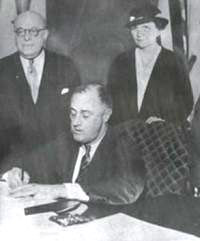
In 1935, with the support of the Roosevelt Administration, Congress passed the National Labor Relations Act of 1935, also known as the Wagner Act. The Wagner Act guaranteed workers the right to:
- form unions where they worked
- join unions
- engage in collective bargaining (negotiating as a union for better pay and working conditions from employers)
- go on strike
Before the Wagner Act, none of these things was protected by federal law. If workers tried to form a union at a factory, the factory owner could forbid it and fire anyone who tried to start a union or join an existing union. Collective bargaining was rejected by employers who refused to recognize unions as legitimate by negotiating with them. And employers, as we have said, were allowed to use any means necessary to break strikes.
The National Labor Relations Board (NLRB) was created to enforce the Wagner Act. Federal NLRB reps would monitor factories and other workplaces to make sure workers were allowed to freely choose whether or not to unionize. The NLRB could lead investigations of employers and report unfair labor practices to the courts.
As a result of the Wagner Act and the NLRB, unions grew even more and won important battles for fair wages, working hours, and working conditions. Test your knowledge of these New Deal programs for labor by answering these questions:
Why was guaranteeing unions the right to collective bargaining important?
Why was guaranteeing the right to strike important?
| Your Responses | Sample Answers |
|---|---|
| Before the NLRB gave union workers this right, employers could just refuse to bargain with a union. They refused to accept that unions were real organizations representing workers and would not listen to their demands. | |
| If strikes were now officially legal actions, it was no longer possible for police or security forces hired by employers to beat and even kill strikers to end the strike. Employers would be forced to negotiate an end to the strike with union leaders. |
