The graph below shows the Gross Domestic Product (GDP) of the U.S. from 1920 to 1940. The GDP is the total dollar value of all the goods and services businesses and individuals sell each year. It is considered one of the most important measures of the nation's economic health. The fluctuating line shows the actual amounts for each year, and the smooth line shows the average trend. The GDP rose steadily through the 1920s, then dropped steeply from 1929 (the year of the Stock Market Crash that began the Depression) to 1933 (the year FDR took office). It rises pretty steeply from 1935 on, with a short relapse between 1937 and 1938.
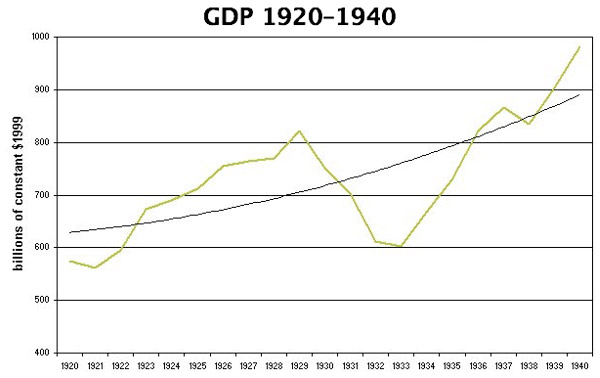
What does it all mean? The GDP reflects the New Deal programs that jump-started the economy and used a combination of short-term relief and recovery and long-term reforms to get American businesses producing again.
If we could make a chart like this one called "Federal Government Power 1920-1940," we would see a flat line hovering around zero from 1920 to 1929, then a small jump up from 1929 to 1933 (when Herbert Hoover was president), and then a very steep line up from 1933 to 1940 under FDR. It was federal government support and money that drove the New Deal, and the federal government expanded in size and power tremendously under Roosevelt. It would never return to its pre-Depression size or commitment to not getting involved in the economy. The federal government would also remain committed to playing a role in society, through programs like Social Security. The impact of the New Deal is still being felt in the United States today.
Check your understanding of the impact of the New Deal on the federal government by completing this activity. Drag the description of the federal government on the left to the correct category on the right.
|
running social programs
|
Before the New Deal
After the New Deal
|
|
a "hands-off" attitude toward the economy
|
Before the New Deal
After the New Deal
|
|
reforming big business
|
Before the New Deal
After the New Deal
|
|
small and not very powerful
|
Before the New Deal
After the New Deal
|
Complete
