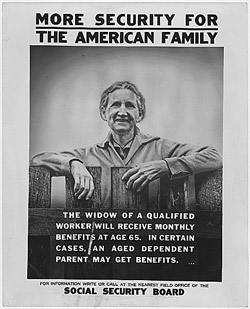
 Some New Deal programs, like the AAA and REA, were challenged in court and debated in Congress. When you think of issues that are hotly debated in Congress today, how--or whether--to fund Social Security probably comes to mind. It isn't news to you that this New Deal program is not only still with us today, but front and center in people's minds. You probably also understand that when people work, money is deducted from their pay for Social Security so that when they retire, they can use that money to help pay their expenses. It seems like a sensible idea, but Social Security was really a huge change in the way the U.S. government works: A program like this had never been offered before, and some people still think it goes too far. Read the questions in the table below, then click each one to learn more about the original New Deal creation of Social Security.
| What did the Social Security Act of 1935 do? | It established a permanent system of retirement pensions (funds that someone pays into that are given back to them after a certain period of time), unemployment payments, and welfare benefits for people with disabilities and needy children. Retired people would have a small guaranteed income to keep them from sinking into poverty. Unemployed people could get small payments while they looked for work. And vulnerable members of society who could not work had something to live on, too. |
| What help did the federal government provide for these people before Social Security? | None. About a dozen states had old-age insurance programs, but most never had much money, and before the Depression people were too proud to ask for the payments. Once the Depression hit and people were forced to ask for the money, there was nothing left. The U.S. was the only modern industrial nation that provided nothing, not even short-term loans, to people who found themselves with no income. |
| Why did FDR want Social Security funded by payroll taxes instead of a federal loan? Why take money out of people's pay during the Depression? | He knew that if it was workers' own money put away for them, then they would have what he called "a legal, moral, and political right to collect their pensions and unemployment benefits." If Social Security were a government loan, then when the economy improved, politicians were bound to say it wasn't needed anymore and get rid of it. FDR wanted a permanent safety net for older adults, unemployed people, young people, and people with physical disabilities. |
| Was Social Security popular right away? | Yes. Some politicians worried that it was socialism, but most Americans were happy to have some kind of guarantee that if they lost their job they would not be out on the streets because they had no money. They were happy to pay a small amount into Social Security to have the assurance of financial help when they retired or if they became unemployed or injured. |
Today, Americans still rely on receiving Social Security payments when they retire and unemployment checks when they are out of work. These people are waiting in line for unemployment checks while they look for work. Most take the supports offered by Social Security for granted, but they did not always exist. They are a lasting contribution of the New Deal.
Use your knowledge of the Social Security Act of 1935 to complete this activity.
| Use the dart to pop any balloons that contain a reason why Social Security had such a big impact on American society. |
reform
for the unemployed
for those
who can't
work
with state insurance programs
Complete
