The WPA reached into every region of the U.S., but even this huge New Deal program had trouble jump-starting the economy in rural areas. Many rural people lived in severe poverty, especially in the South. Farmers had over-supplied the market with food crops, driving prices down. This drop in income meant many had lost their farms to foreclosure because they couldn't pay their mortgages. Farmers needed immediate relief to address their poverty and losing their farms, recovery to bring crop prices back up, and reform to prevent over-supply from happening again. Read these tabs to find out what the New Deal had to offer farmers.
The Agricultural Adjustment Administration (AAA)
The Resettlement Administration (RA)
The Rural Electrification Administration (REA)
The Tennessee Valley Authority (TVA)
The AAA was a First Hundred Days program created in May 1933 to raise crop and livestock prices by producing less of both. The AAA worked with farmers to set a total amount of corn, cotton, dairy products, hogs, rice, tobacco, and wheat that farmers could sell each year. If that total amount meant corn farmers couldn't plant as many acres as they usually did, the AAA paid them to plant fewer acres. For example, 10 million acres of land usually planted with cotton were left unplanted, and some cotton that was already growing was left unharvested in the fields. Unfortunately, six million piglets were killed to end an over-supply of pork.
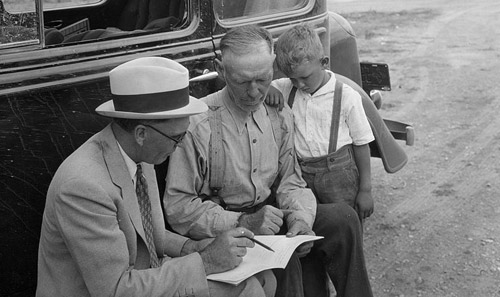 |
| A New Mexico farmer looks over the AAA plan for his farm with a government representative in 1934. |
Question
Was the AAA a long-term reform program or short-term recovery?
It was short-term in that it was shut down in 1936 when the Supreme Court declared the AAA was unconstitutional because it was a kind of price-fixing, which is considered illegal because it does not allow supply and demand to set the price for goods and can be used to keep prices artificially high. It provided for long-term reform, however, because it established a federal role in agricultural planning and farm subsidies.
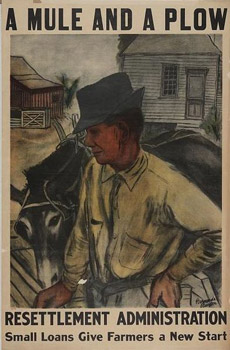 The RA was created in May 1935 to relocate poor families from isolated shacks and villages to planned communities with electricity and running water. The idea was that ending rural poverty could be jump-started by breaking people's ties to poor places and letting them live in places they could never afford to travel to or afford a home in on their own. The RA also built 95 camps with electricity and running water for Dust Bowl migrants (Okies) in California.
Question
Was the RA a successful long-term reform?
No. It moved very few families to planned communities, and even 95 camps were not enough to house all the Dust Bowl migrants who needed shelter in California. People in rural areas resisted leaving the homes and places their families had been in for generations.
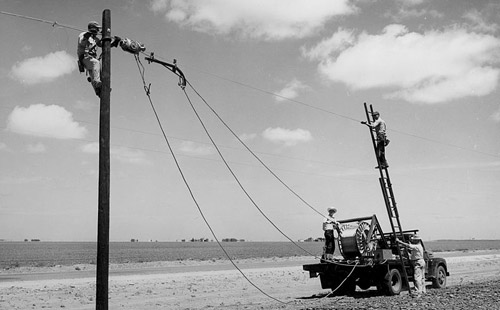 The REA was created in May 1935 to bring electricity to rural areas at a time when only about 10 percent of rural homes in the U.S. had electricity. Private utilities companies charged rural customers four times more than city customers because of the difficulty of running lines through areas with no roads. The REA made government loans to local electrical co-ops that strung power lines and provided electricity to homes. Private utilities companies complained that the government was illegally competing with them by offering electricity for much lower rates than they could, and the REA was challenged in court, but because it operated through local co-ops, it was found to be a fair competitor to existing utilities companies.
Question
Was the REA a long-term reform program or short-term relief?
It was long-term reform. Over the decades, rural America became fully electrified, and the REA itself existed until 1994 when its functions were taken over by the Rural Utilities Service.
In 1933, the Tennessee Valley Authority was established to build dams in the Tennessee River Valley region to stop river flooding and generate electricity for the REA to sell. The hydroelectric network created provided thousands of jobs building the dams, hundreds of jobs running them, and hundreds of jobs in electrical co-ops to provide electricity to homes.
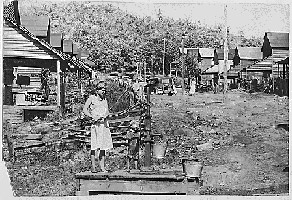 |
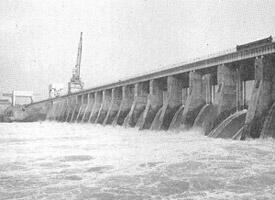 |
| Most rural Americans, like this girl, had no electricity and no running water. Dams like this one, part of the TVA, brought running water, electric lights, and appliances to thousands of rural homes. | |
Question
Was the TVA long-term reform or short-term relief?
It was long-term reform. The TVA is still providing electricity today to 9 million people in seven southern states. You may be using TVA electricity right now to access this lesson online if you live in the South!
Question
Why were the AAA and the REA both challenged in court?
