With banks stabilizing and backed up by the Federal Reserve, Americans were willing to put their money back into the banks. But where would they get the money to deposit? That's where New Deal relief programs came in.
The most popular and successful of the New Deal relief programs was the Works Progress Administration (WPA). The WPA was created in 1935, but it grew out of a First Hundred Days program that gave federal money to states to fund local relief called the Public Works Administration (PWA). From June 1933 to April 1935, the PWA funded over $3 billion in local relief projects, mostly in construction work.
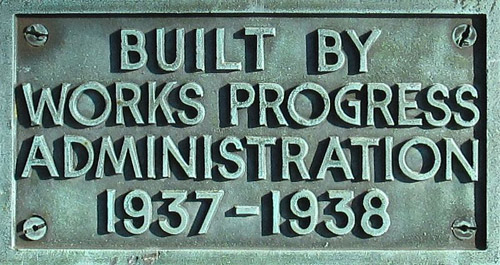 |
| This sign on a building in Manomet, Massachusetts, proudly declares it was built by the WPA, which ran from 1935-1943. |
In April 1935, FDR decided that the program should be nationalized: Instead of giving money to the states, the federal government would create its own, national relief programs. The PWA was closed down and replaced by the WPA. (Don't worry. Keeping track of all the abbreviations of the New Deal was tough for Americans in the 1930s, too! In this case, FDR wanted to keep the initials similar so that people would see the WPA as carrying on the work of the popular PWA--or not even realize there had been a change.)
Watch this video to learn more about the WPA.
 These unemployed women are learning to type so they can work as secretaries in a local or state office. These women are making mattresses for hospitals and other institutions. The WPA offered many types of training programs to give people basic skills to find jobs. The WPA paid for thousands of construction jobs large and small, from schools to the Lincoln Tunnel connecting New York and New Jersey and parks to the San Francisco-Oakland Bay Bridge in California. Over 8.5 million workers built 650,000 miles of highways and roads, 125,000 public buildings, and thousands of bridges, reservoirs, and more. The WPA hired doctors and nurses and paid them to work in areas where there were no medical facilities, either because they were so rural or because they had gone out of business in the Depression. This nurse in New Orleans is making a house call in 1936. This nurse gives a vaccination. The Federal Writers’ Project was a branch of the WPA that hired writers to create travel guides, children’s books, and other literature and, most importantly, to collect folklore and interviews from around the country. Many WPA writers interviewed elderly people who had been enslaved before the Civil War, like this man named Wes Brady, preserving their important stories. The famous novelist Zora Neale Hurston was a WPA writer who collected folklore from people in Florida. The Federal Theater Project hired actors, stage hands, writers, and directors to put on productions that were sometimes free to the public. Theater workers had suffered heavily from unemployment, as their jobs were not considered vitally important. The WPA saw the popularity of the movies, and figured that Americans would flock to see stirring patriotic plays like this one, “Created Equal” (put on in Boston in 1935) or funny plays like this one, called “Horse Eats Hat”, that took their minds off their troubles. Even the circus was paid to perform by the WPA. This branch of the WPA paid artists—painters and sculptors—to create public works of art. This is a WPA mural in the main post office in Bridgeport, Connecticut. Like the plays of the Federal Theater Project, the public art was often patriotic and inspiring, reminding Americans of their proud heritage as a nation. Musicians also found themselves described as “unnecessary” and out of work. The WPA created the Federal Music Program to give concerts for the public that would raise their spirits, and to give children free music lessons around the country.
The programs of the WPA boosted the economy by giving people paychecks to spend and invest. It could not be a permanent program because of its considerable expense--the federal government could not pay tens of thousands of people to work forever--but in the short-term, it improved people's morale, inspired them with art and music and new public facilities, got money moving and into businesses and banks, and made Americans feel like the New Deal was really working to end the Depression. Use your knowledge of the WPA and its goals to answer these questions:
Who did the WPA generally employ?
What made the WPA unsustainable?
| Your Responses | Sample Answers |
|---|---|
| people who were unable to find jobs because their skills were not seen as essential, like musicians, actors, and writers | |
| Since the public could not afford to pay full price for the services and entertainment that WPA programs provided, the government lost money on each program. This could not go on forever. But the government accepted the losses in the short term because the WPA helped raise morale and boost the economy. |
