 |
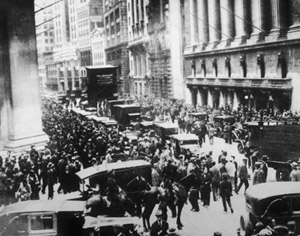
| The Stock Market Crash of 1929 had people panicking in the streets. |
FDR found himself in the same position in 1933 that our government was in in 2008. He had to stop big banks and financial firms from failing. We've looked at his reform programs for banking; now let's look at his plan for reforming the stock market.
One of the reasons for the Stock Market Crash of 1929 was that stock speculation had driven the paper values of stocks up and up, while the real values of the companies that issued the stocks fell. There had always been people who suspected that the stock market was not as healthy as it seemed, but it was hard for them to prove it because companies were not required to publish annual reports stating their gross profits, expenses, and net worth. Companies could hide debt and falling profits while they sold more and more stock to cover their losses.
FDR wanted federal regulation of the stock market so that it could never crash again. Here are the New Deal programs he put in place during the First Hundred Days:
| May 1933: the Securities Act of 1933 | This Act required publicly traded companies to publish their profits, losses, and net worth, as well as the names of their corporate officers. These reports had to be checked by an outside company (called an auditor) and verified as true and accurate before the companies could issue stocks. This would keep companies from issuing more stock than they could back up with money on hand. |
| June 1933: the Glass-Steagall Act | This Act made it illegal for commercial banks (banks that individuals had savings and checking accounts in) to speculate in stocks. Banks could not have financial relationships or partnerships with stockbrokers because these types of relationships had led banks to pour money into worthless stocks on the advice of stockbrokers who were engaged in speculation. |
| June 1933: the National Industrial Recovery Act (NIRA) | This was passed by Congress in June 1933. The goal of the act was to create "codes of fair competition" by regulating such things as prices and wages, production quotas, and limiting the number of companies. The hope was this would help industry, workers, and consumers recover from the Depression quicker. From the start, the NIRA faced criticism from all sides. Business owners wanted more security for their investments and profits. Labor did not receive the promise of collective bargaining. Consumers did not see any relief in prices. This act was never fully implemented and was declared void by the Supreme Court Case Schechter Poultry Corp. v. the United States in 1935. |
| June 1934: the U.S. Securities and Exchange Commission (SEC) | This commission would oversee the enforcement of the Securities Act of 1933. Creating the SEC meant that the requirements in the Act were meant to be permanent. |
Question
Were these New Deal programs really permanent?
Partially. The SEC still exists and was involved in investigating the stock market fraud that created the 2008 recession. The Glass-Steagall Act was repealed in 1999, and some analysts blamed this repeal for the 2008 stock market crisis.
