Making Models
Practice creating models to represent the fractions.
Goal:
Goal:
Use the flashcards below to practice using models to write fractions as division problems. Click the fraction on the front side of the flashcard to reveal a division problem model on the back. Try to figure it out yourself before you flip it!
\(\large\mathsf{ \frac{4}{7} }\)
\(\mathsf{ \frac{4}{7} }\) = four items divided into seven groups.
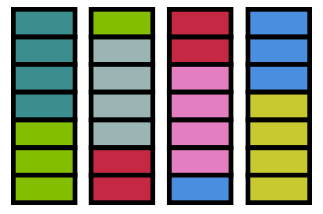
Since there are more pieces than there are items, this one is a challenge. To make it easier, divide each bar into 7 pieces (the denominator), and then color each group of four a different color. The seven colors represent seven groups of four.
\(\large\mathsf{ \frac{4}{3} }\)
\(\mathsf{ \frac{4}{3} }\) = four items divided into three groups \(\mathsf{ = 4 \div 3 = 1\frac{1}{3} }\) items in each group.

Three of the four whole pieces are put into groups. Then, the last piece is divided into three parts and put into those groups. Each group has 1 whole and \(\mathsf{ \frac{1}{3} }\) of a whole.

\(\large\mathsf{ \frac{3}{5} }\)
\(\mathsf{ \frac{3}{5} }\) = three items divided into five groups.

Once again, we have more groups than wholes. So, divide each whole into 5 pieces (the denominator). Then, color each group of three items a different color. The five colors represent the five groups of three.
Cards remaining: