Problem Solving
How do you use what you have learned to problem solve?
Goal:
Goal:

Let’s work on solving a word problem by constructing equivalent fractions. All you will need are a piece of paper and a pencil!
Caleb’s pizza is cut into 2 pieces, and he eats 1 of them. Can you make an equivalent fraction with a pizza cut into 8 pieces?
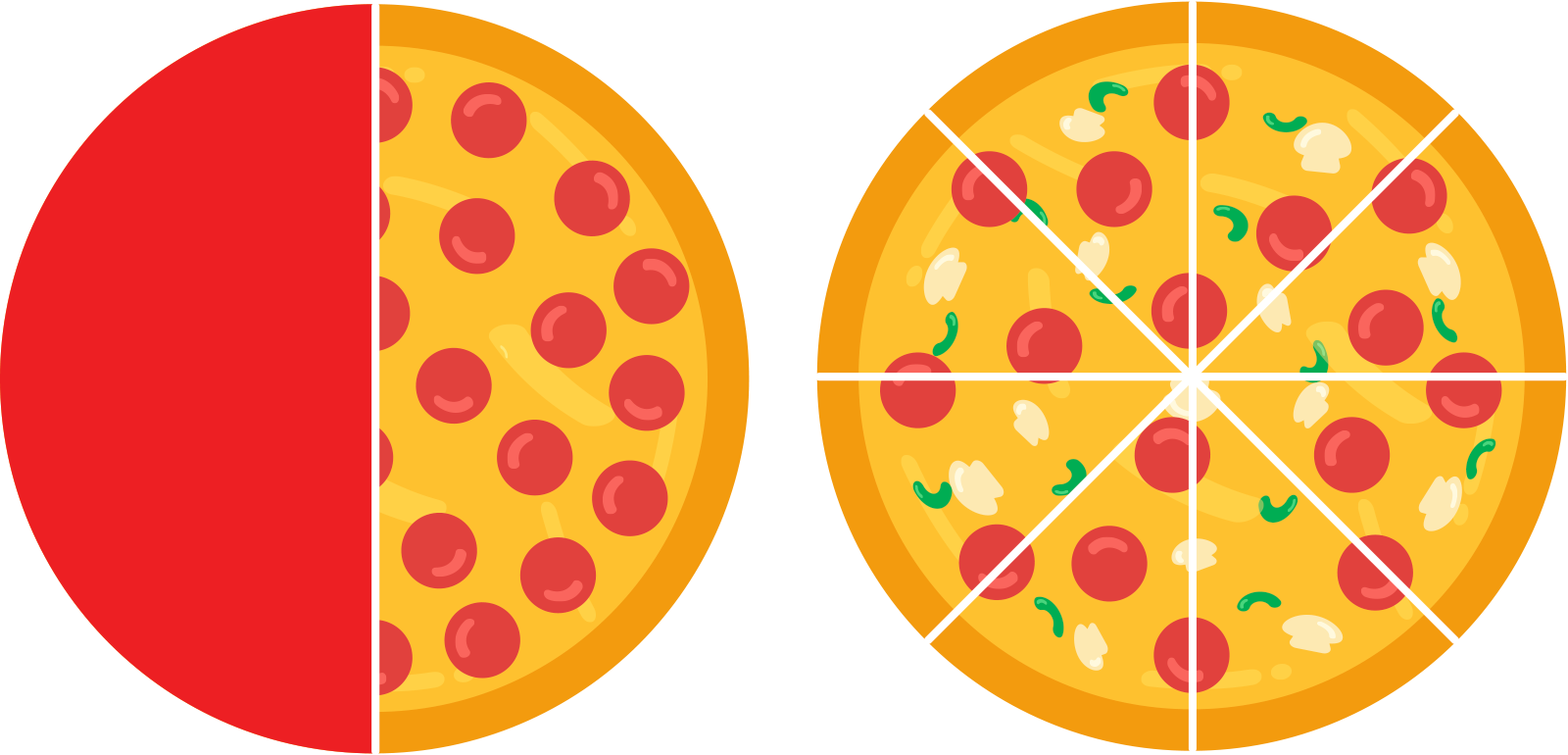
Left: Pizza split into 2 pieces with 1 highlighted. Right: Pizza split into 8 pieces with no pieces highlighted.
Word Problem Solving Steps
- Read the problem.
- Look for important information.
- Draw the fractions.
- Write the fractions.
- Solve and write your answer.
Click through the slides below to solve the problem using the problem-solving steps.
Read the problem.
Write the word problem on your piece of paper. Re-read it to understand what it is asking you to do.
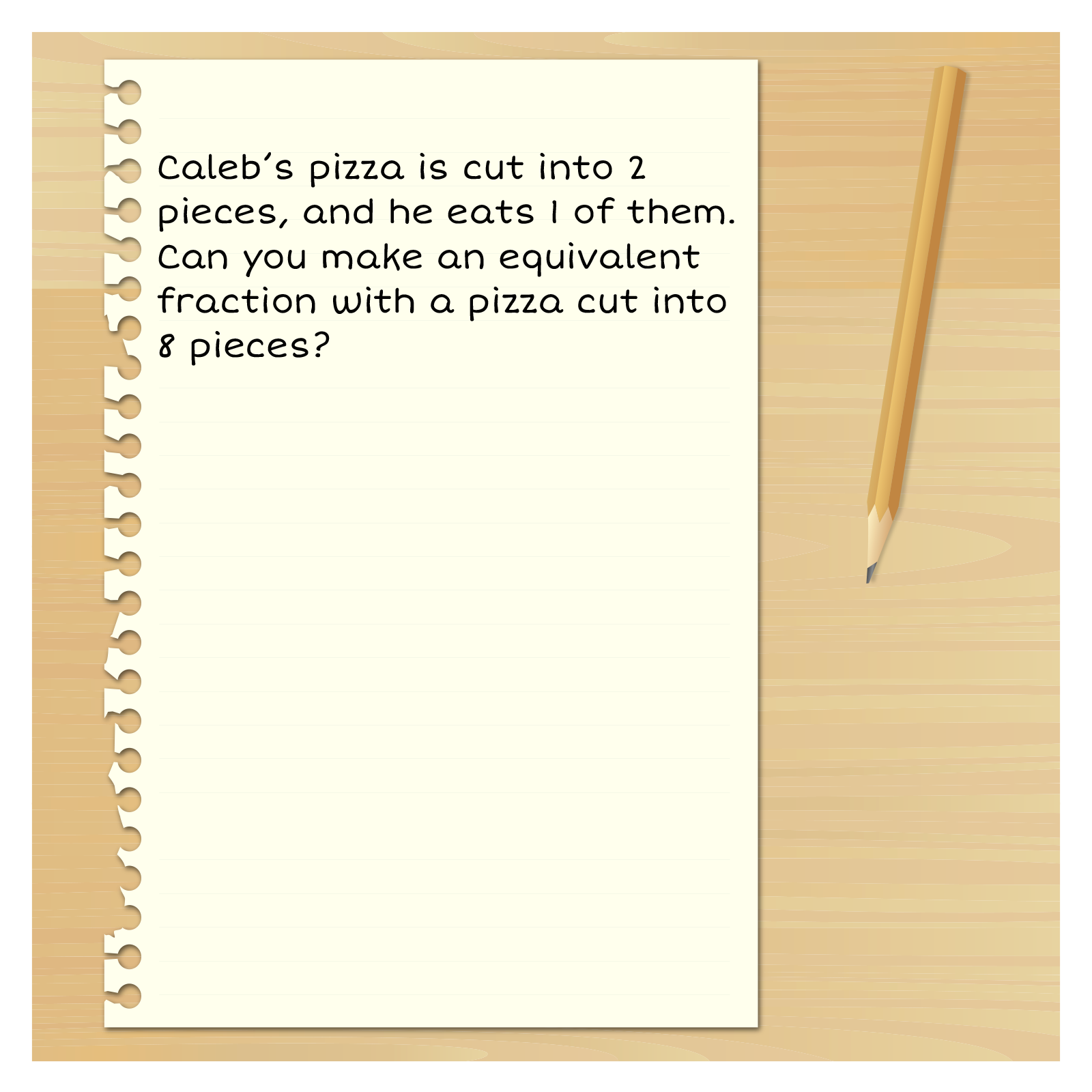
Caleb's pizza is cut into 2 pieces, and he easts 1 of them. Can you make an equivalent fraction with a pizza cut into 8 pieces?
Look for important information.
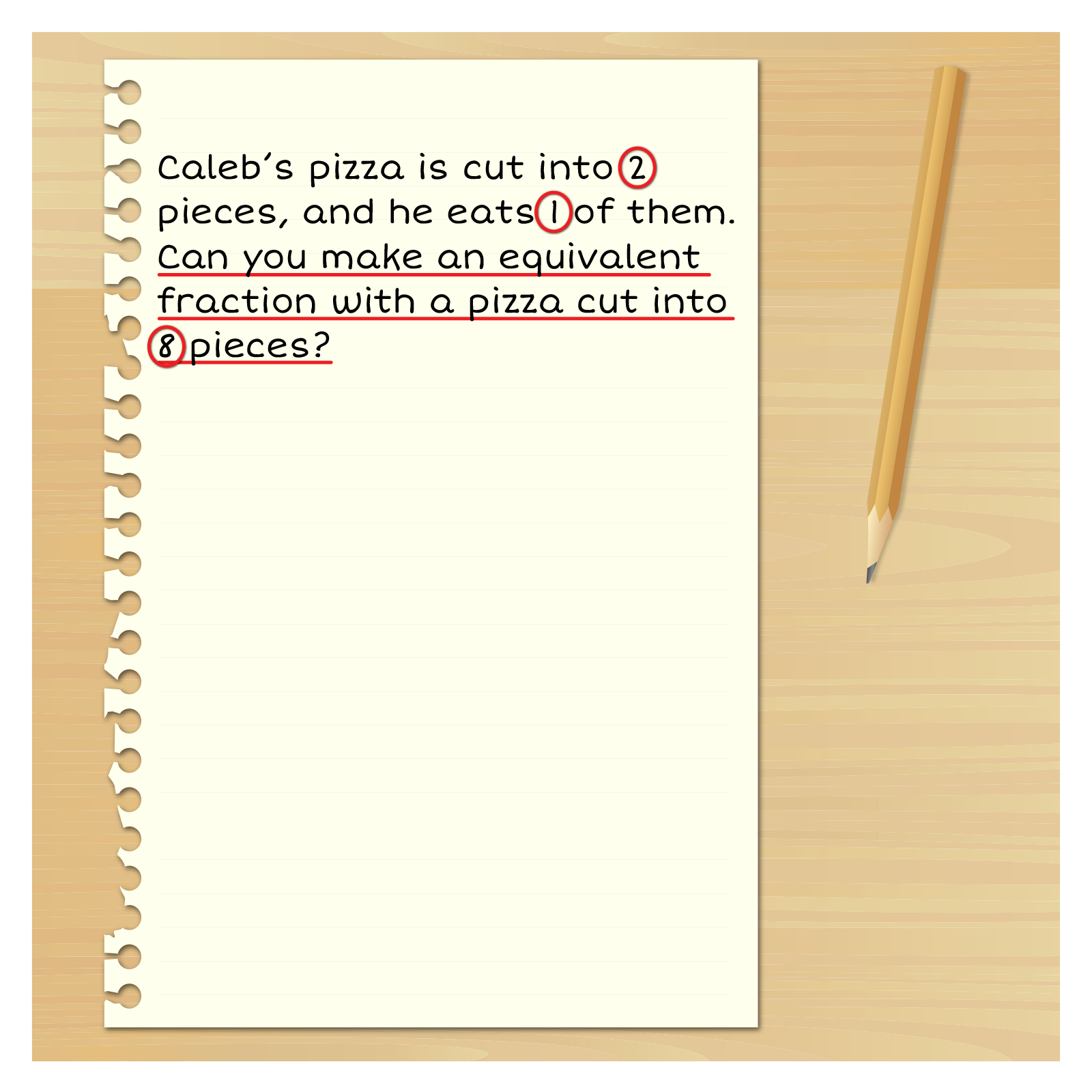
What important information do you see in the word problem? Underline or circle it on your paper. Then, click the Show Me button to check your thinking.
Caleb's pizza is cut into 2 pieces, and he easts 1 of them. Can you make an equivalent fraction with a pizza cut into 8 pieces?
The numbers 2 and 1 are circled. The last sentence, "Can you make an equivalent fraction with a pizza cut into 8 pieces?" is underlined.
Here is the important information:
- Caleb’s pizza has 2 slices, and he eats 1 slice.
- Another pizza has 8 pieces. We need to make an equivalent fraction with this pizza.
Draw the fractions.
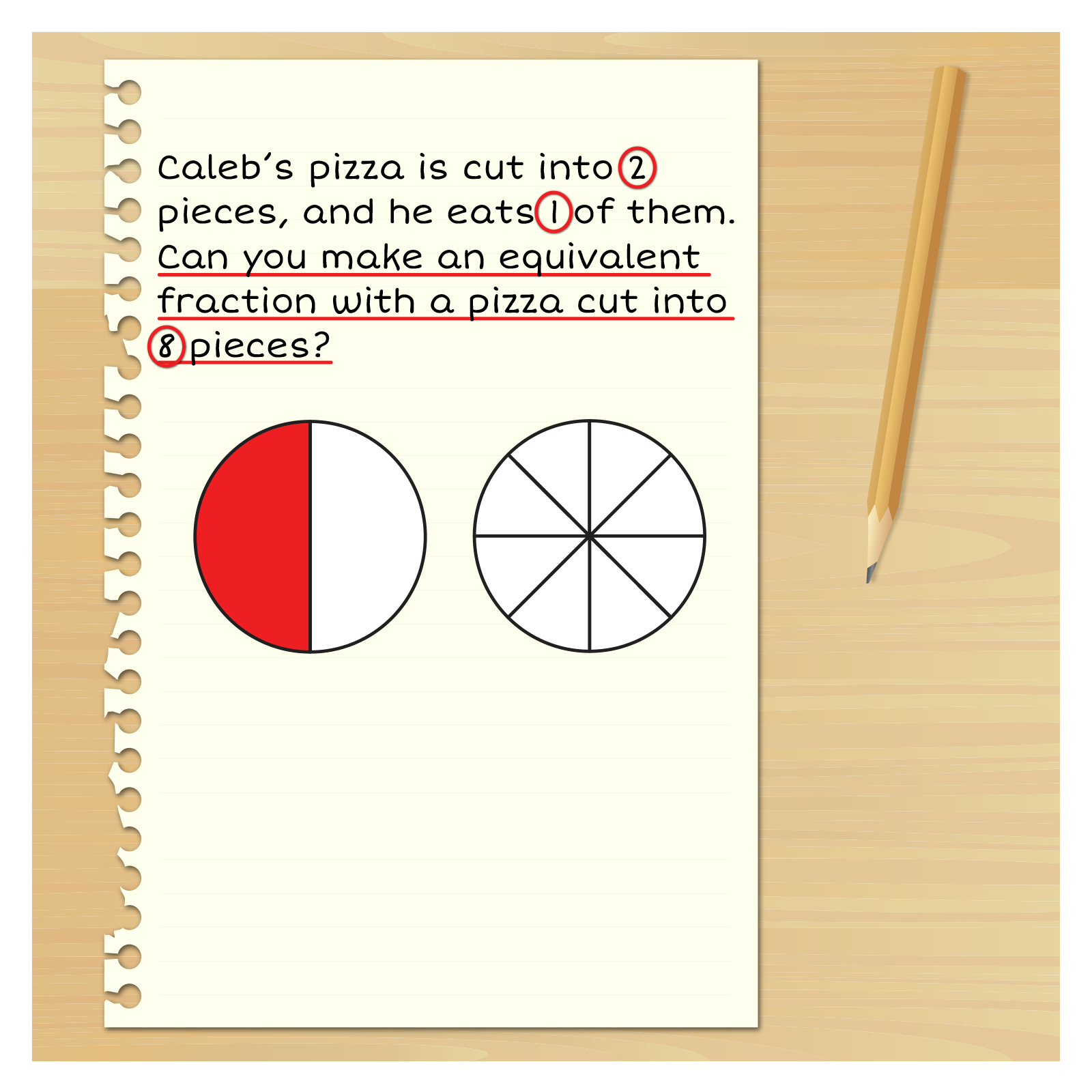
Let’s start by drawing these fractions. First, draw Caleb’s pizza. Color 1 part to represent the piece he has eaten. Then, draw the other pizza with 8 slices.
Caleb's pizza is cut into 2 pieces, and he easts 1 of them. Can you make an equivalent fraction with a pizza cut into 8 pieces?
The numbers 2 and 1 are circled. The last sentence, "Can you make an equivalent fraction with a pizza cut into 8 pieces?" is underlined.
Two circles. Left: Circle split into 2 equal pieces with 1 piece highlighted. Right: Circle split into 8 equal pieces with none highlighted.
Draw the fractions.
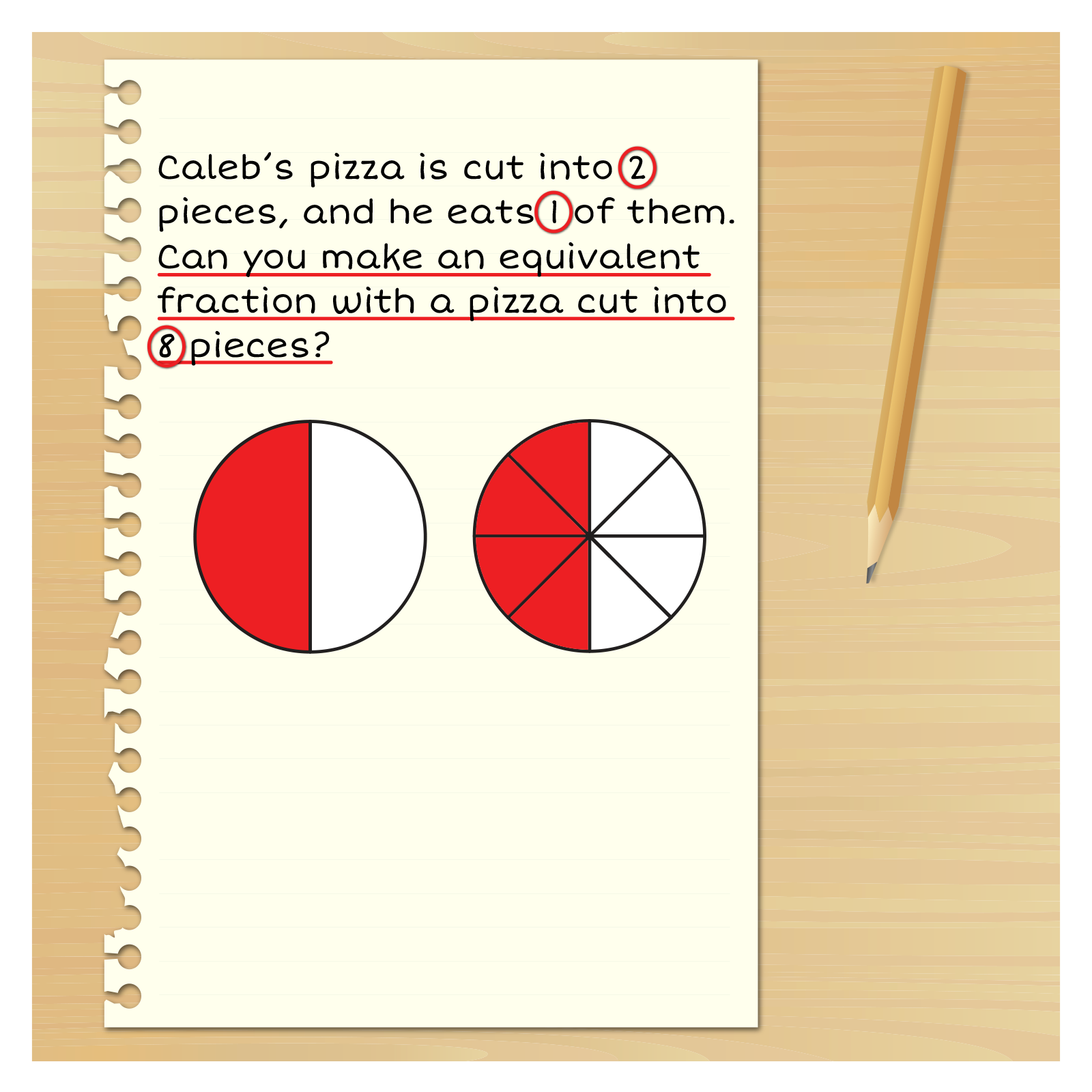
Now it is time to color the pizza with 8 pieces. Remember, the shaded parts of the pizza should match Caleb’s to be equivalent. Click the Show Me button to check your work.
Caleb's pizza is cut into 2 pieces, and he easts 1 of them. Can you make an equivalent fraction with a pizza cut into 8 pieces?
The numbers 2 and 1 are circled. The last sentence, "Can you make an equivalent fraction with a pizza cut into 8 pieces?" is underlined.
Two circles. Left: Circle split into 2 equal pieces with 1 piece highlighted. Right: Circle split into 8 equal pieces with 4 highlighted.
Write the fractions.
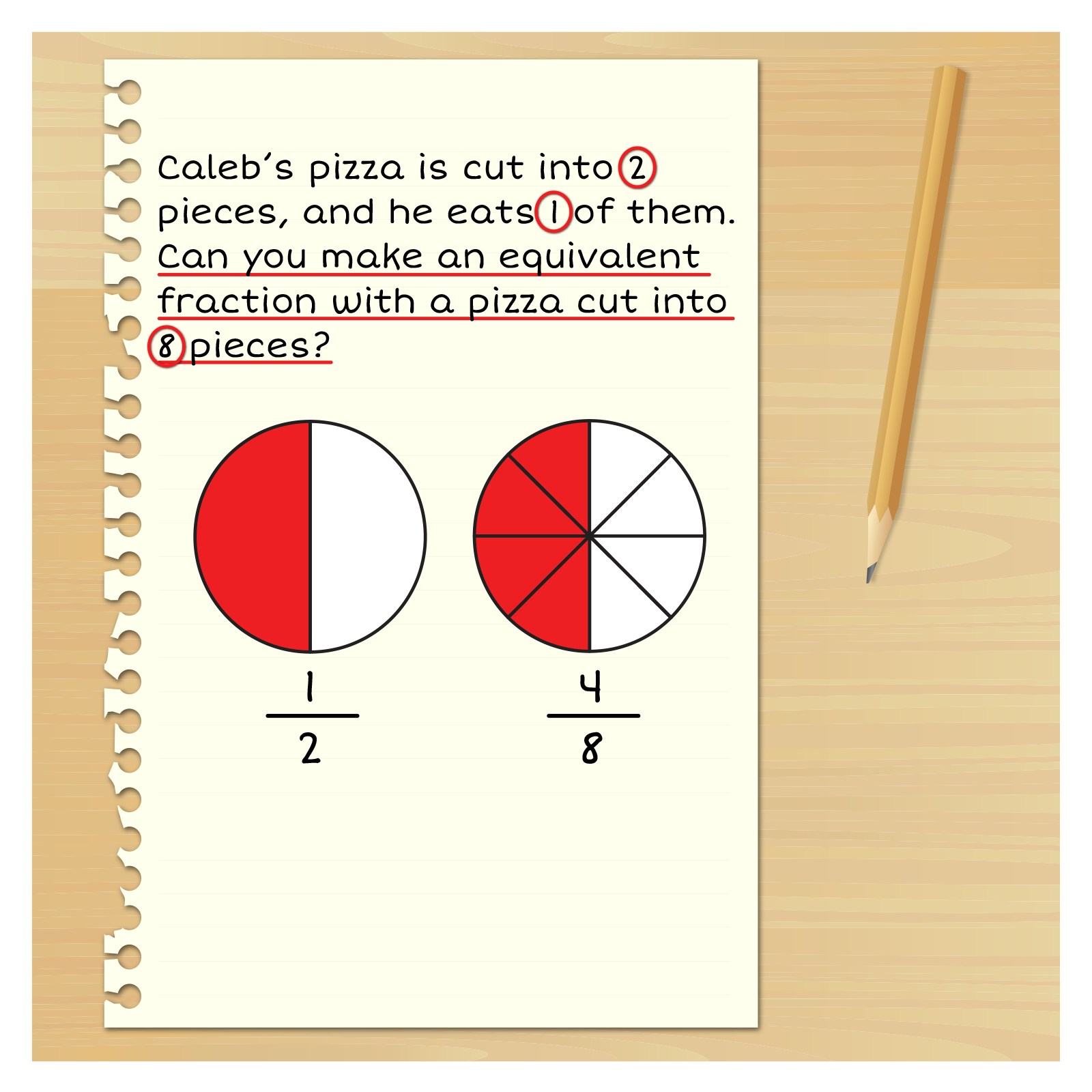
Great job! Now write fractions under both pizza drawings.
Caleb's pizza is cut into 2 pieces, and he easts 1 of them. Can you make an equivalent fraction with a pizza cut into 8 pieces?
The numbers 2 and 1 are circled. The last sentence, "Can you make an equivalent fraction with a pizza cut into 8 pieces?" is underlined.
Two circles. Left: Circle split into 2 equal pieces with 1 piece highlighted. \({ \frac{1}{2} }\). Right: Circle split into 8 equal pieces with 4 highlighted. \({ \frac{4}{8} }\).
Solve and write your answer.
You have made equivalent fractions! Do you know why they are equivalent? Answer this question using a complete sentence at the bottom of your paper. Then, click the Show Me button to check your answer.
\({ \frac{1}{2} }\) is equivalent to \({ \frac{4}{8} }\) because...
Caleb's pizza is cut into 2 pieces, and he easts 1 of them. Can you make an equivalent fraction with a pizza cut into 8 pieces?
The numbers 2 and 1 are circled. The last sentence, "Can you make an equivalent fraction with a pizza cut into 8 pieces?" is underlined.
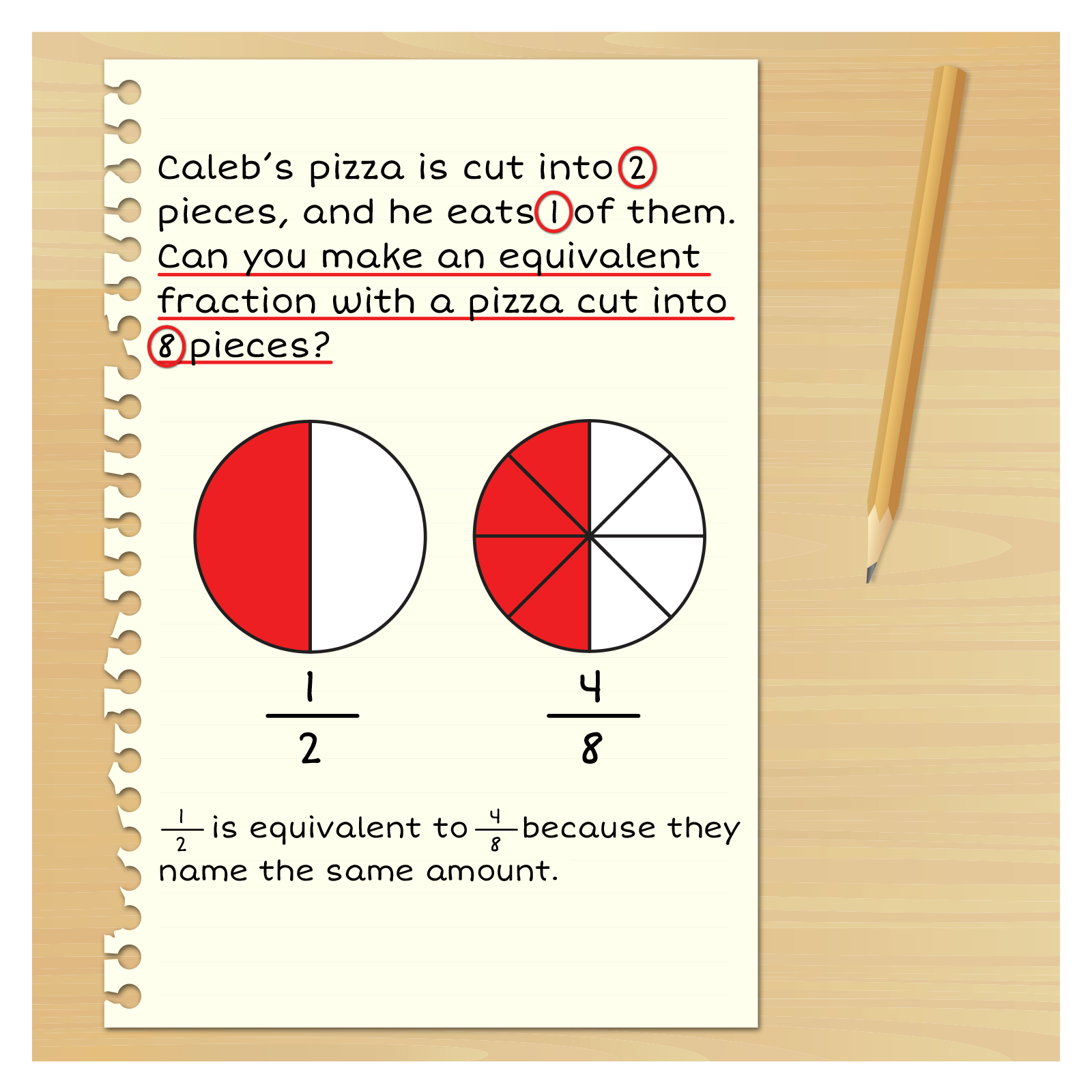
Two circles. Left: Circle split into 2 equal pieces with 1 piece highlighted. \({ \frac{1}{2} }\). Right: Circle split into 8 equal pieces with 4 highlighted. \({ \frac{4}{8} }\).
\({ \frac{1}{2} }\) is equivalent to \({ \frac{4}{8} }\) because they name the same amounts.
Which fraction is equivalent?
Caleb’s deck of cards is partitioned into 3 parts. 1 of the parts is shaded. Make an equivalent fraction with a deck of cards partitioned into 6 parts.

Card with \({ \frac{1}{3} }\) filled in.
\({ \frac{1}{3} }\)

Card with \({ \frac{0}{6} }\) filled in.
\({ \frac{0}{6} }\)
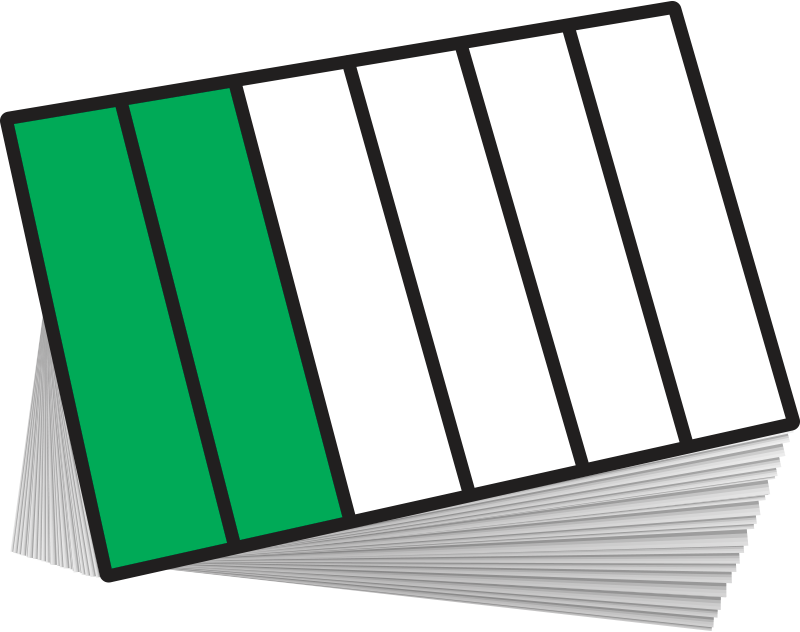
Card with \({ \frac{2}{6} }\) filled in.
\({ \frac{2}{6} }\)
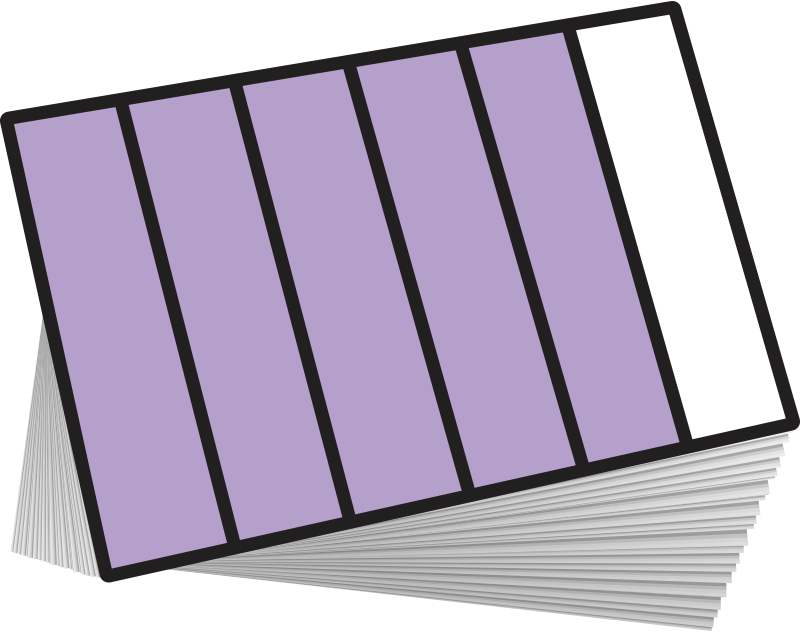
Card with \({ \frac{5}{6} }\) filled in.
\({ \frac{5}{6} }\)
\({ \frac{1}{3} }\) is equivalent to \({ \frac{2}{6} }\) because both decks of cards have the same amount of shaded area.
\({ \frac{1}{3} }\) is equivalent to \({ \frac{2}{6} }\) because both decks of cards have the same amount of shaded area.
\({ \frac{1}{3} }\) is equivalent to \({ \frac{2}{6} }\) because both decks of cards have the same amount of shaded area.
You got # out of # correct. Click the Retry button for another attempt.
You got a perfect score. Great job!