Introduction
How are multiplication and division of fractions related?
Goal:
Goal:
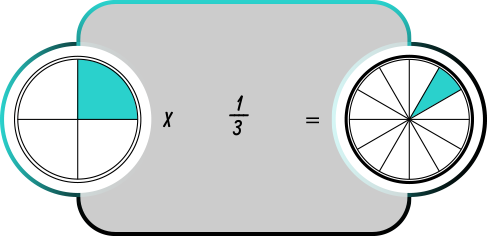
Recall that when multiplying a fraction by a fraction, for example \(\mathsf{ \frac{1}{3} \times \frac{1}{4} }\), you saw models that looked something like this:
Similarly, a division model, for example \(\mathsf{ \frac{1}{4} \div 3 }\), looks similar to this:
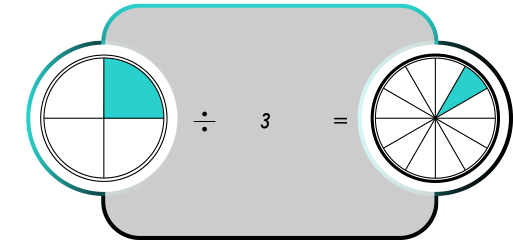
Notice that both models result in the same solution of \(\mathsf{ \frac{1}{12} }\). You may be asking, “How can the models result in the same solution when using different operations?” Click the button below to reveal the answer.
You know that multiplication and
division are related; for instance:
When dividing \(\mathsf{ \frac{1}{4} }\) by the whole
number 3, you are splitting the fraction \(\mathsf{
\frac{1}{4} }\) into 3 parts, as shown in the first
model above.
When multiplying \(\mathsf{ \frac{1}{4}
}\) by \(\mathsf{ \frac{1}{3} }\), you are finding
\(\mathsf{ \frac{1}{3} }\) of the \(\mathsf{
\frac{1}{4} }\) section, which means that you are also
splitting the \(\mathsf{ \frac{1}{4} }\) into 3 parts,
as shown in the second model above.
This means that dividing by the whole number 3
is the same as multiplying by the fraction \(\mathsf{
\frac{1}{3} }\).