Amusement-Park Project!
Let’s watch a video about the factors 1 through 25 to find the greatest common factor.
Goal:
Goal:

Let’s Watch!
Goal: Watch this video to learn the factors of 1 through 25 to find the greatest common factor.
Zoe is building an amusement park. Click on the video below to help Zoe find the factors of 1 through 25 and find the greatest common factor between certain numbers! You will use math strategies to find the factors of 1 through 25 to find the greatest common factor.
It’s the end of the school year, and Zoe’s class is going on a fieldtrip to an amusement park. But before they can go, her teacher assigned an amusement-park building project.
Can you help Zoe build her amusement park?
Zoe is excited to build her own amusement park! She starts off with her favorite ride the Ferris wheel!
Zoe needs to figure out how much space she will need for the ride.
Can you help Zoe figure out the greatest number of squares she can use for the Ferris wheel?
Zoe remembers factors are numbers that are multiplied together. The greatest common factor, GCF, is the largest factor of two numbers.
She has 12 squares, and her partner, Logan, has 24 squares for the Ferris wheel. What is the greatest number of squares they can use?
Zoe starts off with 12. She needs all the factors for twelve. She knows to always start with 1. She thinks, “1 times what number equals 12?” She knows any number times one is itself. So, 1 times 12 is 12.
Now, she uses her multiplication table to find 2 times what number is equal to 12. 2 times 6 is 12! She needs to continue until the same factor is on each side of the rainbow!
3 times 4 equals 12! Now, she is on 4! Wait a minute! She sees the same number on the other side of the rainbow, so she needs to stop! The factor rainbow is complete for 12!
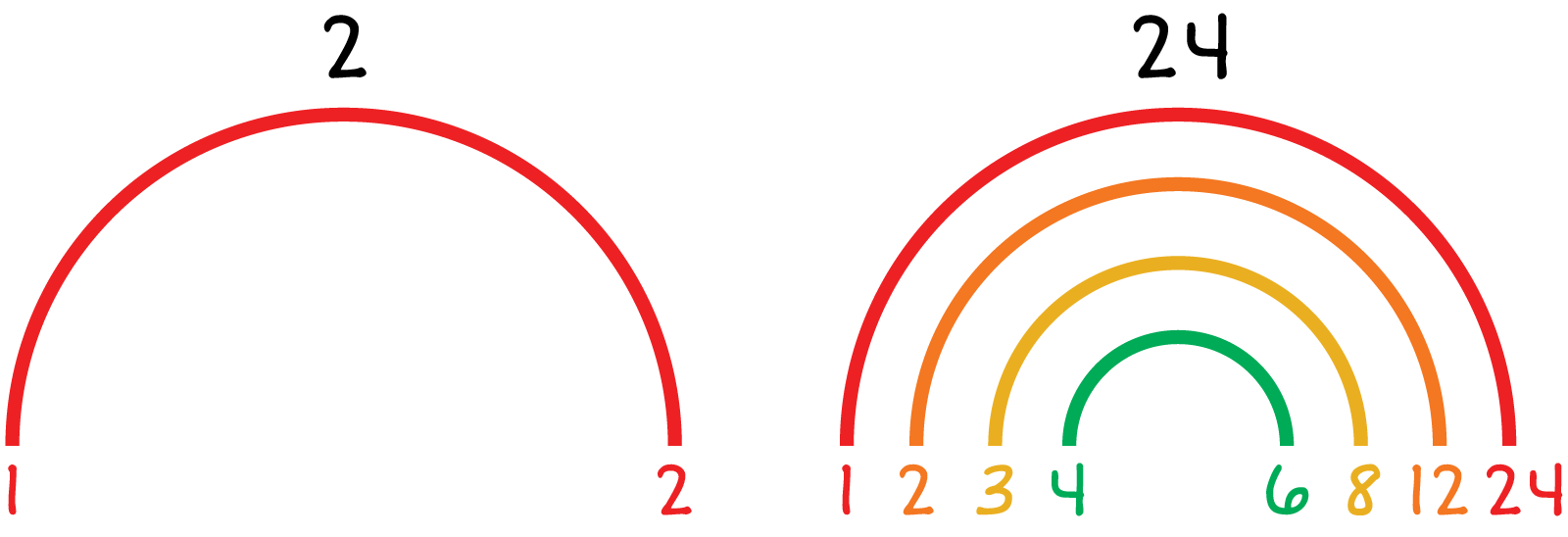
Now, it’s time for 24! Let’s get our factor rainbow ready! She knows she starts with 1. 1 times 24 is 24! That was easy!
She continues to 2 times what number is 24. She knows 2 times 10 is 20, and 2 times 11 is 22. So, 2 times 12 is 24!
Zoe moves on to number 3! 3 times what number is 24. She uses her multiplication table. 3 times 8 is 24. Now, 4 times what number is 24? 4 times 6 is 24! She knows 5 does not go into 24 evenly, so she has completed the second rainbow.
She is not done yet; she needs to figure out what common factors 12 and 24 have. She circles the common factors on the factor rainbows and looks for the greatest number circled. 12 is the greatest of all the common factors. So, the GCF is 12. Zoe and Logan can use 12 squares for the Ferris wheel.
The Ferris wheel took up most of the space! Zoe and Logan want to add one more attraction: bumper cars!
Zoe has 10 squares, and Logan has 20 squares for the bumper cars. What is the greatest common factor between 10 and 20? That will tell them the number of squares they can use?
Can you help Zoe and Logan find the GCF so that they know how many squares they can use for the bumper cars?
Let’s start off with Zoe’s 10 squares. We need all the factors for ten. Can you make a factor rainbow for 10?
We always start with 1. 1 times what number equals 10? Zoe knows any number times one is itself. 1 times 10 is 10. Did you get 10?
Now, let’s use our multiplication table to figure 2 times what number is equal to 10. 2 times 5 is 10! Did you make an arch with 2 and 5?
Let’s continue with the next number until we reach the same factor on each side of the rainbow!
Do 3 and 4 go into 10 evenly? No, 3 and 4 do not go evenly into 10!
So, now we are on 5! Wait a second! We are on the same number that is on the other side of the rainbow, so we need to stop! The factor rainbow is complete for 10!
Now, it’s time to make a rainbow for 20! We know we start off with 1. 1 times 20 is 20! That was simple!
Let’s continue to the next number. Do you know what number times 2 is 20? 10! Yes! So, we can make an arch with 2 and 10.
The next number we need to check is 3. Does 3 go into 20 evenly? No! So, let’s move on to 4. 4 times what number is 20? 4 times 5 is 20!
Next, we move to 5, and 5 is already on the other side of the rainbow, so we completed our second rainbow!
We are not done yet! We need to find the GCF for 10 and 20. Let’s circle the common factors between both rainbows.
Now, let’s circle our greatest common factor! It’s 10. The GCF is 10. Zoe and Logan can use 10 squares for the bumper cars. They don’t have room for anything else!
You did a great job helping Zoe find the factors for numbers 1 through 25 to identify the greatest common factor. Now she is ready for the fieldtrip!
Question
What is the greatest common factor of 2 and 24?