Let’s Learn!
How can we round to the nearest ten, hundred, thousand, and ten thousand?
Goal:
Goal:
Think About It!
Goal: Understand how to use a place-value chart to round.

The third-grade class is ready to review how to round to thousands, hundreds, and tens, to find out if they have about enough money in coins to visit the new aquarium. Rounding is deciding which ten, hundred, or thousand a number is closest to. They can use a number line or a place-value chart to help them.
Number Line

Place-Value Chart
Let's start with Daniel!
Daniel counts his coins and figures out that he has 78 cents. He can use a number line to help him round to the nearest ten.
Daniel will either round down to 70 or up to 80. The place value to the right of the tens place tells us if we round up or down. We can also look on the number line to see which ten 78 is closer to: 70 or 80. Look at the number line to see what Daniel sees!

Once he finds 78 on the number line, Daniel can see that 78 is closer to 80 than to 70, so he rounds up. Daniel has about 80 cents. Rounding doesn't give us an exact number, but it does give us a number that is close and easy to work with. The cost of an aquarium ticket is 5 dollars, which is 500 cents! Does Daniel have enough to buy a ticket? No! Now that he knows this, he can ask for some extra chores at home to earn more money to buy a ticket!
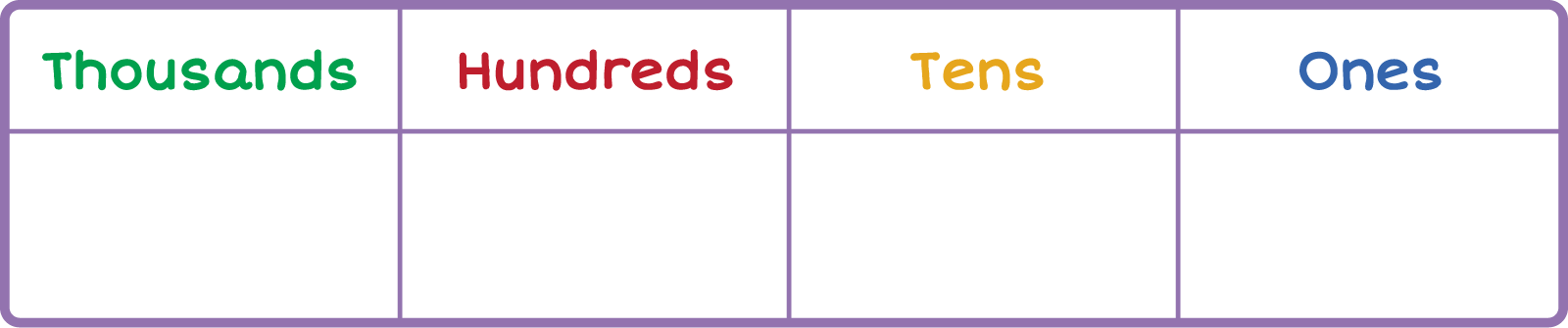
Madelyn is eager to see if she has enough money to visit the new aquarium. Once she adds up her coins, she finds that she has 436 cents. She can round to the nearest hundred using a place-value chart to find out about how much money she has!
She puts the digits in the place-value chart according to their value. We always start with the ones place when we enter the numbers, and move to the left. We are starting with the smallest place value and moving towards the biggest place value. It looks like this:
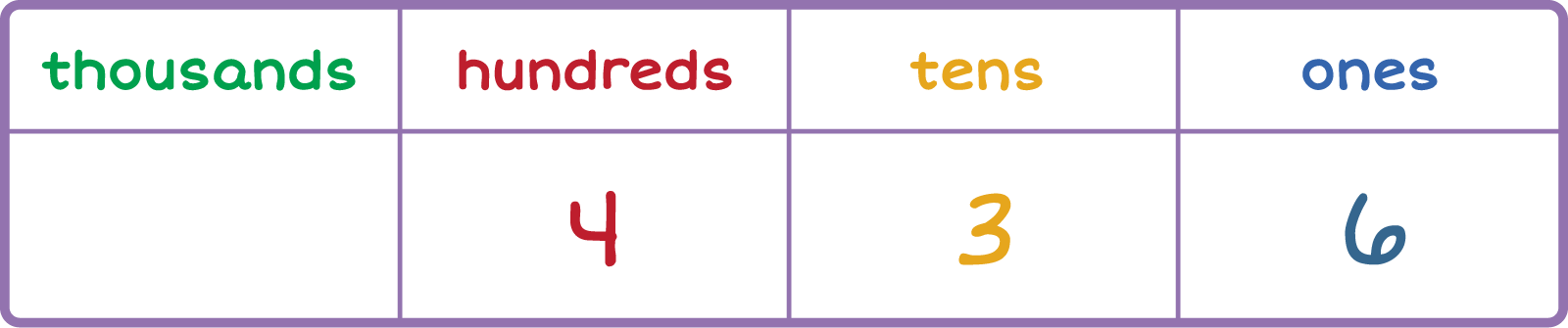
The thousands place is empty because this number doesn't have a digit in the thousands place. To round to the nearest hundred, Madelyn looks at the place to the right of the hundreds place. Which place should she look at to see If she should round up or down?
Click the Show Me Button to see where Madelyn needs to look to decide if she should round up or round down.
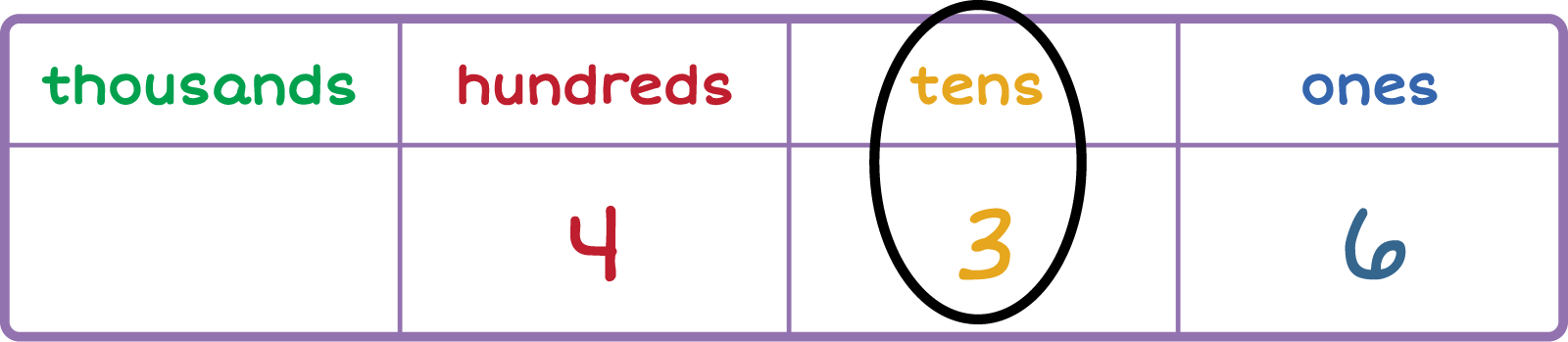
Did you have it right? That's the tens place. What digit is in the tens place? It's a 3. When we round, we use the rounding rule that says when the digit to the right is 4 or below, round down. If the digit is 5 or above, round up. The 3 in the tens place tells us to round down to 400.
Madelyn has about 400 cents. Is that enough money to buy a ticket to the aquarium that costs 500 cents? No, she doesn't have enough, but she is very close! She might be able to find some loose change lying around the house, and then she could have enough for a ticket!
Caleb remembers that he saved his allowance the last few times he earned it. He is confident that he has enough money for an aquarium ticket. Sure enough! After Caleb counts his coins, he finds that he has 2,762 cents! We already know that he has more than enough for an aquarium ticket that cost 500 cents, but let's round to the nearest thousand to find out about how much money Caleb has.
We can use a place-value chart to help us round. Remember that we always enter the digits beginning with the ones place. The place-value chart would look like this:
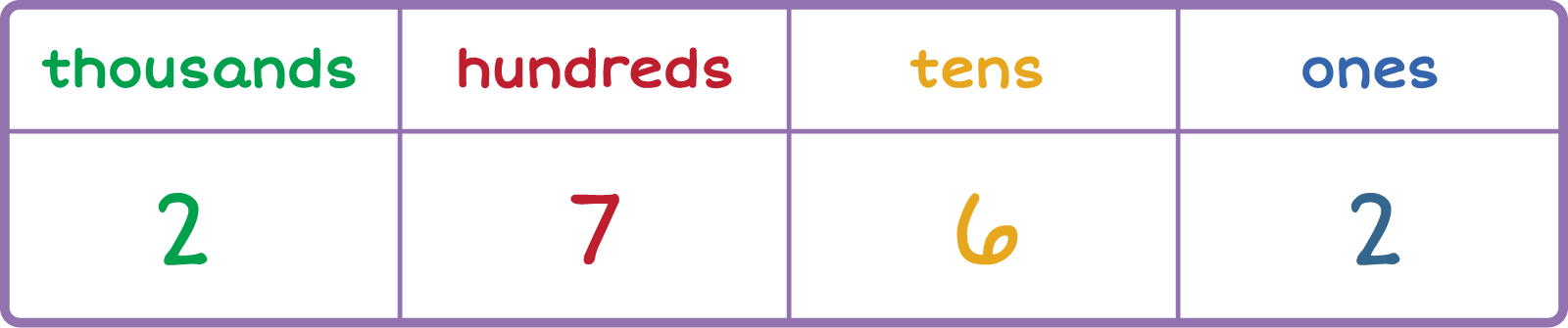
Now we have the thousands column filled because this number contains a digit in the thousands place. Do you remember the rounding rule? When the digit to the right of the thousands is 4 or below, round down. If the digit is 5 or above, round up. Will we round up or down? Click the place-value chart to see what digit will help us round!
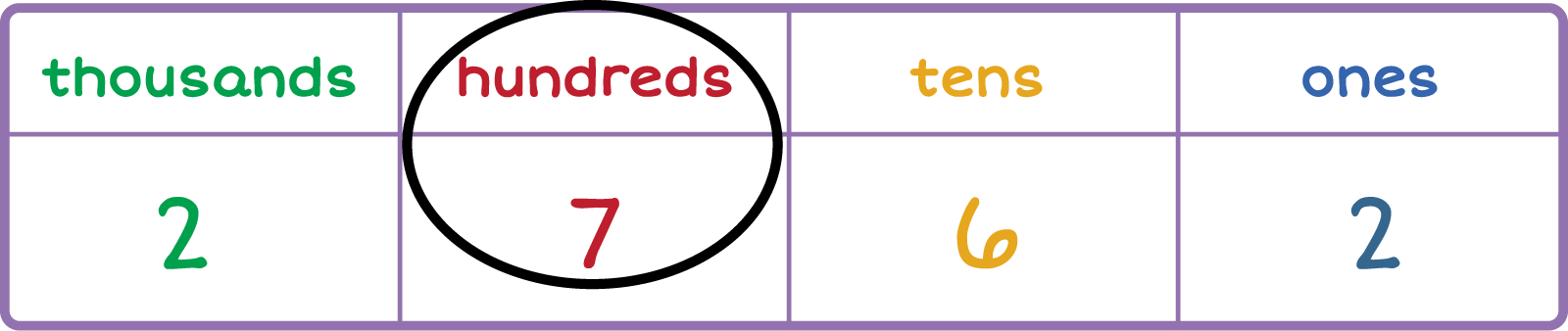
The 7 tells us to round up to the next thousand! We can round 2,762 up to 3,000. Caleb has about 3,000 cents. That's definitely enough to buy an aquarium ticket. He could even help his friends by buying their tickets, too!
Ava just had a birthday, and she received money as one of her gifts! She expects to have a lot of money to add up. Once she empties her piggy bank and totals her coins, she announces that she has 32,478 cents! Wow! We need to add a column to the place-value chart we have been using for this big number. Let's look at the number to see what we need to add.
3 2, 4 7 8
Remember, we always start with the ones place when we use a place-value chart. The 8 is in the ones place. Next, the 7 is in the tens place. We have a 4 in the hundreds place. There is a 2 in the thousands place. And look! There's another number! The place value higher than the thousands place is the ten-thousands place. There is a 3 in the ten-thousands place. We need to add a column to the left of the thousands place to show the ten-thousands place!

With the place-value chart filled in, we can use it to help us round! Even with a bigger number, our rounding rule stays the same. To round to the nearest ten-thousand place, what place will we look at to help us round? Click the place-value chart below to see!

Did you get it right? We will look at the thousands place! If the digit to the right is 4 or below, what do we do? We round down! Ava has about 30,000 cents. Ava could buy her own ticket and many more!
Logan loves saving his money until he sees something he really wants to buy. He hasn't found anything he really wanted lately, so Logan has saved a lot of money. It takes him a while to count all his coins. When he is finally done, he says that he has 67,851 cents. Wow! We know Logan will be visiting the aquarium! About how many cents does he have if we round to the nearest ten thousand? Let's put the digits in the place- value chart first, beginning with the ones place.
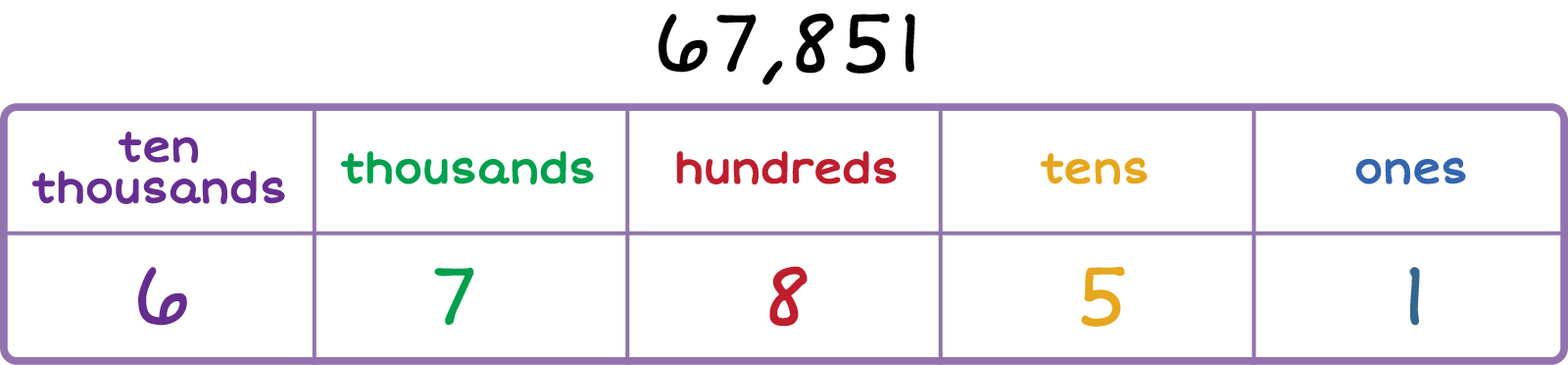
Now the place-value chart can help us round. What place do we need to look at to round to the nearest ten thousand? Click the chart below to see if you know!


Were you right? The 7 in the thousands place tells us to round up to the next ten thousand. We can round this number up to 70,000. Logan has about 70,000 cents. Logan can buy his ticket, his friends' tickets, and a souvenir at the gift shop! Logan finally found something he really wants to buy!