Rounding Around the Aquarium
Let’s watch a video about rounding the attendance at the aquarium.
Goal:
Goal:

Let's Watch!
Goal: Watch this video to learn more about using a place-value chart to round.
Logan is the first one in his class to visit the aquarium! Since it's been open for a month, he is curious about the attendance. He wants to find out about how many people attended the aquarium yesterday and about how many people attended the aquarium last month. Watch the video below to see how he uses a place-value chart to help him round!
Logan decides to visit the aquarium after school one day. He loves to look at all the fish and sea creatures!
He starts looking around at all the people. He can't believe how many people come to the aquarium. This gets him thinking. He starts wondering how many people visit the aquarium each day. How many visit each month?
Logan sees a chart on the wall with all the information he needs! The chart tells the number of people who visited the day before and the total number of people who visited last month.
Logan remembers that he has been learning about rounding numbers in school, and he wants to round the attendance numbers to practice.
He will use place value charts and number lines to help him round the attendance numbers.
Rounding is deciding which group of tens, hundreds, or thousands a number is closer to. Place-value tells you the value of each digit in a number depending on its place.
Logan will start by rounding the attendance from the day before to the nearest ten. Let's help!
We can use a number line and our rounding rules.
Since 78 is between 70 and 80, we know that it will either round down to 70 or round up to 80.
We can use our rounding rule that says if the digit to the right is 4 or below, we round down. If the digit is 5 or above, we round up.
The digit to the right of the tens place is 8. 8 is greater than 5, so we will round up! When we round by tens, we find out that there were about 80 people at the aquarium that day!
There were not exactly 80 people there. Rounding makes a number easier to use while keeping the number close to its original value.
Now let's help Logan practice rounding by thousands! We'll use the number of people who come to the aquarium last month.
We can use a place-value chart to help us round the numbers. The place-value chart tells us the value of each digit depending on its place.
First, put the numbers in the place-value chart starting with the ones. Ones, tens, hundreds, thousands. To round by thousands, look at the number to the right of the digit in the thousands place. 4 is less than 5, so we will round down. 1,498 is between 1,000 and 2,000.
When we round down, we round to 1,000. Remember, rounding is not exact, but it gives us an easy number to work with that is close to the original value of the number. There were about 1,000 people at the aquarium last month.
Logan learned that once you put the digits in a place-value chart or on a number line, rounding can be fun! Thanks for helping him round the aquarium attendance!
Question
Daniel talks to the manager before he leaves the aquarium to ask if they have an anticipated attendance for next month based on the attendance from the first month. The manager tells Daniel that they hope to have 3,298 guests next month.
Can you round that number to the nearest thousand to show about how many guests they are anticipating next month? Use the place-value chart below to help you round!
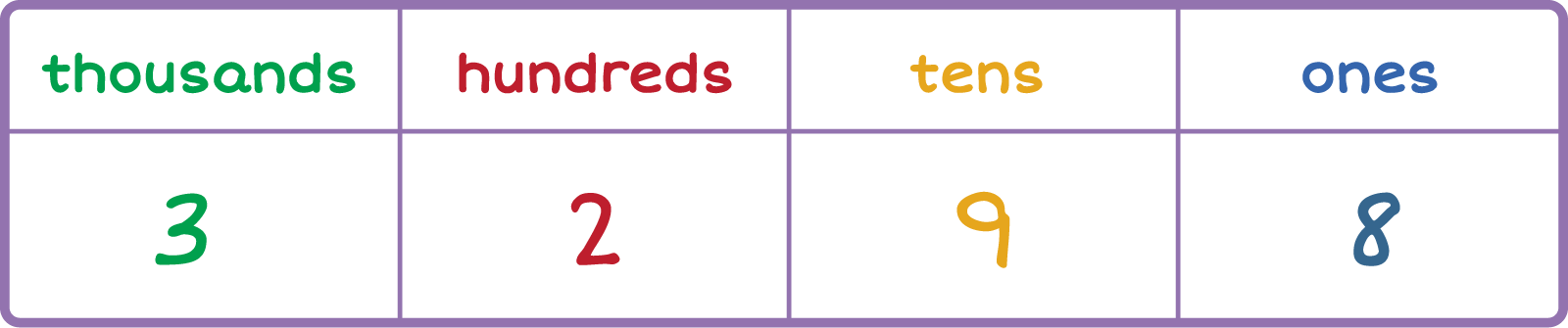
They are anticipating about 3,000 people. To round this number to the nearest thousands, we look to the place to the right of the thousands place. The hundreds place has the digit 2. If the number is 4 or below, we round down. That's why we round down to 3,000 rather than up to 4,000. The aquarium expects about 3,000 guests next month!