Assess Yourself
How well do you understand the ideas in this lesson?
Goal:
Goal:
Show What You Know!
Are you ready to take this lesson's quiz? These questions will help you find out. Go back to the lesson if you do not know an answer.
Find the total area:
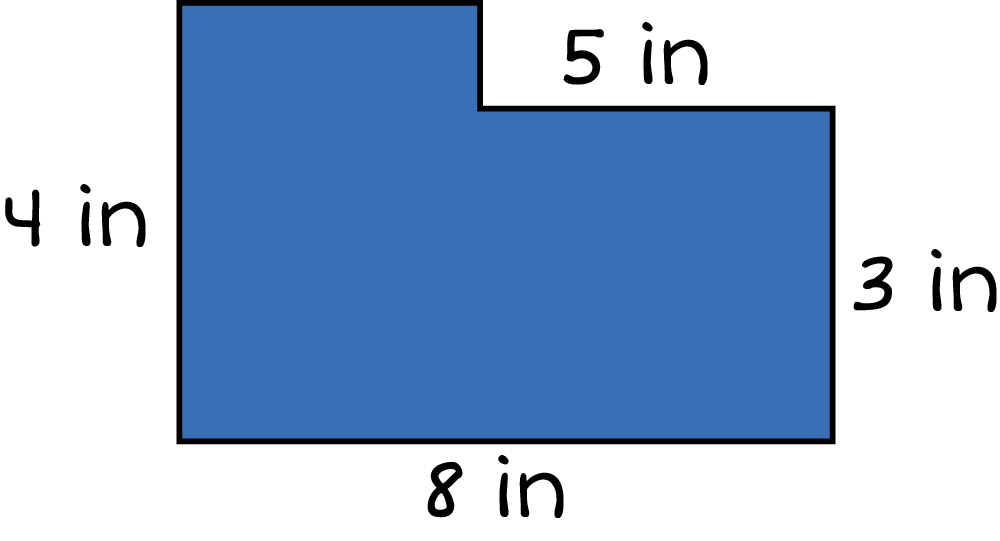
An area with the left width of 4 inches, the top length of 5 inches, the right width of 3 inches and a bottom length of 8 inches.the area is colored blue.
- 27 in\({^2}\)
- 15 in\({^2}\)
- 12 in\({^2}\)
- 20 in\({^2}\)
This is correct!
5 in
\({\times}\) 3
in \({=}\) 15
in\({^2}\), 4 in
\({\times}\) 3
in \({=}\) 12
in\({^2}\), 15
in\({^2}\)
\({+}\) 12
in\({^2}\)
\({=}\) 27
in\({^2}\)
This is incorrect. It looks like you found the area for one of the parts. Remember, you need to find the area of both parts and then add them to get the total area.
This is incorrect. Remember to break the figure into smaller rectangular shapes, then find the area of each section, and finally add the different areas together.
This is incorrect. It looks like you added all the measurements, instead of breaking the shape into smaller rectangles, finding the areas of each part, and then adding to get the total area.
Find the total area:
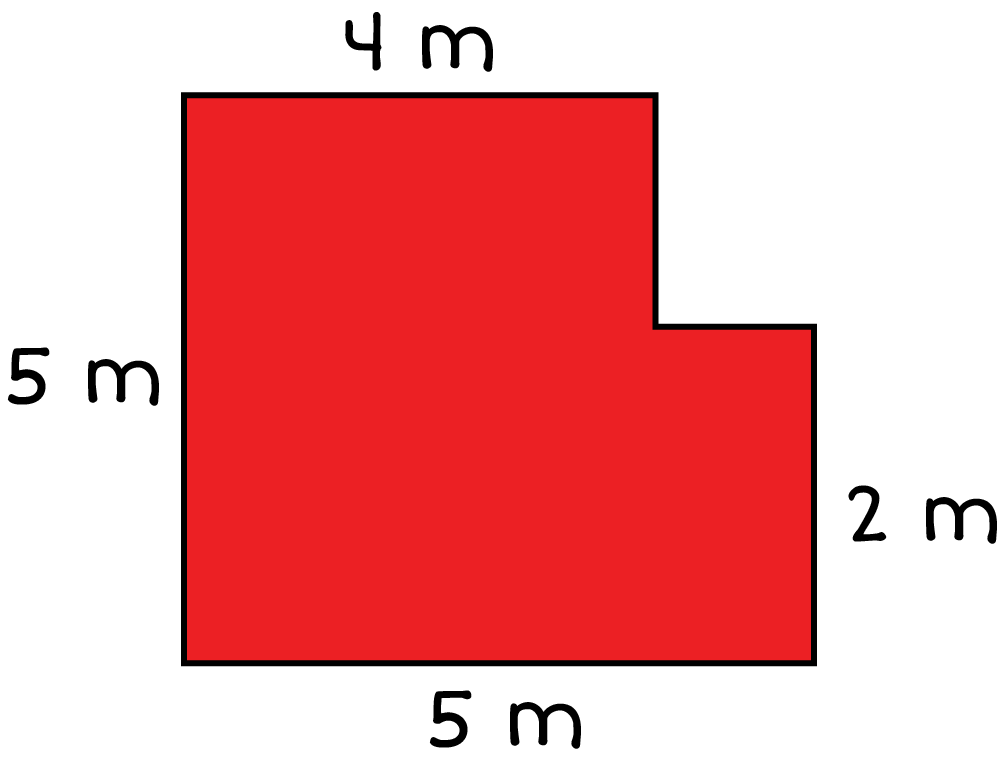
An area with the left width of 5 meters, the top length of 4 meters, the right width of 2 meters and a bottom length of 5 meters the area is colored red.
- 22 m\({^2}\)
- 25 im\({^2}\)
- 30 m\({^2}\)
- 20 m\({^2}\)
Great job! \({(5 \text{ m} \times 2 \text{ m}) + (4 \text{ m} \times 3 \text{ m}) = 10 \text{ m}^2 + 12 \text{ m}^2 = 22 \text{ m}^2}\) OR \({(4 \text{ m} \times 5 \text{ m}) + (1 \text{ m} \times 2 \text{ m}) = 20 \text{ m}^2 + 2 \text{ m}^2 = 22 \text{ m}^2}\)
This incorrect. It looks like you found the area for one of the parts. Remember, you need to find the area of both parts and then add them to get the total area.
This is incorrect. It looks like you multiplied the sides together and added them. Remember to break the figure into smaller rectangular shapes first, then find the area of each section, and finally add the different areas together.
This incorrect. It looks like you found the area for one of the parts. Remember, you need to find the area of both parts, and then add them to get the total area.
What is the total area?
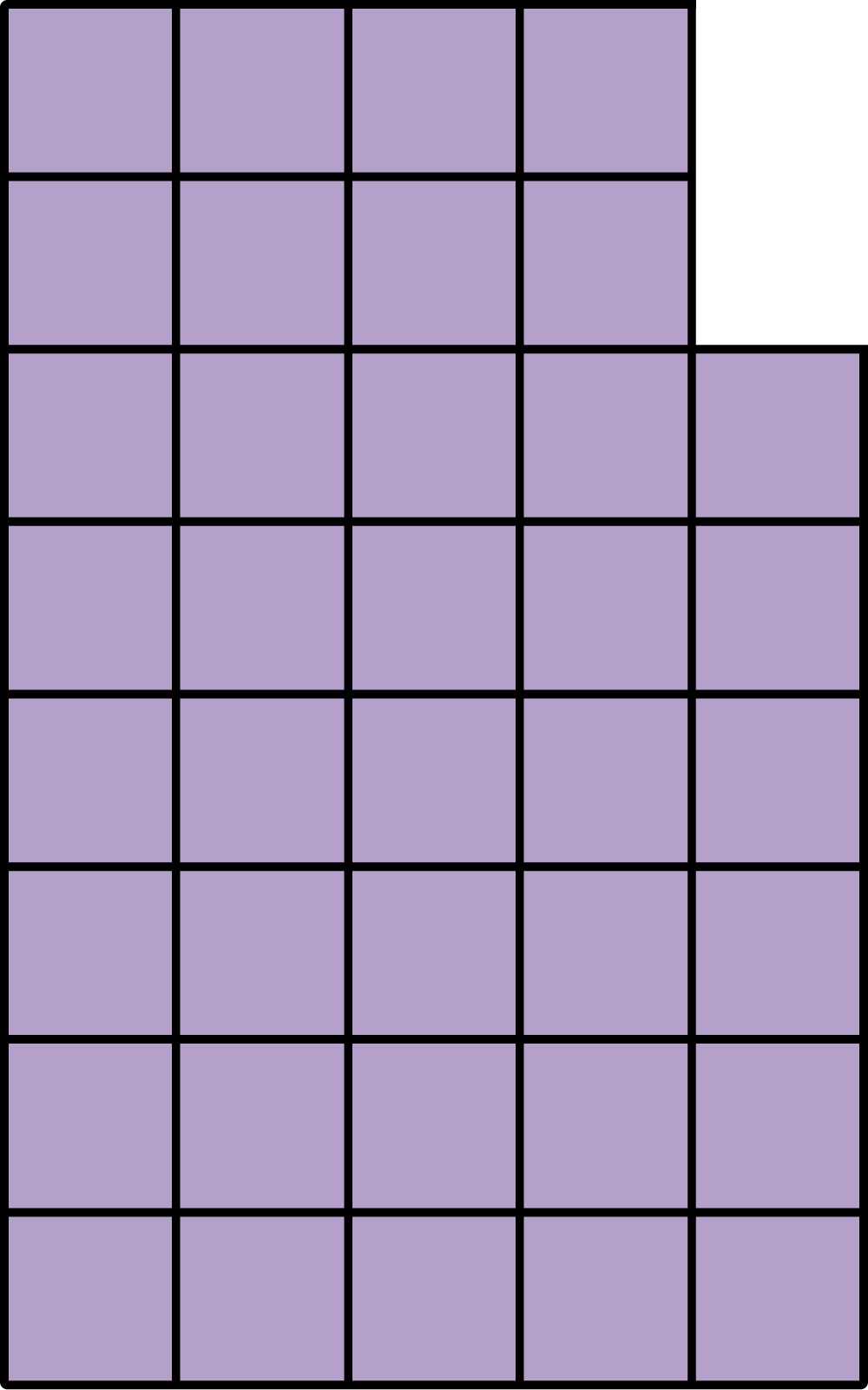
An area grid with the top being 2 units by 4 units. Seperating horizontally we have another grid of 6 units by 5 units. The grid is purple.
- 38 square units
- 32 square units
- 30 square units
- 8 square units
This is correct! \({(5 \times 6) + (4 \times 2) = 30 + 8 = 38}\) square units.
This is incorrect. It looks like you multiplied the left side measurement by the top measurement. Remember, you must break the figure into smaller rectangular shapes first, then find the area of each section, and finally add the different areas together.
Try again. It looks like you found the area for one of the parts. Remember, you need to find the area of both parts and then add them to get the total area.
Try again. This is the area of only one part of the figure.
Find the total area:
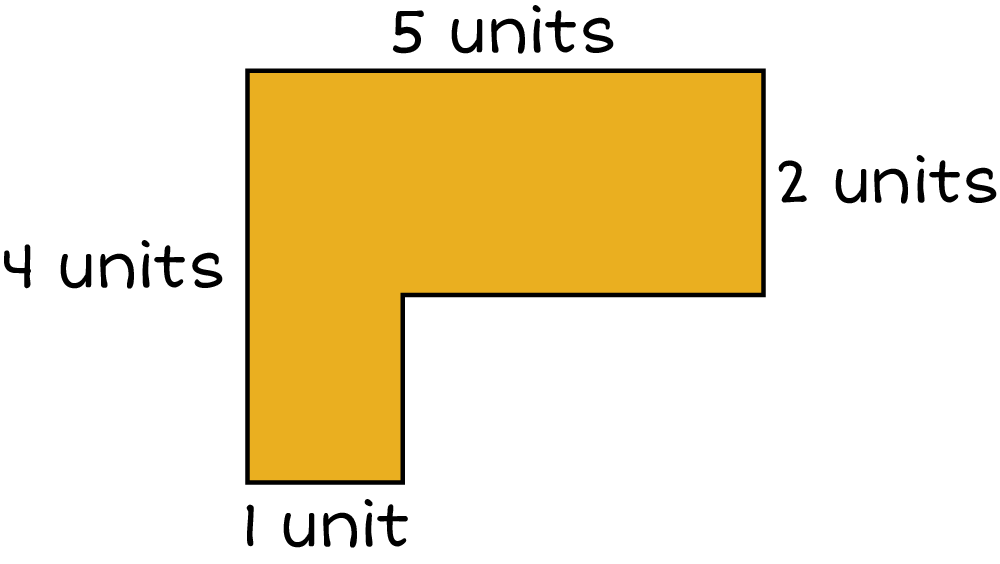
An area with the left width of 4 units, the top length of 5 units, the right width of 2 units and a bottom length of 1 unit the area is colored orange.
- 12 square units
- 22 square units
- 10 square units
- 14 square units
Great job! \({(1 \times 4) + (4 \times 2) = 4 + 8 = 12 }\) square units OR \({(1 \times 2) + (2 \times 5) = 2 + 10 = 12}\) square units
Try again. It looks like you multiplied the sides together and added them. Remember you must break the figure into smaller rectangular shapes first, then find the area of each section, and finally add the different areas together.
Try again. Check your area calculations. It looks like you found the area for one of the parts. Remember, you need to find the area of both parts and then add them to get the total area.
Try again. It looks like you multiplied the sides together and added them. Remember you must break the figure into smaller rectangular shapes first, then find the area of each section, and finally add the different areas together.
In which line does the FIRST mistake occur?
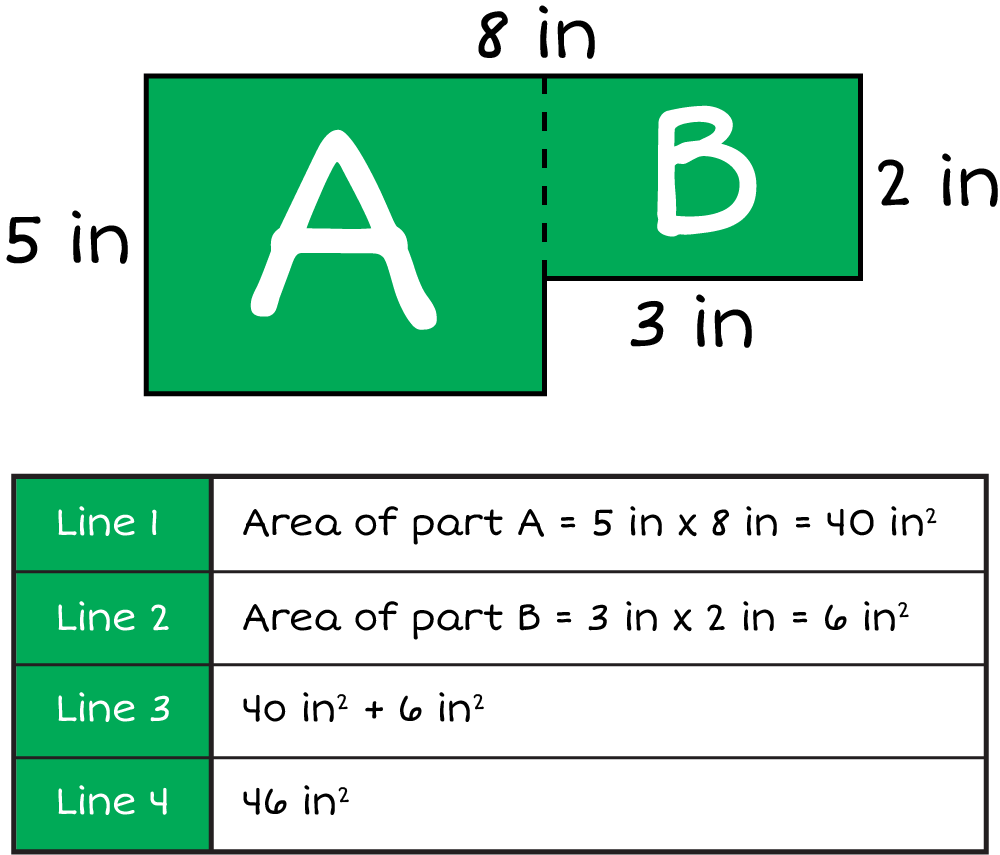
An area made of two parts. The first part is labelled part A. The second part is labelled part B. The entire shape is divided vertically from top to bottom. The width of the left side of the entire shape is 5 inches. The length of the top of the entire shape is 8 inches. The width of the right side of the entire shape is 2 inches. The bottom length of part B is 3 inches. Line 1: Area of part A equals 5 inches times 8 inches equals 40 inches\({^2}\) Line 2: Area of part B equals 3 inches times 2 inches equals 6 inches\({^2}\) Line 3: 40 inches\({^2}\) \({+}\) 6 inches\({^2}\) Line 4: 46 inches\({^2}\)
- Line 1
- Line 2
- Line 3
- Line 4
That is correct. This is the first error. The measures of part A should be 5 inches and 5 inches.
This is incorrect. This is the correct value for the area of part B.
This is incorrect. This is the correct step to find the total area, even if the values are incorrect.
This is incorrect. This is the sum of 40 in\({^2}\) and 6 in\({^2}\), but not the total area of this figure.
Find the total area.
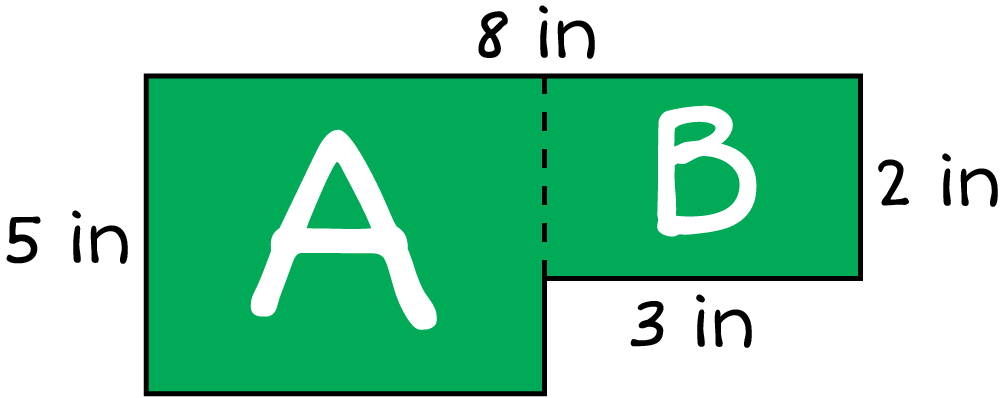
An area made of two parts. The first part is labelled part A. The second part is labelled part B. The entire shape is divided vertically from top to bottom. The width of the left side of the entire shape is 5 inches. The length of the top of the entire shape is 8 inches. The width of the right side of the entire shape is 2 inches. The bottom length of part B is 3 inches. Line 1: Area of part A equals 5 inches times 8 inches equals 40 inches\({^2}\)
- 31 in\({^2}\)
- 46 in\({^2}\)
- 25 cm\({^2}\)
- 16 cm\({^2}\)
That is correct.
Try again. Remember to break the figure into smaller rectangular shapes, then find the area of each section, and finally add the different areas together.
Try again. It looks like you found the area for one of the parts. Remember, you need to find the area of both parts and then add them to get the total area.
Try again. It looks like you found the area for one of the parts. Remember, you need to find the area of both parts and then add them to get the total area.
Find the total area:
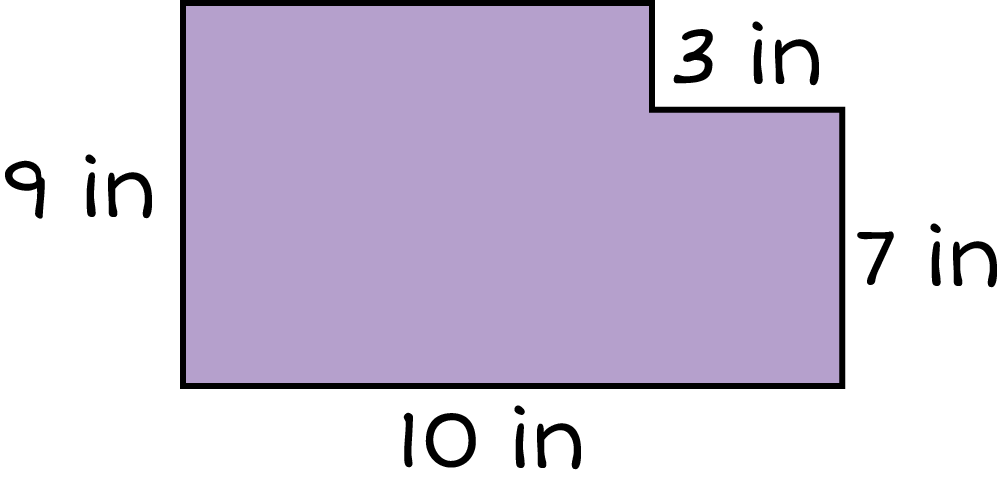
An area with the left width of 9 inches, the top length of the right side is 3 inches, the right width of 7 inches and a bottom length of 10 inches the area is colored purple.
- 80 in\({^2}\)
- 84 in\({^2}\)
- 70 in\({^2}\)
- 97 in\({^2}\)
Try again. Check your area calculations. Remember, you need to find the area of both parts and then add them to get the total area.
Great job! \({(10 \text{ in} \times 7 \text{ in}) + (7 \text{ in} \times 2 \text{ in}) = 70 \text{ in}^2 + 14 \text{ in}^2 = 84 \text{ in}^2}\) OR \({(9 \text{ in} \times 7 \text{ in}) + (3 \text{ in} \times 7 \text{ in}) = 63 \text{ in}^2 + 21 \text{ in}^2 = 84 \text{ in}^2}\)
Try again. Remember to break the figure into smaller rectangular shapes, then find the area of each section, and finally add the different areas together. What are the measurements of the different sections?
Try again. It looks like you multiplied two sides together and added them. Remember you must break the figure into smaller rectangular shapes first, then find the area of each section, and finally add the different areas together.
Find the total area:
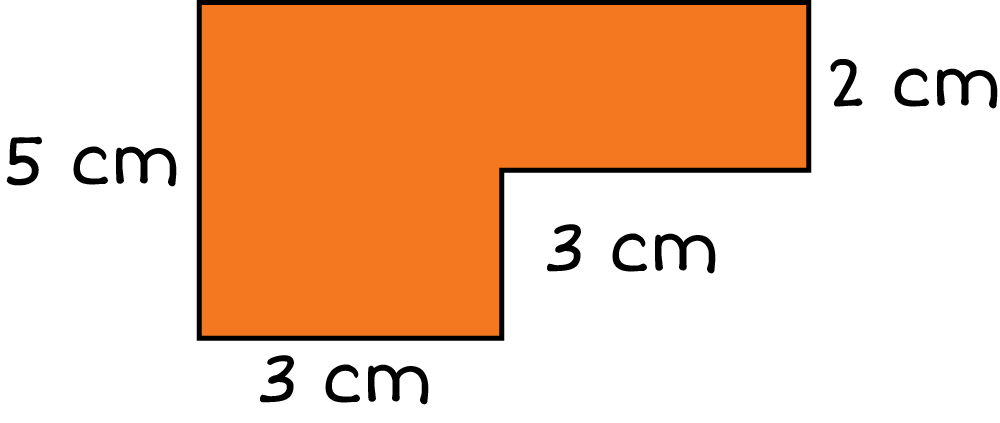
An area with the left width of 5 centimeters, the right width of 2 centimeters and a bottom length of 3 centimeters on the left side and 3 centimeters on the right side. the area is colored orange.
- 30 cm\({^2}\)
- 15 cm\({^2}\)
- 21 cm\({^2}\)
- 14 cm\({^2}\)
This is incorrect. Remember to break the figure into smaller rectangular shapes, then find the area of each section, and finally add the different areas together. What is the area of the different sections?
This is incorrect. It looks like you found the area for one of the parts. Remember, you need to find the area of both parts and then add them to get the total area.
Great job! \({(3 \text{ cm} \times 5 \text{ cm}) + (3 \text{ cm} \times 2 \text{ cm}) = 15 \text{ cm}^2 + 6 \text{ cm}^2 = 21 \text{ cm}^2}\)
This is incorrect. It looks like you added all the measurements, instead of breaking the shape into smaller rectangles, finding the areas of each part, and then adding to get the total area.
Find the total area:
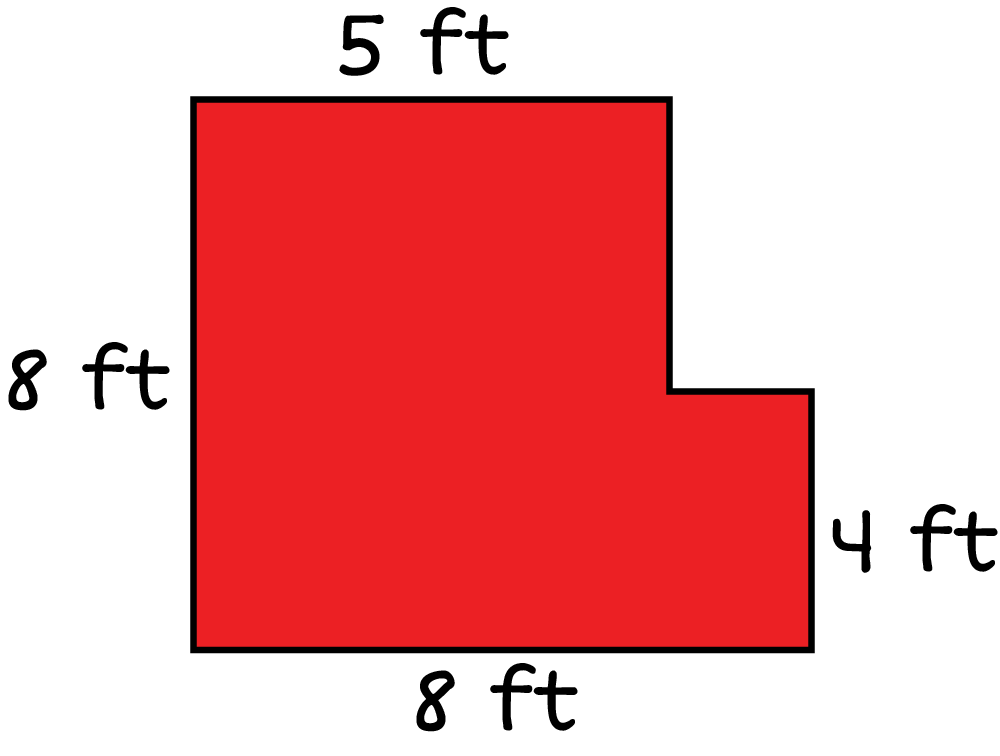
An area with the left width of 8 feet, the top lenght of 5 feet, the right width of 4 feet and a bottom length of 8 feet. the area is colored red.
- 52 ft\({^2}\)
- 32 ft\({^2}\)
- 40 ft\({^2}\)
- 64 ft\({^2}\)
That is correct. \({(8 \text{ ft} \times 5 \text{ ft}) + (3 \text{ ft} \times 4 \text{ ft}) = 40 \text{ ft}^2 + 12 \text{ ft}^2 = 52 \text{ ft}^2}\)
This is incorrect. Remember to add both sections together to find the total area.
That is incorrect. Remember to add both sections together to find the total area.
This is incorrect. Remember to break the figure into smaller rectangular shapes, then find the area of each section, and finally add the different areas together.
Find the total area:
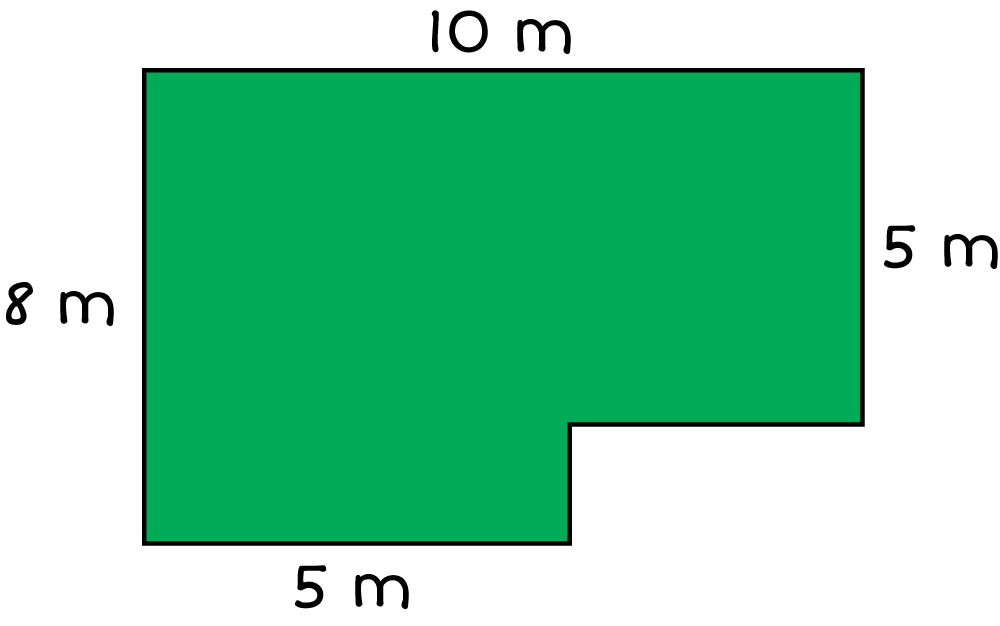
An area with the left width of 8 meters, the top lenght of 10 meters, the right width of 5 meters and a bottom length of 5 meters. the area is colored green.
- 65 m\({^2}\)
- 90 m\({^2}\)
- 50 m\({^2}\)
- 40 m\({^2}\)
This is correct! \({(10 \text{ m} \times 5 \text{ m}) + (5 \text{ m} \times 3 \text{ m}) = 50 \text{ m}^2 + 15 \text{ m}^2 = 65 \text{ m}^2}\)
This is incorrect. It looks like you multiplied the sides together and added them. Remember you must break the figure into smaller rectangular shapes first, then find the area of each section, and finally add the different areas together.
This is incorrect Remember to break the figure into smaller rectangular shapes, then find the area of each section, and finally add the different areas together. Did you add both sections together?
This is incorrect Remember to break the figure into smaller rectangular shapes, then find the area of each section, and finally add the different areas together. Did you add both sections together?
Summary
Questions answered correctly:
Questions answered incorrectly: