How many ways can we multiply a fraction by a fraction?
Goal:
Goal:
Imagine three-fourths of your class are boys. Two-thirds of the
boys are wearing tennis shoes. How would you figure out what
fraction of the class is boys with tennis
shoes?
First, what do you think the question is really asking?
The question is asking what is \(\mathsf{ \frac{2}{3}
}\) of \(\mathsf{ \frac{3}{4} }\), or in other words,
\(\mathsf{ \frac{2}{3} \times \frac{3}{4} }\).
Using a visual fraction model, how would you
figure out what fraction of the class is boys with tennis
shoes?
Try to determine this answer on your own. After writing down the
answer on a sheet of paper, see how your method compares to the
methods of the three students below by clicking each picture.
Sara: I drew a rectangle to represent the
whole class. The four columns represent the fourths of the
class. I shaded three columns to represent the fraction
that are boys. I then split the rectangle with horizontal
lines into thirds. The orange area represents the fraction
of the boys in the class wearing tennis shoes, which is 6
out of 12. That fraction is \(\mathsf{ \frac{6}{12} }\),
which simplifies to \(\mathsf{ \frac{1}{2} }\). So, half the
class are boys wearing tennis shoes.
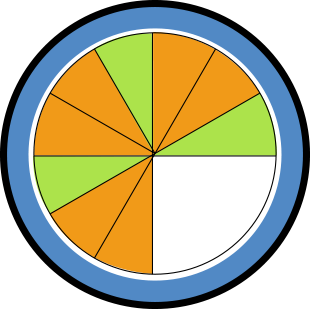
Dave: I used a fraction circle to model
my thinking. First, I shaded three-fourths of the circle,
and then I shaded \(\mathsf{ \frac{2}{3} }\) of that by
cutting each slice into three pieces and then shading two
of them. Turns out, my overlapped shaded region equals
\(\mathsf{ \frac{1}{2} }\) the whole circle. This means
that half the class are boys wearing tennis shoes.
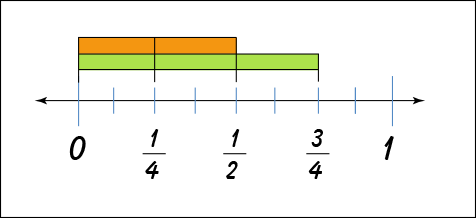
Taylor: I drew a green fraction bar on a
number line that is a length of \(\mathsf{ \frac{3}{4}
}\).
I then drew an orange fraction bar on top of that,
measuring \(\mathsf{ \frac{2}{3} }\) of the length of the
green bar. Now visually, on the number line, I can see
that \(\mathsf{ \frac{2}{3} }\) of \(\mathsf{ \frac{3}{4}
}\) is \(\mathsf{ \frac{1}{2} }\). This means that half the
class are boys wearing tennis shoes.
Notice that they all did the problem correctly—but they each had
their own way to solve it. In this lesson, you may come across a
problem done in a way that is different from your own. It’s
okay, as long as you get the same final answer!