Problem Solving
How do you use what you have learned to problem solve?
Goal:
Goal:

Practice!
Goal: Apply what you have learned about comparing numbers in the millions to solve a word problem.
It's time to solve word problems!
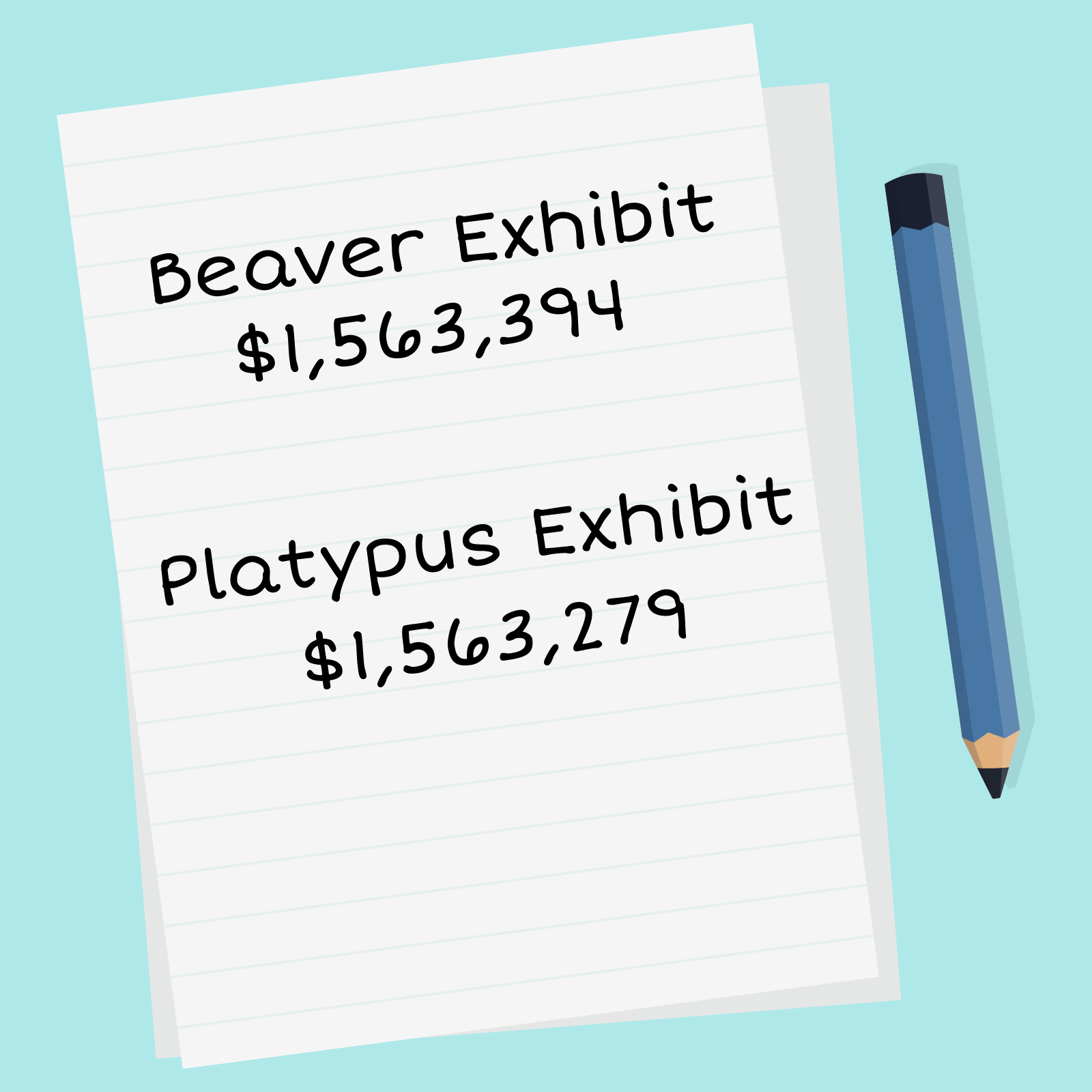
After seeing the construction projects at the aquarium, Ava is curious about future projects the aquarium has planned. She talks to an employee and finds out that over the next five years, the aquarium plans to add 2 more exhibits. The beaver exhibit will cost $1,563,394 to create, and the platypus exhibit will cost $1,563,279 to install. Which exhibit will cost more?
Word Problem Solving Steps
- Read the problem.
- Look for important information.
- Put the numbers in place-value charts.
- Decide how to solve.
- Solve and label your answer.
Don't skip this step! Sometimes you may think you can read the problem one time quickly and move on to solving it, but that is how mistakes get made. Take your time with this step to understand the information in the problem!

The next step is to find the important information in the problem. Numbers are usually important in a math problem. There are 2 very important numbers in this problem. Can you find them? The costs of the new exhibits are the numbers to focus on. Let's write those on our paper.
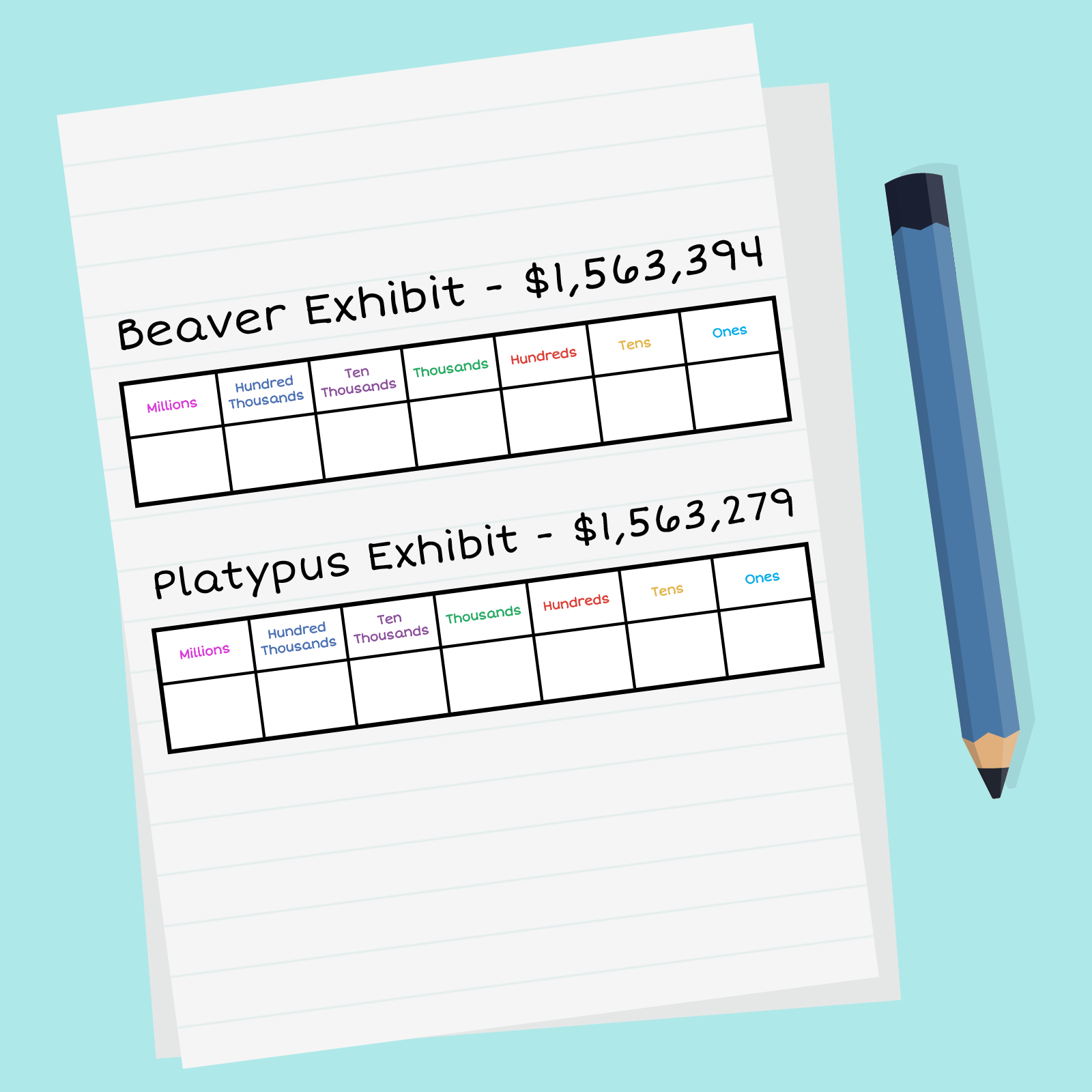
Next, we need to place the numbers in place-value charts so that we can compare them! Now is the time to make two place-value charts. Remember, you need to make them a bit larger than before since the numbers are bigger. Once you have your charts made and labeled, fill them in beginning with the ones place.
Click the Show Me button to see how you did creating and labeling your chart. Then, click the chart to see how you did filling it in
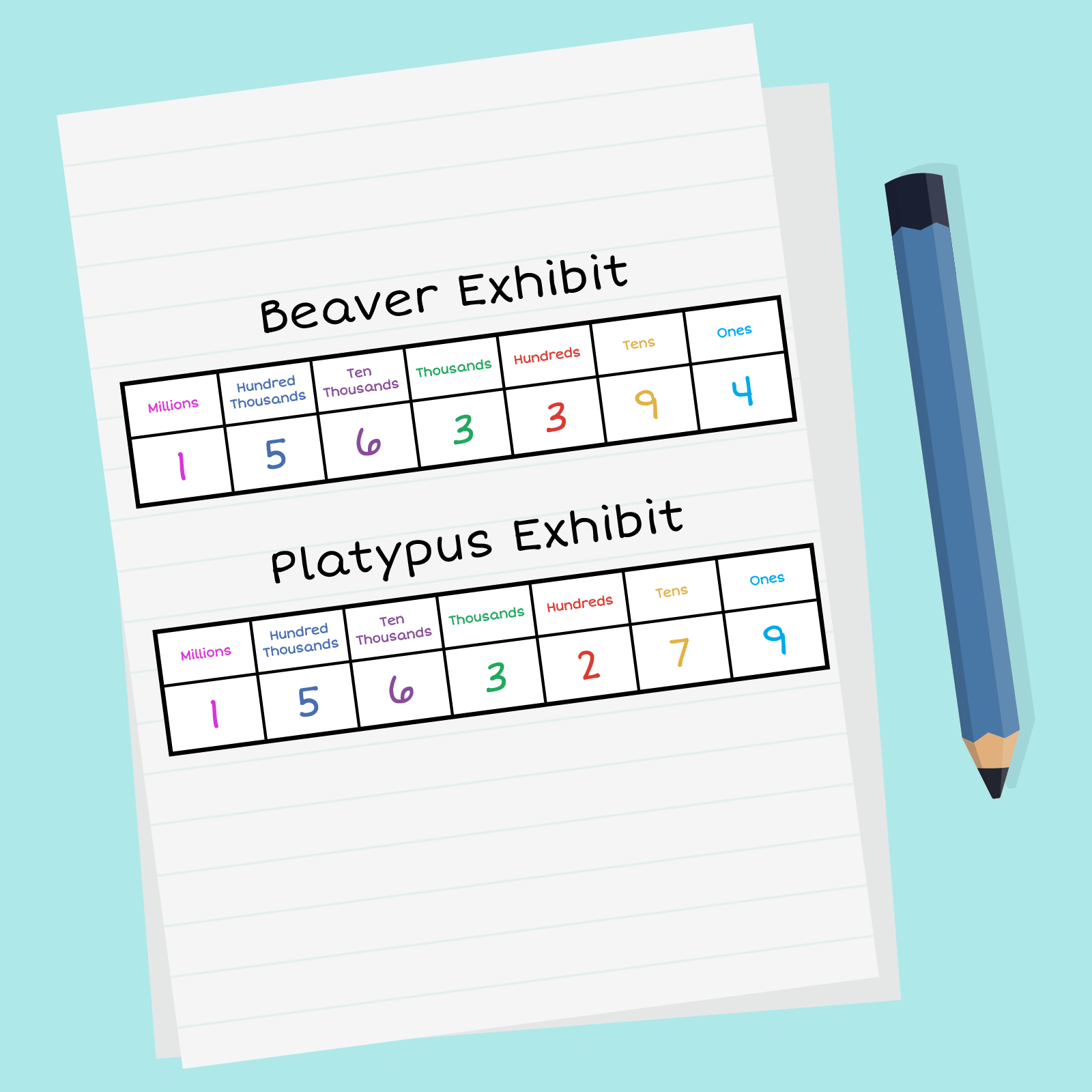
Now, we can solve the problem by comparing the two numbers. As we compare, remember what the word problem is asking for. We want to find out which exhibit will cost more. That means we are looking for the greater, or bigger, number.
We learned to compare numbers beginning with the largest place-value. Do you know what place-value to start on?
Start with the millions place!
It's time to solve! Look at your filled-in charts to compare each place beginning with the millions place. When you reach 2 numbers that are different, you can compare the numbers. The one that has the larger digit is the greater number! Can you find the place that will help you compare?
Click the charts to see if you are right!
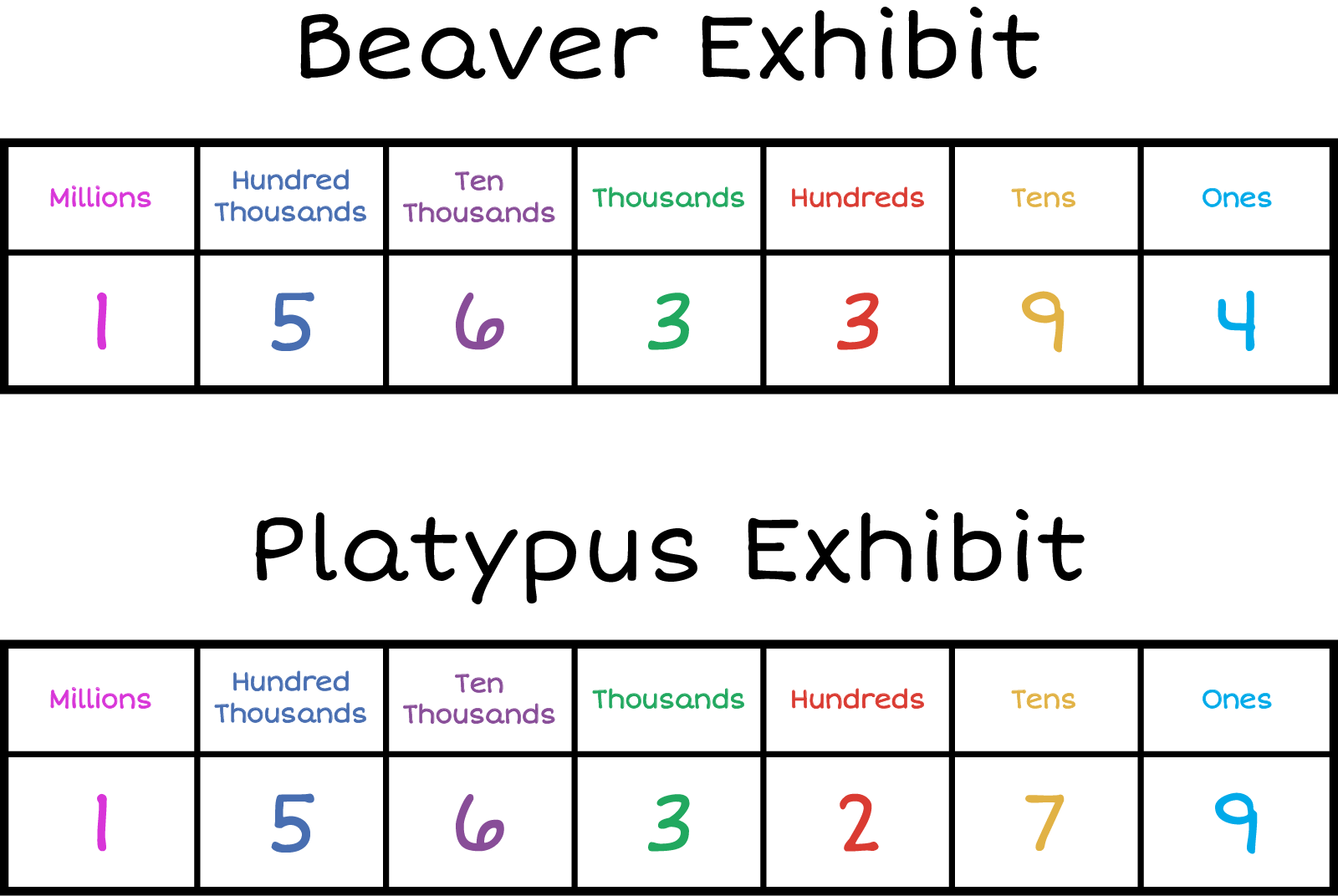 Platypus Exhibit Place value chart. Column
1-Millions: 1, Column 2-Hundred Thousands:5
,Column-3 Ten Thousands:6 , Column-4 Thousands:3
, Column-5 Hundreds: 2, Column-6 Tens:7 ,
Column-7 Ones:9 .
Platypus Exhibit Place value chart. Column
1-Millions: 1, Column 2-Hundred Thousands:5
,Column-3 Ten Thousands:6 , Column-4 Thousands:3
, Column-5 Hundreds: 2, Column-6 Tens:7 ,
Column-7 Ones:9 .
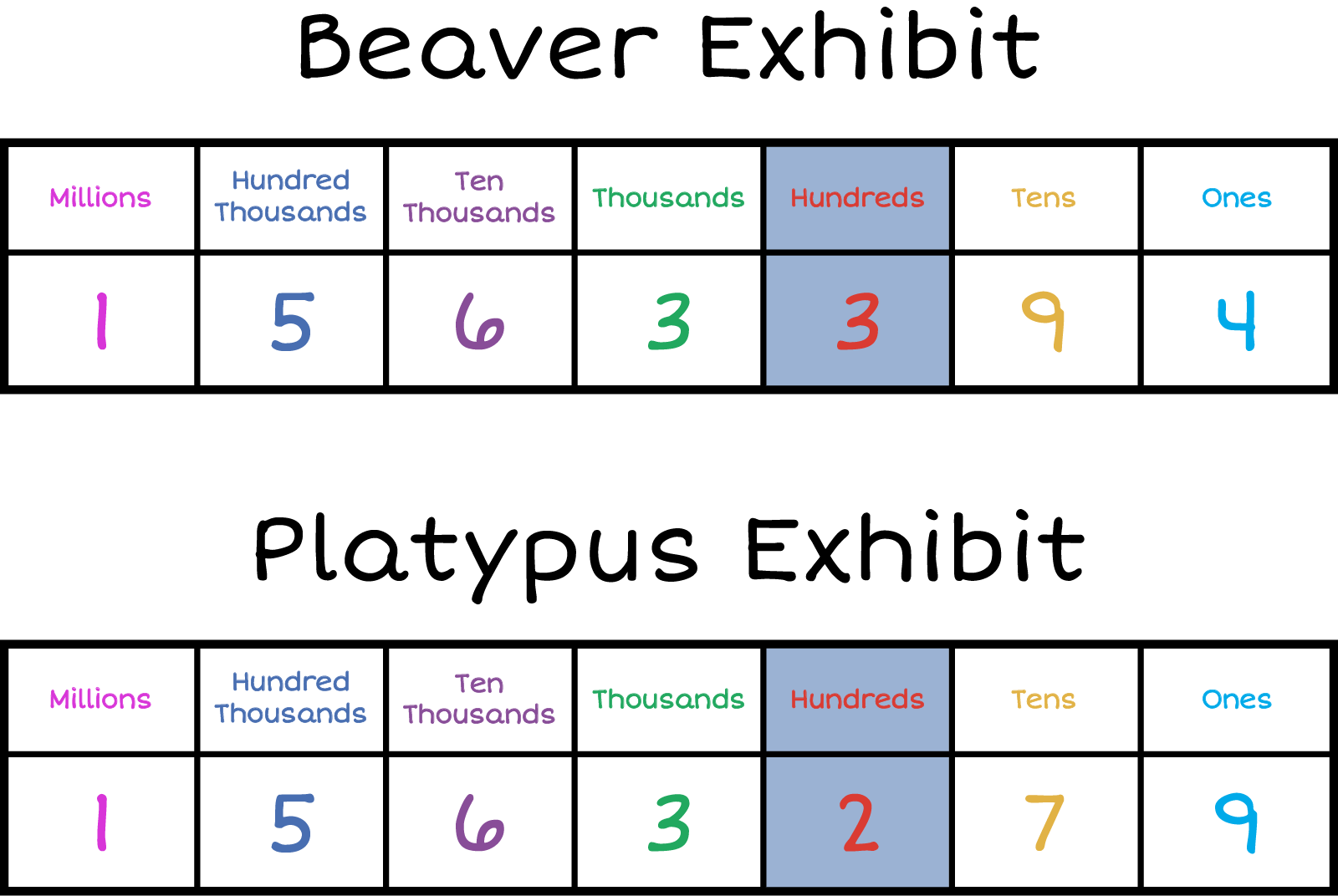 Platypus Exhibit Place value chart. Column
1-Millions: 1, Column 2-Hundred Thousands:5
,Column-3 Ten Thousands:6 , Column-4 Thousands:3
, Column-5 Hundreds: 2, Column-6 Tens:7 ,
Column-7 Ones:9 . Hundreds place is
highlighted.
Platypus Exhibit Place value chart. Column
1-Millions: 1, Column 2-Hundred Thousands:5
,Column-3 Ten Thousands:6 , Column-4 Thousands:3
, Column-5 Hundreds: 2, Column-6 Tens:7 ,
Column-7 Ones:9 . Hundreds place is
highlighted.
The hundreds place determines the greater number! Because 3 is greater than 2, we found the exhibit that will cost more.
$1,563,394 > $1,563,279
Answer: The beaver exhibit will cost more.
The owner is wondering if he should bring a polar bear to the aquarium. The cost would be very large to add a polar bear exhibit. He gets prices from two different companies. The first company will charge $3,252,389. The second company will charge $3,250,575. Which cost is the lesser amount?
- 3,252,389
- 3,250,575
After you put the numbers in the place-value chart, compare each digit beginning with the largest place. When you find two digits that are different, the digit that is smaller is the lesser number.
Correct! by comparing the thousands place, 3,250,575 is the lesser amount
Summary
Questions answered correctly:
Questions answered incorrectly: