
Let's Break it Down
Two events are said to be dependent when the outcome of the first event affects the probability of the second event. When events are dependent, the probability that the second event occurs, given that the first event has already occurred, is called conditional probability.

You can calculate the condition probability of dependent events using a two-way frequency table or by using the conditional probability formula.
Conditional Probability Formula
For any two events A and B, when \( P\left( A \right) \neq 0 \), \( P\left( B \middle| A \right) = \frac{P \ (A \text{ and } B)}{P \ (A)} \).
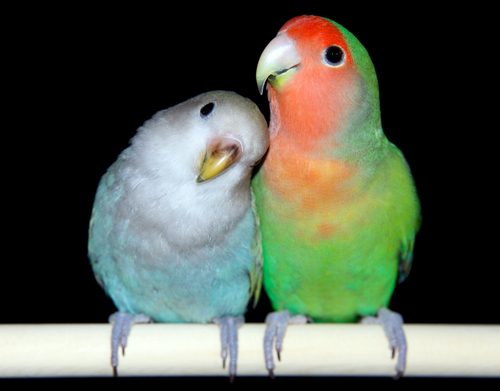
How well can you use two-way frequency tables and the conditional probability formula to calculate the conditional probability of dependent events? Use the activity below to find out. You will need to use this two-way frequency table for all the questions. It shows the number of blue and green parrots and parakeets in a rescue facility.
| Green | Blue | Total | |
|---|---|---|---|
| Parrot | 17 | 20 | 37 |
| Parakeet | 16 | 28 | 44 |
| Total | 33 | 48 | 81 |

Think you got it?
Look at the information given on each tab and then calculate the requested conditional probability. Express your final answers as a percent rounded to the nearest tenth. Be sure to check your answer before moving to the next question.
Find the probability that a randomly selected bird is a parrot given that the bird is green.
51.5%
If you need help arriving at this answer, click the solution button.
| Express the probability using “given that” notation, P(B|A). |
| Event A = “the bird is green” Event B = “the bird is a parrot” P(parrot|green) |
| Use the table to find the probability. |
| Read the “green” column in the table. There are 33 green birds. Of those, 17 are
parrots. P(parrot|green) \( = \frac{17}{33} = 51.5\% \) |
Find the probability that a randomly selected bird is a parakeet given that the bird is blue.
58.3%
If you need help arriving at this answer, click the solution button.
| Express the probability using “given that” notation, P(B|A). |
| Event A = “the bird is blue” Event B = “the bird is a parakeet” P(parakeet|blue) |
| Use the table to find the probability. |
| Read the “blue” column in the table. There are 48 blue birds. P(parakeet|blue) \( = \frac{28}{48} = 58.3\% \) |
Find the probability that a randomly selected bird is blue given that the bird is a parrot.
54.0%
If you need help arriving at this answer, click the solution button.
| Express the probability using “given that” notation. |
| Event A = “the bird is parrot” Event B = “the bird is blue” P(blue|parrot) |
| Use the table to find the probability. |
| Read the “parrot” row in the table. P(blue|parrot) \( = \frac{20}{37} = 54.0\% \) |
Find the probability that a randomly selected bird is green given that the bird is a parakeet.
36.4%
If you need help arriving at this answer, click the solution button.
| Express the probability. |
| Event A = “the bird is parakeet” Event B = “the bird is green” P(green|parakeet) |
| Use the table. |
| Read the “parakeet” row in the table. P(green|parakeet) \( = \frac{16}{44} = 36.4\% \) |
Use the conditional probability to show that the probability that a randomly selected bird is green given that the bird is a parakeet is approximately 36.4%
\( P\left( \text{green} \middle| \text{parakeet} \right) = \frac{0.197}{0.543} = 36.4\% \)
If you need help arriving at this answer, click the solution button.
| Express the probability. |
| Event A = “the bird is parakeet” Event B = “the bird is green” P(green|parakeet) |
| Define the probabilities P(A), P(B), and P(A and B). |
| Use the table. P(A) = the probability the bird is a parakeet. P(B) = the probability the bird is green. P(A and B) = the probability the bird is a green parakeet. |
| Calculate the probabilities P(A), P(B), and P(A and B). |
|
P(A) \( = \frac{44}{81} = 0.543 \) P(B) \( = \frac{33}{81} = 0.401 \) P(A and B) \( = \frac{16}{81} = 0.197 \) |
| Use the formula. |
| Substitute. P(green|parakeet) \( = \frac{0.197}{0.543} \) P(green|parakeet) \( = 36.4\% \) |
