As trade within and between civilizations became more common, people began to look for a way to place value on the things they offered for trade. The result was the world's first currency. Currency is any material that represents or stands for an item of trade. Civilizations used currency to trade in a more flexible and useful way. For example, if you had some grain to trade, and you met someone who didn't need grain, but had something you needed, you could offer the other trader some type of currency instead of grain. Then, the other trader could use that currency to trade for something he needed.
In the ancient city of Çatal Hüyük, located in present-day Turkey, archeologists found one of the earliest examples of currency in human history--a dark volcanic glass called obsidian. Traces of the obsidian currency have been found as far away from Turkey as Syria and Cyprus.
|
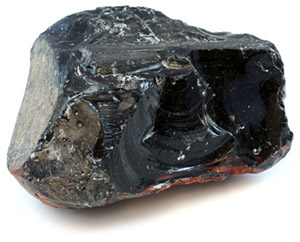
Raw obsidian, as it would have looked when a resident of Çatal Hüyük found it near the local volcano
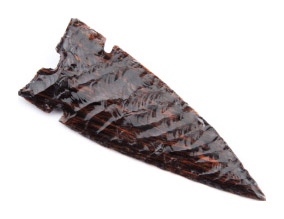
Obsidian shaped into an arrowhead used for hunting. This would be a desirable trade item.
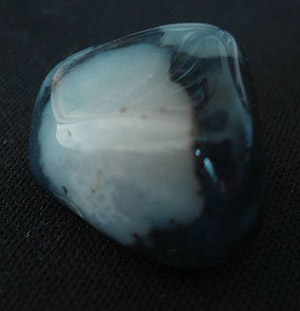
By Bordercolliez (Own work) [CC0], via Wikimedia Commons This is a polished piece of obsidian that has been shaped into a circle. This could be a piece of currency because the stone is beautiful and desirable but, unlike the arrowhead, it has no functional purpose. |
 |

Question
What made obsidian a valuable form of currency?
