Many Americans were angry that President Jefferson did not ask for a declaration of war following the Chesapeake-Leopard Affair. Realistically he couldn't, though. The United States was not equipped to win a war with Britain in 1807. Jefferson had sent most of the Navy to the Mediterranean to deal with the Barbary Pirates, and he had drastically decreased the size of the Army shortly after taking office.
Realizing that the United States needed to be better prepared for military engagement, Jefferson recalled all naval ships to American ports. He also ordered all state governors to be ready to call up 100,000 militia for duty. In the meantime, Jefferson decided to try an economic approach to dealing with British and French interference with American trade. In December 1807, Jefferson asked Congress to cease trade with all foreign nations. Congress responded by passing the Embargo Act, a law that prohibited American ships from leaving American ports for any foreign port. The Embargo Act also prohibited foreign ships from carrying any goods from American ports.
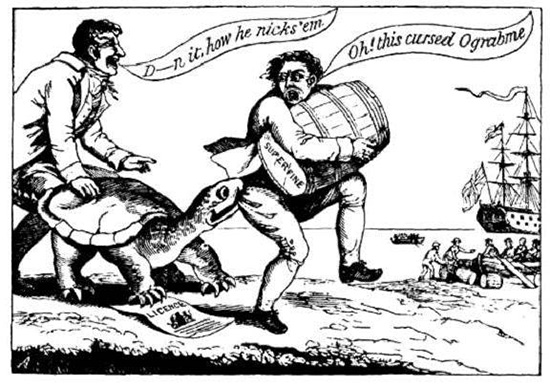 |
| Cartoon showing American opposition to the Embargo, or "Ograbme" spelled backwards |
The Embargo Act turned out to be a complete failure. It did not hurt the British economy, as intended. In fact, without competition from American shippers, the British shipping industry experienced an increase in business. While the British barely felt the effects of the Embargo Act, American shippers, especially those in New England, lost a great deal of business because of the law. In 1807, the United States exported $108 million worth of goods. By the spring of 1808, the value of American exports had plummeted to just $22 million.
Jefferson realized that the Embargo Act was hurting the American economy, but he still thought it was important to punish the British and French for interfering with American trade. In 1809, Jefferson persuaded Congress to replace the Embargo Act with the Non-Intercourse Act, which allowed American trade to resume with all countries except Britain and France. According to the replacement act, the president could restore trade with either nation once if it recognized American neutral shipping rights. Jefferson signed the Non-Intercourse Act into law three days before leaving office.
Question
Was the Non-Intercourse Act likely to be more effective than the Embargo Act in forcing Britain and France to recognize American shipping rights?
