If you live in the 21st century, you are always surrounded by sources of information. Analyzing them before accepting the "facts" they provide is part of life as we know it today. Back in 1692, though, life was different. Citizens were not taught how to analyze sources of information. In fact, they weren't allowed to question "official" sources even if the facts seemed suspect. Here's a primary source document that was written over 300 years ago. First, read the background information about the document. Then apply what you have learned about source analysis to the primary source (in italics). The questions at the bottom of the page will help you see how sharp your detective skills are!
 Background:
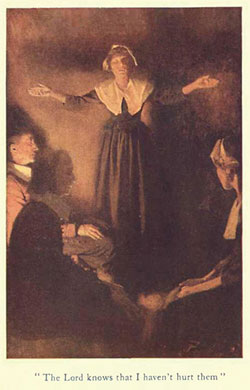
In 1692 in Salem Village, Massachusetts, two young girls named Abigail Williams and Betty Parris started acting strangely. They would flap their arms, pretend to fly, and try to jump into the fire. Abigail and Betty also claimed that people around the town would appear to them as spirits, asking the girls to sign their names in the "Devil's book." The girls would even cry out in pain, claiming that the spirits were pinching, biting, and otherwise hurting them. A priest named Deodat Lawson was sent to investigate.
What Lawson experienced when he saw the girls convinced him that they were victims of witchcraft, and that many people of Salem (including a respectable old grandmother named Rebecca Nurse) were sending out their spirits to torture Abigail and Betty. Lawson encouraged Salem leaders to take legal action against the dozens of townspeople that the girls said they saw, and nearly everyone who was put on trial was hanged for the crime of being a witch, including Mrs. Nurse.
Here is Lawson's account of what he witnessed when he visited the Parris home [edited for clarity/modern English].
In the beginning of the evening, I went to give Mr. Parris a visit. When I was there, his niece, Abigail Williams, (about 12 years of age) had a grievous fit; she was at first violently thrown back and forth around the room (although Mrs. Ingersol tried to hold her), sometimes making as if she would fly, stretching her arms as high as she could, and crying, "Whish, whish, whish!" several times; soon after she saw the spirit of Mrs Nurse and said, "Do you not see her? Why there she stands!" And she said that the spirit of Mrs. Nurse offered her The Devil's Book, but she was resolved she would not take it... After that, she ran to the fire, and began to throw burning pieces of wood around the house; and ran out back; as if she wanted to run up the chimney.
From A Brief and True Narrative... Relating to sundry Persons Afflicted by Witchcraft, at Salem Village... Deodat Lawson, 1692
Is Lawson's eyewitness account a credible source of information about what was happening in Salem 300 years ago? Think about the context of the times, the author and audience, and how the description fits with modern facts about witchcraft.
What aspect of life in 1692 made it more likely that Deodat Lawson would see Abigail's behavior as supernatural?
- Young women of the time were always well-behaved and honest.
- Most people at the time believed in witchcraft.
- Salem had been attacked by witches 20 years before.
- Most doctors in Salem used spells and magic to cure disease.
Most people in Salem believed that witches were real, and that they could harm other people and animals by sending out their spirits. This made it more likely that Deodat Lawson would jump to a conclusion of witchcraft before investigating other possibilities.
Most people in Salem believed that witches were real, and that they could harm other people and animals by sending out their spirits. This made it more likely that Deodat Lawson would jump to a conclusion of witchcraft before investigating other possibilities.
Most people in Salem believed that witches were real, and that they could harm other people and animals by sending out their spirits. This made it more likely that Deodat Lawson would jump to a conclusion of witchcraft before investigating other possibilities.
Most people in Salem believed that witches were real, and that they could harm other people and animals by sending out their spirits. This made it more likely that Deodat Lawson would jump to a conclusion of witchcraft before investigating other possibilities.
What part of Lawson's account shows that he may not be a reliable source about Abigail's behavior?
- Lawson believes that Abigail really sees Mrs. Nurse's spirit in the room with them.
- Lawson suspects that it is Abigail throwing herself around the room, not any spirit or witch.
- Lawson has always hated Mrs. Nurse and wants to see her hang.
- Lawson wasn't there at the time and is only writing about what he heard.
Although Deodat Lawson was really there and saw what happened, he believed Abigail when she claimed that "the spirit of Mrs. Nurse" was in the room. A more reliable eyewitness would report that Abigail said or thought she saw a spirit.
Although Deodat Lawson was really there and saw what happened, he believed Abigail when she claimed that "the spirit of Mrs. Nurse" was in the room. A more reliable eyewitness would report that Abigail said or thought she saw a spirit.
Although Deodat Lawson was really there and saw what happened, he believed Abigail when she claimed that "the spirit of Mrs. Nurse" was in the room. A more reliable eyewitness would report that Abigail said or thought she saw a spirit.
Although Deodat Lawson was really there and saw what happened, he believed Abigail when she claimed that "the spirit of Mrs. Nurse" was in the room. A more reliable eyewitness would report that Abigail said or thought she saw a spirit.
Lawson strongly believed in witchcraft and wanted to prove that witch trials were necessary for maintaining a safe and moral society. How might critics of the witch trials have reported the same events differently?
- They would have interviewed Mrs. Nurse and other people accused as witches.
- They would have looked for a medical explanation for Abigail's behavior.
- They would have run an experiment to see if Abigail's story could be verified.
- All of the above
Someone who was not convinced of the need for witch trials might look for evidence, gather accounts of the events from several different points of view, and try to figure out what was really happening in Salem--rather than just believing the girls' version of the story.
Someone who was not convinced of the need for witch trials might look for evidence, gather accounts of the events from several different points of view, and try to figure out what was really happening in Salem--rather than just believing the girls' version of the story.
Someone who was not convinced of the need for witch trials might look for evidence, gather accounts of the events from several different points of view, and try to figure out what was really happening in Salem--rather than just believing the girls' version of the story.
Someone who was not convinced of the need for witch trials might look for evidence, gather accounts of the events from several different points of view, and try to figure out what was really happening in Salem--rather than just believing the girls' version of the story.
In 1976, a scientist discovered that a fungus found in rye seeds could explain Abigail's fits. How does this discovery change the historical context for the scene Lawson witnessed?
- It tells us how dangerous it is to eat spoiled food--or to let your neighbors eat spoiled food.
- It proves that Abigail and Betty were lying about what they saw and felt.
- It gives a medical, scientific explanation for something that was hard to explain at the time.
- All of the above
This new discovery offers an explanation for the girls' behavior that doesn't rely on witches or spells. If this information had been available at the time, the Salem witch trials might not have occurred.
This new discovery offers an explanation for the girls' behavior that doesn't rely on witches or spells. If this information had been available at the time, the Salem witch trials might not have occurred.
This new discovery offers an explanation for the girls' behavior that doesn't rely on witches or spells. If this information had been available at the time, the Salem witch trials might not have occurred.
This new discovery offers an explanation for the girls' behavior that doesn't rely on witches or spells. If this information had been available at the time, the Salem witch trials might not have occurred.
Summary
 Questions answered correctly:
 Questions answered incorrectly:
