Events like the Longoria Affair caused Mexican-Americans to question their place in American society, and some looked back on their culture's history, especially the Mexican-American War, which ended in 1848 with the annexation of Texas and the land that became the American Southwest. Check out the map below:
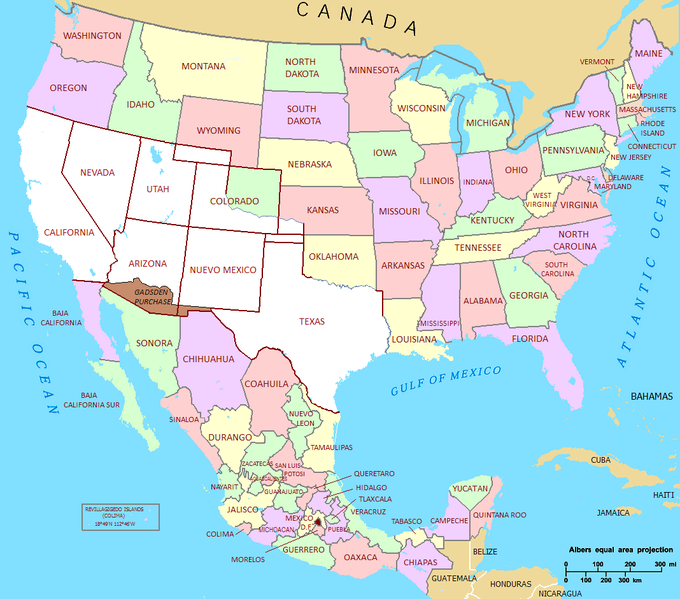 Mexico surrendered the territory in white to the United States in 1848. The modern states (as they look today) have been laid over the conquered white territory. |
Calls for Mexican-American rights increased after World War II, and racial tension in the Southwest caused some Mexican-Americans to think of themselves as a conquered people being denied their rights and portrayed as uneducated villains in the media. They weren't fully Mexican because Mexico lost that territory a long time ago, but they weren't fully American either because the government of the United States tolerated discrimination against them. So some activists started calling themselves "Chicanos" instead, adopting a previously derogatory word and changing it into a proud ethnic label.
Discrimination and unfair employment practices gave Mexican-Americans a cause to be passionate about, and calling themselves "Chicano" gave them a word for their shared struggle. The civil rights actions that exploded after World War II are called the Chicano movement. For a deeper explanation of what the Chicano movement meant to many Mexican-Americans in the 1960s, watch this video.
 People join groups for a variety of reasons, but mostly because they want to get more accomplished. Blending into the background and feeling like you belong are nice bonuses.
There’s a reason that school uniforms and “volunteer” shirts with the same colors actually help people work together and act as a unit.
During the Chicano movement, the concept of “chicanismo” served a similar purpose. It declared Mexican-Americans to be one culture and one nation, and many found it inspiring.
Chicanismo taught Mexican-Americans to think of themselves as descendants of the Aztec and Mayan civilizations of Meso-America, as well as the Spanish conquerors of those races. They were a unique nation without a country.
But being a Chicano was more than a political statement--it evolved into an artistic one, too. Poems and paintings by Chicano artists blended Mexican, ancient Meso-American, and modern American art styles to show off their mixed racial heritage.
Like the black power movement that resulted from the black civil rights movement, the Chicano movement started as anger about racism but evolved into something that was occasionally violent, but generally more positive.
Chicanismo allowed Mexican-Americans to share and revel in their common identity as if they were members of the same team wearing the same uniform. After decades of second-class treatment from their government and their neighbors, they wanted to feel proud instead of inferior.
People join groups for a variety of reasons, but mostly because they want to get more accomplished. Blending into the background and feeling like you belong are nice bonuses.
There’s a reason that school uniforms and “volunteer” shirts with the same colors actually help people work together and act as a unit.
During the Chicano movement, the concept of “chicanismo” served a similar purpose. It declared Mexican-Americans to be one culture and one nation, and many found it inspiring.
Chicanismo taught Mexican-Americans to think of themselves as descendants of the Aztec and Mayan civilizations of Meso-America, as well as the Spanish conquerors of those races. They were a unique nation without a country.
But being a Chicano was more than a political statement--it evolved into an artistic one, too. Poems and paintings by Chicano artists blended Mexican, ancient Meso-American, and modern American art styles to show off their mixed racial heritage.
Like the black power movement that resulted from the black civil rights movement, the Chicano movement started as anger about racism but evolved into something that was occasionally violent, but generally more positive.
Chicanismo allowed Mexican-Americans to share and revel in their common identity as if they were members of the same team wearing the same uniform. After decades of second-class treatment from their government and their neighbors, they wanted to feel proud instead of inferior.
Use the following activity to review the origins of the Chicano movement. Complete each sentence by dragging the correct word or phrase into the blank space.
|
Correct! Some activists didn't think they belonged to either Mexico or the United States. They had their own ethnic identity to be proud of, and they used the word Chicano to describe it.
Sorry, but that is not correct. Some activists didn't think they belonged to either Mexico or the United
States. They had their own ethnic identity to be proud of, and they
used the word Chicano to describe it.
|
|
Activists chose the word Chicano because .
|
|
they had their own culture
they wanted to distance themselves from Mexico
|
|
Correct! It was evidence of racial discrimination, like the Longoria Affair, that brought people together to form the Chicano movement.
Sorry, but that is not correct. It was evidence of racial discrimination, like the Longoria Affair, that brought people together to form the Chicano movement.
|
|
Anger over led to the formation
of the Chicano movement. |
|
lost territory
discrimination
|
Complete
