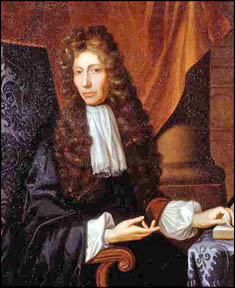
 ROBERT BOYLE (1627 - 1691)
British Chemist, Natural Philosopher
Some regard Boyle, and not LaVoisier, as the father of modern chemistry. He was born in Ireland, and educated in England, where he remained the rest of his life. While studying at Eton, Boyle read Galileo’s works (who was alive at the time.) He developed a keen interest in chemistry. He was a pioneer in experiments on the properties of gases and the “corpuscular” view of matter, which was the forerunner of the modern theory of chemical elements. This was a direct attack on the old Greek Aristotelian and alchemical views.
Boyle collaborated with Robert Hooke in constructing an air pump he used to perform experiments that led to Boyle’s Law (shown below). It states that “at constant temperature, the volume of a gas is inversely proportional to its pressure.” Boyle continued his experiments with air, vacuums, metals, combustion and sound. His experimental approach did much to influence the adoption of the modern scientific method.
Boyle's Law
At a constant temperature, the volume of a gas is inversely proportional to its pressure.
