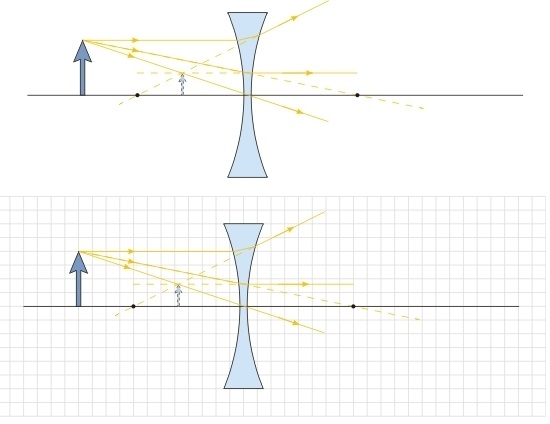
What do eyeglasses, contacts, a camera, and a magnifying glass all have in common? They are all lenses! A lens is any object that is molded and shaped in such a way as to refract light so that an image is formed. Many times it has to do with vision or capturing light. Similar to that of mirrors, there is still a principal axis, a focal point, and a focal length. The principal axis is just an axis drawn through the center of the lens (usually horizontal). The focal point and focal length depends on how the light refracted in the lens and that is determined by whether the lens in diverging or converging. Read through the tabs below to learn specifically about these lens types.
Converging Lens
Diverging Lens
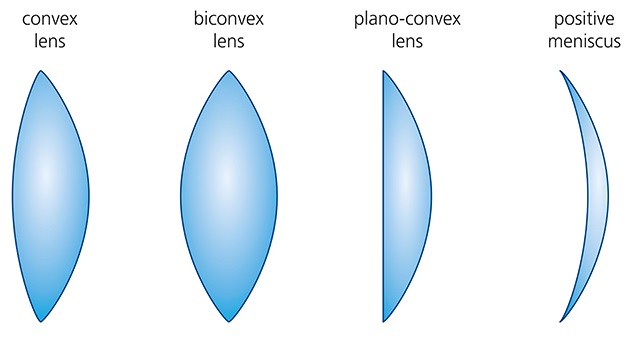
Any lens that is thicker in the middle and thinner on the edges is considered a converging lens. That's because as the light hits the lens parallel to the principal axis and passes through it, the light rays are bent towards and pass through the focal point on the other side. There are many different types of lenses that fall into this category, but we will focus on the biconvex lens. Notice here, the convex lens is actually converging. It is the opposite of the mirrors—where the convex mirror was diverging.
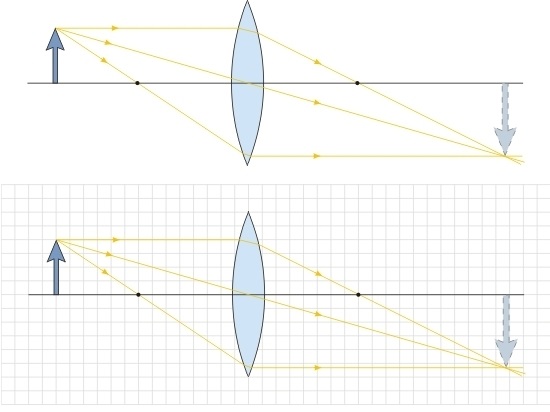
As with mirrors, you can use a ray diagram to help determine the characteristics of the image that is formed by the lens using three rules:
- A ray that comes into the lens parallel to the principal axis will refract through the lens and travel through the focal point.
- A ray that comes through the focal point on the way to the lens will refract and travel parallel to the principal axis on the other side.
- A ray that passes through the center (i.e. the principal axis) will continue traveling in that same direction.
Where the object is located in reference to the focal point will determine the type of image that is created (real/virtual, upright/inverted, larger/smaller).
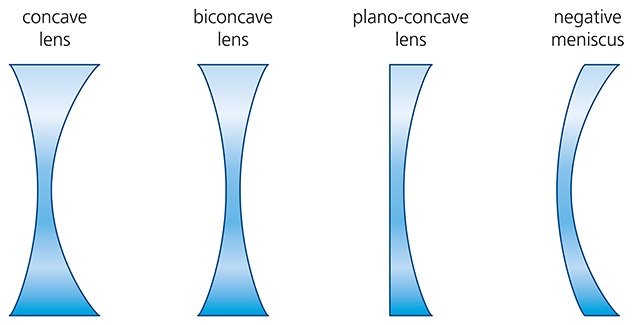
Any lense that is thicker on the edges than it is in the center is considered a diverging lens. That's because as the light hits the lens parallel to the principal axis and passes through it, the light rays are bent away from the focal point. Again, there are multiple types of lenses that fall into this category, but we will focus on the biconcave lens. It is also the opposite of a mirror: biconcave lenses are diverging.
You can also use ray diagrams to determine the characteristics of the image formed by a diverging lens. You can use these rules as you draw the ray diagrams for diverging lenses:
- A ray that comes in to the lens parallel to the principal axis will refract in a direction so that the extension of the ray in front of the lens passes through the focal point on the same side of the lens as the object.
- A ray that travels toward the focal point on the other side of the lens will refract so that the ray travels parallel to the principal axis.
- A ray that passes through the center of the lens will continue in that same direction.
All diverging lenses produce the same type of image: virtual, upright, and smaller. The image is also always located on the same side of the lens as the object.