If you added dialogue, precise words and phrases, or sensory language to your narrative, you may have noticed that some additional punctuation marks also crept into your draft. During the editing stage of the writing process, your goal should be to make sure that your writing is free of errors in usage and mechanics.
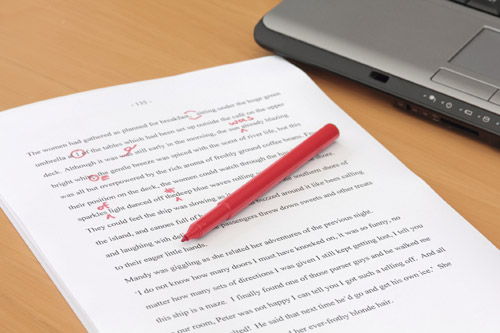
Use the tabs to learn more about editing your draft to make sure you're punctuating dialogue and using colons correctly.
Punctuating Dialogue
Colons
You already know that the spoken words of dialogue are enclosed in quotation marks. But do you know how other punctuation marks are used to connect dialogue to the rest of a sentence?
Read this example from "Pillowcases."
"No, thank you," I say again.
Question
What do you notice about the punctuation in the sentence?
You can probably see that a comma separates the spoken words from the identification of the speaker and that the comma is nestled inside the closing quotation marks. The spoken words "No, thank you" would normally end with a period, but because the speaker of the dialogue is identified afterward, a comma takes the place of the period.
But not all dialogue follows this pattern. Read this same sentence rewritten in slightly different ways in the chart below. Pay attention to how the punctuation changes. Try to determine the "rules" of each type of sentence. Click the sentence to compare your thoughts with the stated rule.
| I say again, "No, thank you." | Use a comma to separate the identified speaker and the spoken words. |
| "No, thank you!" I say again. | When the spoken words appear first in the sentence, do not use a comma to separate the speech and the identified speaker if the spoken words end in an exclamation point. |
| "No, thank you?" I say again. | When the spoken words appear first in the sentence, do not use a comma to separate the speech and the identified speaker if the spoken words end in a question mark. |
| "No," I say again, "thank you." | If the identified speaker interrupts the spoken words, use a comma on either side of the identified speaker. The first comma should be inside the quotation marks; the second comma should not. |
Although colons are used in many different scenarios, such as showing the time, writing a Works Cited citation, or following a greeting in a business letter, the two most common uses for colons involve introducing a list or adding explanatory information. When crafting a sentence that is especially precise and sensory, colons can be very convenient.
Examine these two example sentences from "Peak to Peak."
An argument for the Rockies' superiority is their bombastic aesthetic: rugged peaks, sharp tree lines, gorgeous formations of stone.
But consider this: The Blue Ridge's dense temperate green up close, slopes along its sides like the fingers of a hand bridged to hold a pool cue.
Question
The first example uses a colon to introduce a list, and the second example uses a colon to add an explanation. What do you notice about the information on either side of the colon in both examples?
The information in front of the colon must be a complete sentence. It doesn't matter if the information following the colon is a complete sentence or not. If what follows the colon is a complete sentence, it should be punctuated like one. If what follows the colon is a list, its first word should remain lowercase unless it is a proper noun.
