The DBQ prompt will be followed by seven (or more) documents that must be used in your essay. The College Board recommends that you spend 15 minutes reading over the documents provided and outlining your response to the prompt. While you do not have to use the entire 15-minute period, you may find that you need to spend a bit more. Keep in mind that the whole reading and writing period is only 60 minutes, so if you use more than 15 minutes to read, you will have less time to write.
You can use the SOAPSTone method to analyze the documents. This method will help you better understand what’s in the documents as well as to figure out where best to use them in your essay.
| S |
Speaker: Who wrote it? Why are they important? |
| O |
Occasion: When was it produced? Was it produced for a specific event or occasion? |
| A |
Audience: Who was the intended audience? |
| P |
Purpose: Why was it written? What was the author's motivation? |
| S |
Subject: What is the main topic of this source? |
| Tone |
Tone: Is there any apparent tone or “voice” in this source that would influence one’s interpretation? Is it filled with any apparent emotion? (e.g. sarcasm, anger) |
Take a look at each of the following documents and use the SOAPSTone method to come up with a good summary of each one. Try to complete this process in less than 15 minutes to give yourself some time to outline your essay during that review period as well.
Download the SOAPSTone worksheet by clicking on the Activity button. In the worksheet you will see some guiding questions for you to use as you analyze each of the following documents. Take some notes on the second page for each of the seven documents. You do not have to answer every question for every document—just answer the questions that are most relevant for each.
Also, keep in mind the essay prompt as you are reading through these documents.
Prompt:Evaluate the extent to which railroads affected the process of empire-building in Afro-Eurasia between 1860 and 1918.
Source: Petition in English to the British colonial government of India from the British-Indian Association, an organization consisting of high-caste Indians, 1866.
Railway travel for [Indian] natives has for a long time been full of the most bitter and serious grievances. The miseries suffered equal the horrors of the ‘middle passage.’
We would beg to draw your attention to the bad treatment of native passengers, with no distinctions been made between. Indiscriminate abuse is lavished freely without regard to differences in rank and social scale. Passengers have often been struck and otherwise treated with great indignity. Passengers traveling in second class are not even allowed to get to the platform, but are made to herd with the masses outside. We would like to emphasize the painful fact that the most respectable natives are liable to personal ill-treatment and loss from their European fellow passengers in the second-class carriages. Native gentlemen of birth and respectability, in striving to avoid the large crowds to be found in the third-class carriages, find themselves even worse off in a second-class seat. In a variety of ways attempts are incessantly made to degrade an insult second-class passengers.
We want to draw attention here to the present impossibility of native ladies of respectable birth and breeding taking advantage of railways. The honor of our wives and families is very dear and sacred to us, and the advent of the railroad has cut off old modes of transit without providing adequate ones for respectable women.
Source: Shen Boazhen, Qing dynasty official and advocate of domestic reforms, memorandum to the Qing court, 1967.
What shall we do about telegraphs and railroads? The Qin dynasty built the Great Wall, and at the time it was considered a disaster, but later generations relied on it. If telegraphs and railroads are built, China will likewise enjoy great benefits from them in the future. Moreover, as the work of constructing them is enormous, it will be quite beneficial to the poor people now. However, although the foreigners plead with the Court to include a formal treaty permitting them to begin this work, this absolutely must not be done. Perhaps the government could give its generous permission, but only if the Western [interests] can devise a plan that would guarantee that no arable fields, houses, and ancestral graves would be harmed in the least. Otherwise, permission should decidedly not be given.
Source: Ottoman government report concerning a proposal to build a railway from Damascus to Mecca, 1893.
Unless an alternative way, other than the Suez Canal controlled by the British, is found to connect they holy cities [of Mecca and Medina] to the rest of the empire, the Red Sea coast of Arabia might fall prey to the evils of those who strive to overthrow the very foundations of the caliphate.* At present, Muslims going on pilgrimage must either use foreign ships, where they are subjected to humiliation, or ravel by came, a very challenging journey through months of drought. It has become necessary to construct a railway in this region, both to solve these problems and to show the power of the caliph. The railway has to be built solely by Muslim involvement, by obtaining a huge amount of finance from the Islamic world and recruiting Muslim engineers in its construction.
Our sultan must personally lead this highly significant undertaking. Muslims across the world hold our sultan in very high regard; therefore people of political and economic influence will not hesitate to allocate some of their assets to this cause when they see our sultan personally leading the initiative.
*The Ottoman sultan claimed the title of caliph of all Muslims.
Source: “The Cape to Cairo Railway, and Rhodes’* Gigantic Proposal,” article illustration from the Auckland Weekly News, a newspaper published in British New Zealand, 1899.
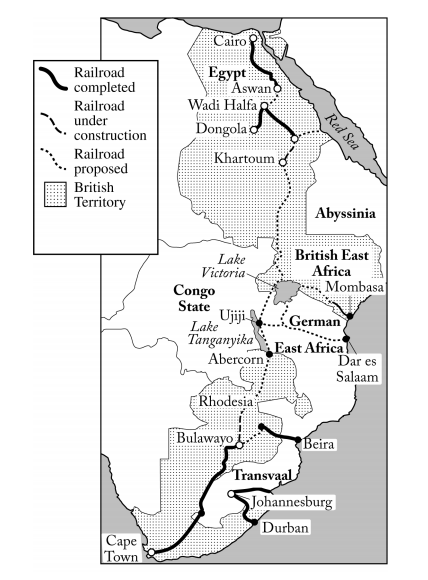
Sir George Grey Special Collections, Aukland Libraries, AWNS-18991110-8-4
*Cecil Rhodes was a British imperialist and entrepreneur. The proposed railway in the illustration was never fully build.
Source: Sir Henry Norman, English political, editorial discussing the Trans-Siberian Railroad, News Chronicle. Published in London, 1901.
Since the Great Wall of China the world has never seen an undertaking of equal magnitude. Russia, single-handedly, has conceived it and carried it out. Its strategic results are already easy to foresee. It will consolidate Russian influence in the Far East in a manner yet undreamed of. But this will be by slow steps. The expectation that the railroad could be used to transport masses of soldiers from European Russia to China, either in response to an attach or for Russian herself to launch an attack, is yet far from becoming reality. The line and its organization would break down utterly under such pressure. But bit by bit it will grow in capacity, and the Powers that have enormous interests at state in the Far East, if they continue to sleep as England has done of late, will wake to find a new, solid, impenetrable, self-sufficient Russian dominating China as she has dominated, sooner or later, every other Oriental land against whose frontier she has laid her own.
Source: Ernest Roume, governor of French West Africa, speech delivered before the colonial administrative council, Dakar, 1904.
We wish to truly open up to civilization the immense regions that the foresight of our statesmen and the bravery of our soldiers and explores have passed down to us. The necessary condition for achieving this goal is the creation of lines of penetration, a perfected means of transportation to make up for the absence of natural means of communication that has kept this country in poverty and barbarism. True economic activity cannot even be conceived without railroads. It is, therefore, our duty as a civilized nation to take the steps that nature itself imposes and are the only effective ones. It is now everyone’s conviction that no material or moral progress is possible in our African Colonies without railroads.
Source: Lieutenant-Colonel R. Gardiner, British army officer, “Indian Railways,” magazine article published in London, 1913.
The effect of this vast movement of people, with the interactions that has brought about between what previously were great nationalities practically unknown to one another, is now beginning to be felt in the drawing together of the people of India with a recognition of common interests, common ideals and ambitions—in other words, the birth of a common national and patriotic sentiment – which, if well directed, would eventually mold India into a unified and loyal people, still the brightest gem in the Imperial crown.
Now, consider the ways in which these documents are similar to or different from each other. Using your SOAPSTone analysis of the documents, find a way to group or categorize your documents together in way that makes sense. Do some of the documents have a similar tone? Are certain documents written for specific audiences?
Question
How would you group (or categorize) these documents? Why?
While there are numerous ways to group documents for each DBQ, here is a sample of how to do this with the documents given:
Group 1: Documents 5, 6, and 7 all discuss the political or economic outcomes of the railway system.
Group 2: Documents 1, 2, 3, and 4 all discuss cultural or social outcomes of the railway system.
These factors all played an important role in empire-building between 1860 and 1918.
After you have completed your analysis of each document, you should have your SOAPSTone document complete. Using that analysis, provide a brief summary of each document.
Summarize document 1.
Summarize document 2.
Summarize document 3.
Summarize document 4.
Summarize document 5.
Summarize document 6.
Summarize document 7.
| Your Responses | Sample Answers |
|---|---|
| Claims that high-caste Hindus are subject to abuse from European passengers on second-class carriages and are forced to interact with the masses outside the train platforms. Women’s respectability is also jeopardized. | |
| Argues that the Qing government should build railroads but should not do so by giving concessions to Western companies, unless they meet very stringent criteria. | |
| Argues that the construction of a railroad from Damascus to Mecca would aid Muslims in traveling to the holy cities of Mecca and Medina and would increase the prestige of the Ottoman sultan in the Muslim world. It would also decrease reliance on foreign/Western ships. | |
| The map shows a proposed railway advocated by the imperialist Cecil Rhodes to connect Cairo to the South African port of Cape Town. | |
| Argues that the construction of the Trans-Siberian Railroad will allow Russia to dominate East Asia unless the other European powers protect their interests there. | |
| Argues that the construction of railroads in French territory in West Africa is not only necessary for economic reasons but also to lift Africa out of “poverty and barbarism.” | |
| Argues that the construction of railways in India is helping to unify the numerous ethnic and religious groups of India into a more cohesive political and cultural community loyal to Great Britain. | |
