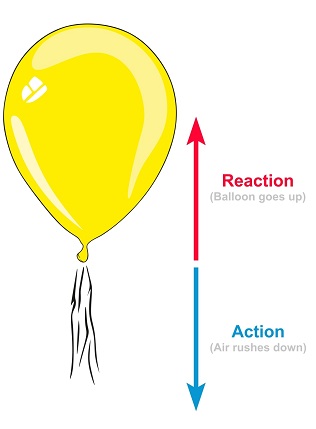
Newton's Third Law states that every force has an equal and opposite reaction force. To identify those action-reaction pairs is simple if you overcome some common misconceptions. Just remember that just because a pair of forces is equal and opposite, does not necessarily mean that they are action-reaction pairs. When you identify the action-reaction pair, you simply switch the order of the reference.
Newton's Third Law of Motion
\(\large\mathsf{ \overrightarrow{F}_{\text{1 on 2}} = - \overrightarrow{F}_{\text{2 on 1}} }\)
Newton's Third Law explains why rockets move up when it spews particles down, why a bird can move up when its wings move down, and why a gun recoils when it fires. Keep in mind, the action-reaction pair of forces act on two different objects. In each situation below, identify the reaction to each action force. Click on the action force to check your understanding.
| Action Force | Reaction Force |
|---|---|
| The tire of a car pushes on the road. | The road pushes on the tire. |
| The rocket pushes on the gas as it leaves the exhaust tube. | The gas pushes on the rocket. |
| Your hand applies a force on a ball as you throw it. | The ball pushes back on your hand. |
| The Earth pulls down on a person standing on the ground. | The person pulls up on the Earth. |
Question
Are action-reaction pairs always contact interactions?
These action-reaction pairs are often contact pairs, but that is not always the case. Some action-reaction pairs happen at a distance. For example, the force of gravity on a satellite that is orbiting the Earth has an action-reaction pair of the force of the satellite on the Earth. These are not contact forces, but they are still there.
