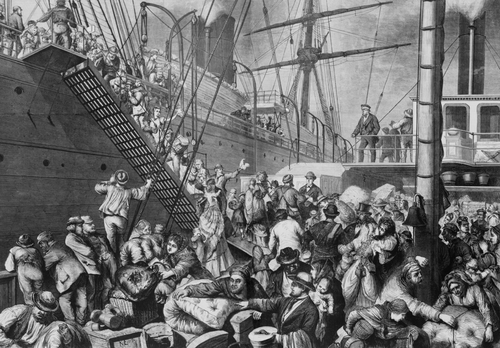
The late 19th century and early 20th century saw an immense influx of new immigration to the United States. People were coming to America by the boatloads in search of better opportunities. Early immigrants to America (except for the enslaved) were from western European countries like England, Scotland, Germany, Holland, and Sweden. Most of these arrivals already knew English and were Protestant, the dominant religion of the colonies. They fit in.
Other immigrants came from southern and eastern European countries, such as Italy, Hungary, Greece, Poland, and Russia. Another wave of new immigrants came from China and Japan. These new immigrants had a rough time assimilating, or fitting in, because many did not speak English and they had different cultural traditions.
Many new immigrants moved to large cities where they lived in squalor and faced discrimination. Particularly antagonistic toward immigrants were the nativists. Nativists were people born in the U.S. who believed they should be given advantages over new arrivals. These people resented new arrivals for not speaking English and for working for less money than those born in the U.S. Because of this attitude, anti-immigration Americans supported legislation that blocked new immigrants from entering the country.
Watch the following video about immigration. Be sure to take notes as you listen.
 Between 1880 and 1920, over 20 million people immigrated to the United States. Immigration had been nothing new to the U.S. The so-called “old immigration” in the 1700s and early 1800s had brought thousands of Irish and German immigrants to the new world in search of religious freedom and land. But in the 19th century a new immigration wave of different ethnic groups came to America.
Many hailed from southern and eastern Europe, as well as from Asia. This created a hodgepodge of languages, religions, and diversity that would add to the American melting pot. The old immigrant groups mostly came to America by choice. They had many similarities with each other. They had mostly come from northern and western Europe. Most knew about representative government. Except for the Irish, most immigrants were Protestant, literate, and had some money.
During the Gilded Age, the age following Reconstruction in America, new groups arrived by the boatloads, a majority landing in the East Coast cities of New York and Philadelphia. Over 4 million came from Italy, another 4 million from the Austro-Hungarian lands, over 3 million came from Russia, over 2 million came from Germany, another 1.5 million came from Sweden-Norway, and yet another 1.5 million came from Ireland. Other immigrants came from Greece, France, Serbia, and Poland. From Asia, nearly a quarter million Japanese arrived, as did over 100,000 Chinese. They migrated to the West Coast through such ports as San Francisco.
Virtually none of the new immigrants were Protestant--the religion of most people living in the U.S at the time. They were mostly Roman Catholic or Eastern Orthodox. Many new Jewish immigrant were migrating to America from Eastern Europe to escape persecution. The newcomers did not speak English and many were illiterate--even in their own language. Many of the new immigrants came from repressive countries ruled by monarchs or military men. Notions of democracy and American governance was unfamiliar to the newcomers. The most destitute seemed to migrate to the new large cities.
Areas of ethnicities were created in the cities and called Chinatown, Greektown, or Little Italy. Once settled in these areas, the different ethnic groups rarely mingled. Even though tenement housing and factory work was oppressive, the money they earned and the food they regularly ate in their new land, was more than they had in their former lives.
In the years between 1880 and 1920, at least 25% of European immigrants did not intend to become American citizens. They just wanted to earn enough money to support their families until they could return to their old country.
Factory owners were happy with the cheap labor and willingness to work by the immigrants. American laborers were not so happy with their new competition. The so called nativists lobbied to restrict immigration to America. In 1882, Congress passed the Chinese Exclusion Act, barring the Chinese from entering the U.S. entirely. Twenty-five years later they banned the Japanese as well. Congress banned criminals, contract workers, mentally ill, anarchists, and alcoholics from entering as well.
A bill was passed in 1917 requiring immigrants to pass a literacy test. The Immigration Act of 1924 limited the annual number of immigrants who could be admitted from any country to 2% of the number of people from that country who were already living in the U.S as of the 1890 census. The law was primarily aimed at further restricting immigration of southern and eastern Europeans, particularly Italians and Jews. Moreover, it severely restricted African immigration and outright banned the immigration of those of Arabic descent. But by this time millions had already immigrated. America became a diverse nation with pieces of old cultures sewn into the fabric of the United States. The Immigration Acts sorely tested the words found on the Statue of Liberty:
"Keep, ancient lands, your storied pomp!" cries she
With silent lips. "Give me your tired, your poor,
Your huddled masses yearning to breathe free,
The wretched refuse of your teeming shore.
Send these, the homeless, tempest-tossed to me,
I lift my lamp beside the golden door!"
