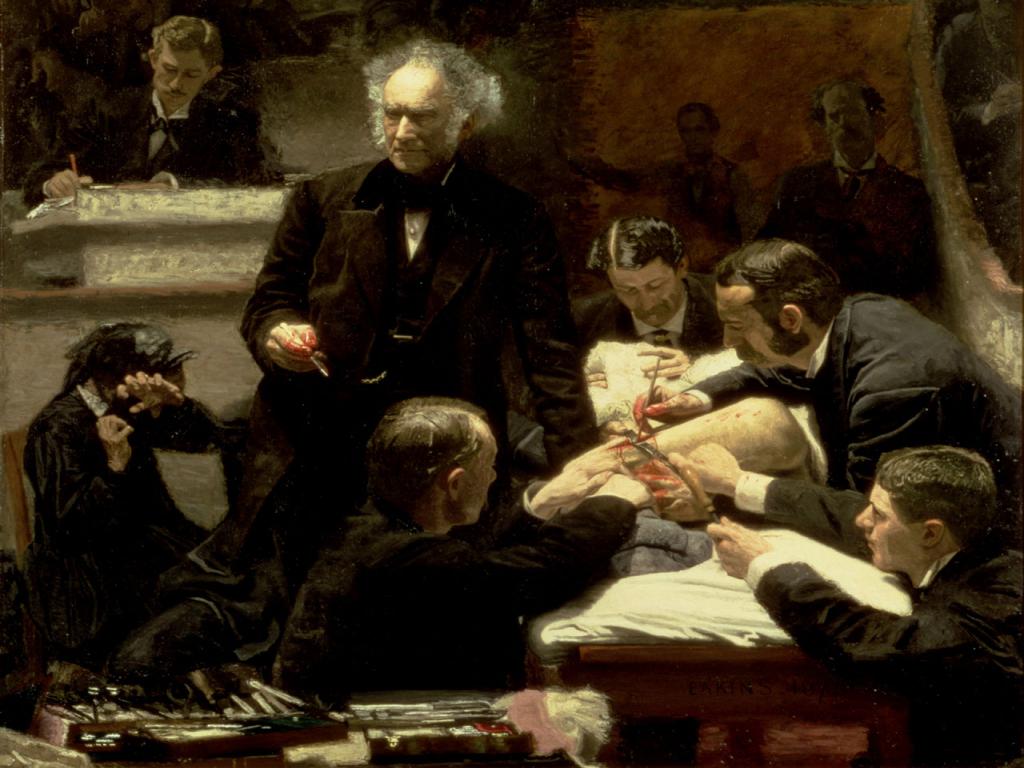
During the Gilded Age, business tycoons could spend their millions on art, and many did just that. Some of the more famous artists of the era included Winslow Homer and James McNeill Whistler (who famously painted his mother). Artists such as Winslow Homer were known to the masses because their illustrations also appeared in magazines like Harper's Weekly.
As the costs of producing books became less expensive, thousands of people began to read more. The literary titan of the age, Mark Twain, was extremely popular, as were the writings of Emily Dickinson, Edgar Allan Poe, and Walt Whitman. Moreover, the philosophy of Realism took hold in America during this time. Realists attempted to depict and view the world as logically and factually as possible. One example of realism in art was Thomas Eakins painting of medical procedures, called The Gross Clinic. In literature, Theodore Dreiser's realistic tale of the tragedies of a working woman became a bestseller.
As many Americans began working fewer hours because of more favorable labor laws, sports and leisure activities rose in popularity. It was in this era that baseball became the national pastime. Other sports popular during this era included boxing and basketball. Additionally, bicycling became all the rage, as did going to circuses.

The cover of The Adventures of Huckleberry Finn from the 1885 edition of the book by Mark Twain
E. W. Kemble (1861–1933) - illustrator / Public domain
In 1881 Andrew Carnegie, the wealthy steel industrialist, made an extraordinary announcement. He pledged to build a public library in any city that would agree to pay its operating costs. In the next 30 years, Carnegie donated more than $30 million to found more than 2,000 libraries throughout the world. With gifts from Carnegie and others, and the efforts of state and local governments, every state in the Union established free public libraries. With more readers, authors began to expand their influence on society.
Many writers of the era explored new themes and subjects. Their approach to literature was called realism because they sought to describe the lives of people. Related to realism was regionalism, writing that focused on a region of the country. Mark Twain was a realist and a regionalist. Many of his books, including Adventures of Huckleberry Finn and The Adventures of Tom Sawyer, are set along the Mississippi River, where Twain grew up.
Stephen Crane wrote about city slums in Maggie and about the Civil War in The Red Badge of Courage. In books such as The Call of the Wild and The Sea Wolf, Jack London portrayed the lives of miners and hunters in the far Northwest. Edith Wharton described the joys and sorrows of the upper-class Easterners in The House of Mirth and The Age of Innocence. Paul Laurence Dunbar, the son of former slaves, wrote poetry and novels that used the dialects and folktales of Southern African Americans. Dunbar was one of the first African American writers to gain fame worldwide.
Paperback books appeared for the first time in the late 1800s, and these inexpensive books helped expand the reading public. Many paperbacks featured lively adventure tales or stories of athletic boys and girls. Horatio Alger wrote a successful series of young adult books with such titles as Work and Win and Luck and Pluck. Based on the idea that hard work and honesty brought success, Alger’s books sold millions of copies.
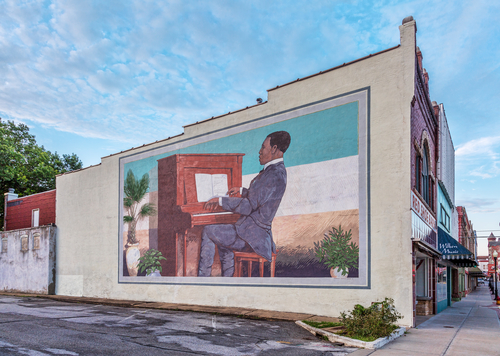
A mural by Stanley James Herd in the historic downtown of Sedalia, Missouri, shows Scott Joplin playing "Maple Leaf Rag" on the piano.
For most of the 1800s, the work of American artists and musicians reflected a European influence. After the Civil War, Americans began to develop a distinctively American style. Some American painters pursued realist themes. Thomas Eakins painted the human anatomy and surgical operations. One of Eakins’s students, Henry Tanner, depicted warm family scenes of African Americans in the South. Frederic Remington portrayed the American West, focusing on subjects such as cowhands and Native Americans. Winslow Homer painted Southern farmers, Adirondack campers, and stormy sea scenes. James Whistler’s Arrangement in Grey and Black, commonly known as “Whistler’s Mother,” is one of the best-known American paintings. Mary Cassatt was influential in the French Impressionist school of painting. Impressionists tried to capture the play of light, color, and patterns as they made immediate impressions on the senses.
More distinctively American kinds of music were also becoming popular. Bandleader John Philip Sousa composed many rousing marches, including “The Stars and Stripes Forever.” African American musicians in New Orleans in the late 1800s developed an entirely new kind of music, jazz. Jazz combined elements of work songs, gospel music, spirituals, and African rhythms. Related to jazz was ragtime music. For about 20 years, beginning around the turn of the century, ragtime and its complex rhythms were the dominant force in popular music. One of the best-known ragtime composers is Scott Joplin. He wrote “Maple Leaf Rag” and many other well-known works.
The symphony orchestras of New York, Boston, and Philadelphia, all founded before 1900, were among the world’s finest. Great singers and conductors came from all over the world to perform at New York’s Metropolitan Opera House.

The Boston Americans and the Pittsburgh Pirates at Huntington Avenue Grounds for the 1903 World Series
Although sweatshop workers labored long hours for six or even seven days a week, middle-class people and even some factory workers enjoyed increasing amounts of leisure time. Unlike round-the-clock farm work, professional and industrial jobs gave people hours and even days of free time. Americans developed new forms of recreation.
A favorite leisure-time activity for many people was watching and following sports. Baseball became the most popular spectator sport in America. By the turn of the century, both the National and American Leagues had been founded, each made up of teams from major cities. Their games drew large crowds of enthusiastic fans, and in 1903 the first World Series was held. Another popular spectator sport was football, which developed from the English game of rugby. By the 1890s college games were drawing huge crowds. Basketball, invented by Dr. James Naismith of Springfield, Massachusetts, also became popular. Naismith developed the game in the 1890s as an indoor winter sport for the boys in his YMCA physical education classes. Considered the only major sport that is completely American in origin, basketball soon spread to other countries.
Americans not only watched but also participated in sports. Tennis and golf were enjoyed by the wealthy, usually in exclusive private clubs. Bicycling grew in popularity after the “safety” bicycle was developed. Older bicycles had metal-rimmed wheels, a large one in front and a small one in back, while the new ones had two air-filled rubber tires of the same size. These improvements helped bicycle riding take the country by storm.
Large cities had many theaters. Plays performed ranged from serious dramas by Shakespeare to vaudeville shows, which were variety shows with dancing, singing, comedy, and magic acts. Many people could afford the price of a ticket, and in the early 1900s, vaudeville offered the most popular shows in town. The circus also attracted large crowds. In 1910, the United States had about 80 traveling circuses. Thomas Edison invented “moving pictures” in the 1880s. The “movies” soon became enormously popular. Some theaters, called nickelodeons, charged five cents to see short films. The nickelodeons were the beginning of today’s film industry.
Question
Give one reason sports and leisure activities became popular in the Gilded Age?
Americans were working fewer hours and had more time to devote to leisure.

