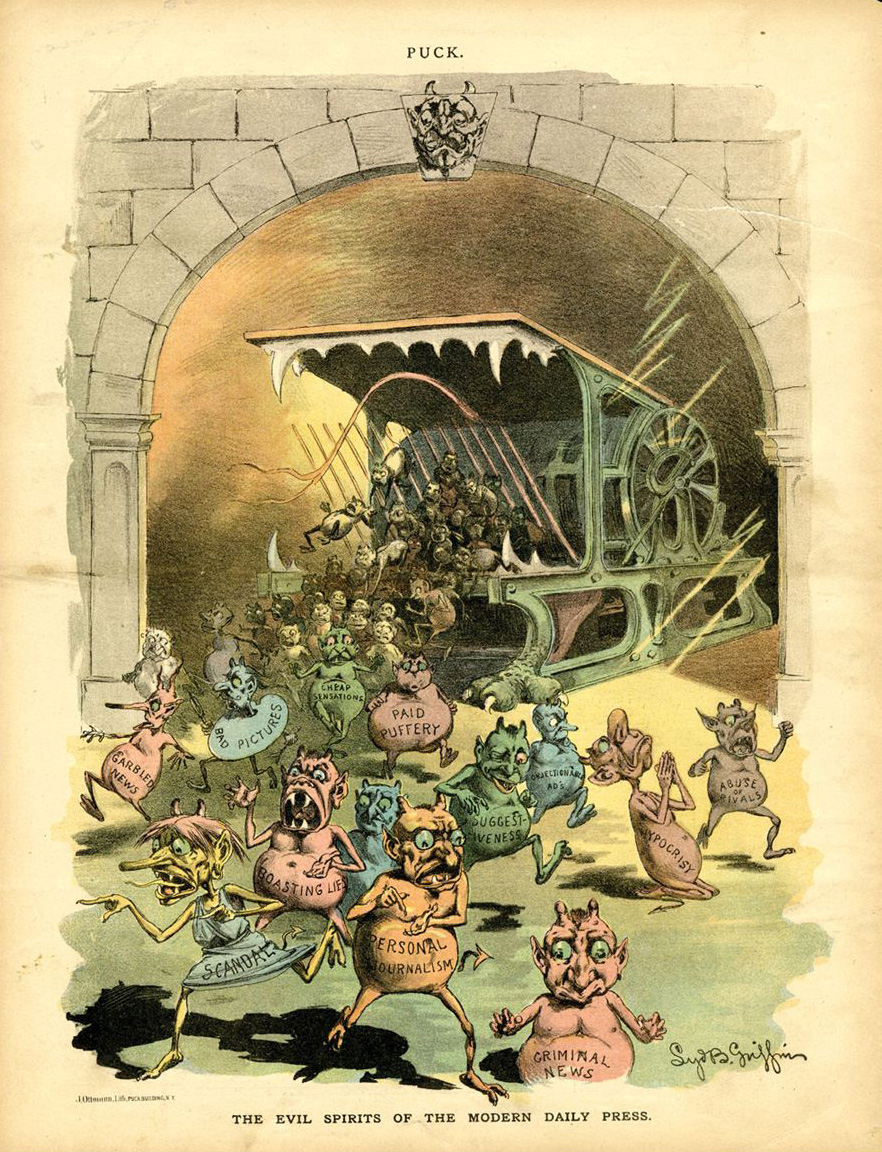
Click image to enlarge.
Just as big changes were taking place in the business world during America's Gilded Age after the Civil War, the news industry was also facing many new changes. With faster printing (Linotype press), as well as improvements in communications due to the telegraph, a revolution was occurring in the printing industry. Many were realizing there was money to be made in newspapers if they could just get the people to read them.
To attract readers, some newspapers were known to embellish the facts to make a story more compelling. Sometimes "fake news" stories would be added to lure in more readers. Called "yellow journalism" by critics, this type of reporting was practiced by the biggest newspaper publishers of the era, such as Joseph Pulitzer and William Randolph Hearst. (The term yellow journalism came from name of a comic strip character, the Yellow Kid.)
Sometimes this type of exaggerated reporting proved harmless, but at other times it was very dangerous. Some historians believe that yellow journalism led to the assassination of President William McKinley and inflamed public sentiment, igniting a war with Spain.
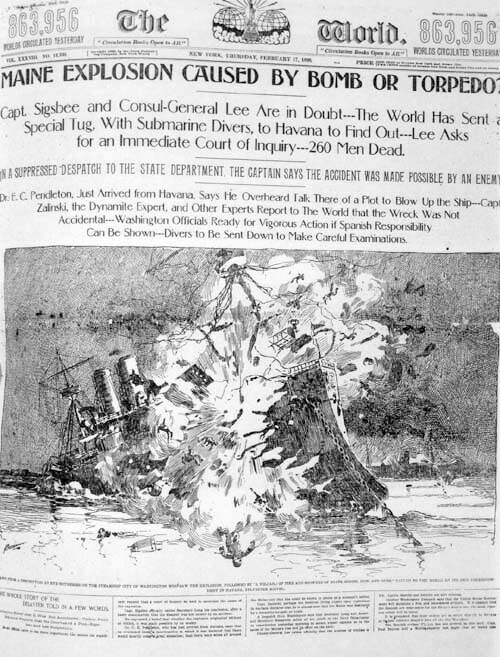
The February 17, 1898, edition of the New York World emphasizes a horrible explosion.
The news became a business, too. As Americans streamed into cities from small towns and overseas, professional news writers called journalists realized the economic potential. If half of Boston's citizens would buy a newspaper three times a week, a publisher could become a millionaire.
Technological advances in printing, paper making, and communications made it possible to publish a daily paper for many readers. The linotype machine, invented in 1883, made the printing of newspapers faster. The growing cities provided readers for the newspapers. The same year, Joseph Pulitzer purchased the New York World and created a new kind of newspaper. The paper grabbed the reader’s attention with illustrations, cartoons, and sensational stories with huge, scary headlines—such as “ANOTHER MURDERER TO HANG.” Under Pulitzer’s management, the World built up its circulation to more than one million readers every day.

The front page of the inaugural issue of The Louisianian, an early African American newspaper in New Orleans, dated December 18, 1870. At the time, the New Orleans Tribune had just closed, and The Louisianian was the state's only African American newspaper.
Other newspapers soon imitated Pulitzer’s style. William Randolph Hearst’s New York Morning Journal became even more successful than the World, attracting readers by exaggerating the dramatic or gruesome aspects of stories. This style of sensational writing became known as yellow journalism, a name that came from the paper’s popular comic strip, “The Yellow Kid.”
Ethnic and minority newspapers thrived as well. By 1900, there were six daily Jewish language newspapers operating in New York City. African Americans started more than 1,000 newspapers between 1865 and 1900. More magazines took advantage of printing improvements and mass circulation techniques to reach a national market. Between 1865 and 1900, the number of magazines in the United States rose from about 700 to 5,000. Some magazines of that era, the Atlantic Monthly, Harper’s Magazine, and Ladies’ Home Journal, are still published today.
