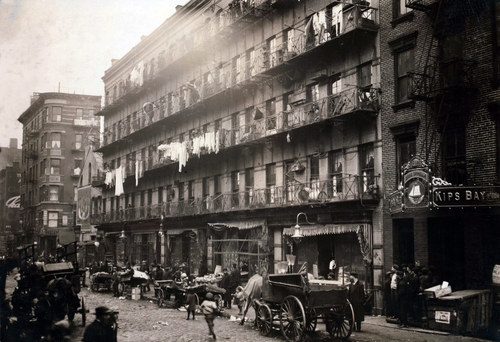
While American cities were glamorized as centers of ideas, opportunities, and new inventions, the reality was that most people in the cities lived in slums. Many people could not afford to live in luxury housing, so they lived in poor areas that were full of crime, disease, and very poor sanitary conditions.
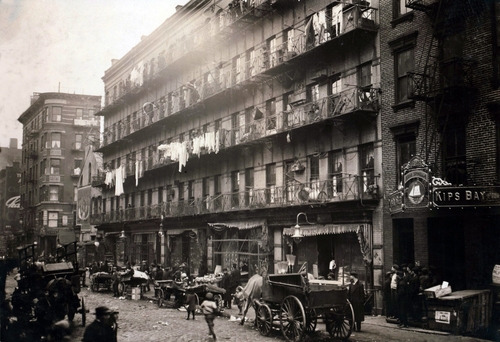
Tenements in New York's crowded immigrant neighborhood on the Lower East Side in 1912
Cities were exciting places that offered jobs, stores, and entertainment. But there was also substandard housing and desperate poverty. People poured into the cities faster than housing could be built to accommodate them. In the biggest, most crowded cities, the poorest residents, including most immigrants, lived in tenements. Originally a tenement was simply a building in which several families rented rooms.
By the late 1800s, however, a tenement had come to mean an apartment building in the slums, poor, run-down urban neighborhoods. Tenements had many small, dark rooms. Three, four, or more people lived in each room. Usually several families had to share a cold-water tap and a toilet. Few tenement houses had hot water or bathtubs.

Damage from the 1871 Chicago Fire
The rapid growth of the cities produced serious problems. The terrible overcrowding in tenement districts created sanitation and health problems. Garbage and horse manure accumulated in city streets, and the sewers could not handle the flow of human waste. Filth created a breeding ground for diseases, which spread rapidly through the crowded districts. Fires were an ever-present threat. About 18,000 buildings were destroyed and 100,000 citizens lost their homes in the Chicago fire of 1871. Two years later, Boston experienced a devastating fire.
In a poor Chicago neighborhood in 1900, babies often died of whooping cough, diphtheria, or measles before their first birthday. To control disease, New York City began to screen schoolchildren for contagious diseases and to provide visiting nurses to mothers with young children. The city also established public health clinics for those who could not pay for medical care. The poverty in the cities inevitably led to crime. Orphaned and homeless children sometimes resorted to picking pockets and other minor crimes to survive. Gangs roaming the poor neighborhoods committed more serious crimes.
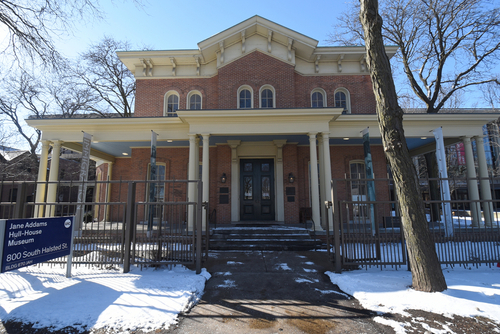
The Jane Addams Hull House and museum at the University of Illinois at Chicago
The problems of the cities did not go unnoticed. Many dedicated people worked to improve urban life and help the poor. Religious groups aided the poor. Some religious orders helped the poor in orphanages, prisons, and hospitals. Organizations such as the YMCA (Young Men’s Christian Association) and YWCA (Young Women’s Christian Association) offered recreation centers where city youngsters could meet and play. The poor also received assistance from establishments called settlement houses.
The settlement house movement had spread to the United States from Britain. Located in poor neighborhoods, settlement houses provided medical care, playgrounds, nurseries, and libraries as well as classes in English, music, and arts and crafts. Settlement workers— mostly women—also tried to get better police protection, garbage removal, and public parks for poor districts. One of the most famous settlement houses was Chicago’s Hull House, founded by Jane Addams in 1889.
| Because of overcrowding, which diseases were ravaging the cities? | cholera, yellow fever, and tuberculosis |
| What kind of building was created to house masses of people in impoverished areas of cities? | tenement housing |
