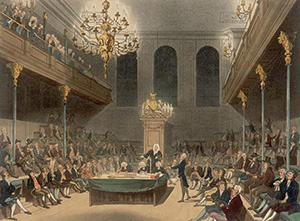
 Population centers changed during the Industrial Revolution as people moved from one area (usually the countryside) to another (usually the city) to look for jobs. Even though some older areas had decreased in population, they still had the same power in Parliament--that is, they had the same number of representatives in Parliament even though there were fewer people to represent. In some cases, so few people lived in a voting district that a politician could personally bribe everyone into electing him. These places were called rotten boroughs.
If someone was willing to buy a seat in Parliament with bribes, how concerned do you think he was about working conditions?
But the existence of rotten boroughs was just one of many problems that people had with their elected representatives, who did very little to rein in industrialists taking advantage of workers to make higher profits. Years of effort trying to fix these problems resulted in the Reform Act of 1832, a law that reorganized the structure of Parliament to better reflect an England based on industry, not agriculture and aristocracy. The Reform Act eliminated rotten boroughs and slightly expanded voting rights. It also modernized voter registration, making it somewhat easier for more people to vote.
In spite of these changes, workers as a class were still disenfranchised--deprived of political power--compared to other classes. The Reform Act stated that you had to own property worth £10 in order to vote, and that was much more than most members of the working class could afford to buy.
The numbers explain the situation better than words: In 1832, England had a population of 14 million. Even after the expansion of voting rights in the 1832 Reform Act, only 650,000 people had the right to vote--that's about 5 percent of the population.
Out of 100 people, about how many would have had the right to vote in Britain in 1832?
- 15
- 10
- 20
- 5
- 50
Only 5 percent of England's population could vote, even after the 1832 Reform Act. Out of every 100 people, 5 would have been the wealthy citizens who were able to vote.
Only 5 percent of England's population could vote, even after the 1832 Reform Act. Out of every 100 people, 5 would have been the wealthy citizens who were able to vote.
Only 5 percent of England's population could vote, even after the 1832 Reform Act. Out of every 100 people, 5 would have been the wealthy citizens who were able to vote.
Only 5 percent of England's population could vote, even after the 1832 Reform Act. Out of every 100 people, 5 would have been the wealthy citizens who were able to vote.
Only 5 percent of England's population could vote, even after the 1832 Reform Act. Out of every 100 people, 5 would have been the wealthy citizens who were able to vote.
Summary
 Questions answered correctly:
 Questions answered incorrectly:
Question
Why would wealthier members of Parliament oppose extending voting rights to the working classes?
