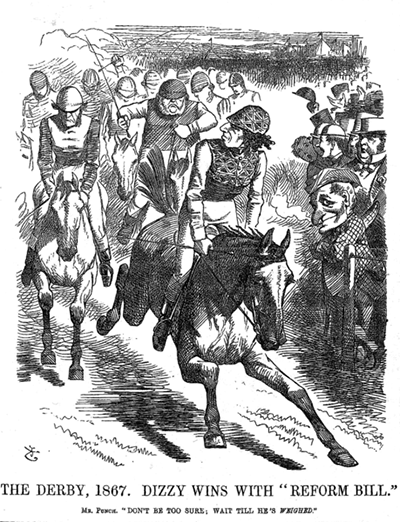
 As Chartism faded away in 1848, no action had been taken to improve the lives of the people in the large industrial working class created by the Industrial Revolution. Despite further expansion of the right to vote, only 20 percent of Britain's adult male population could head to the polls. That all changed in the 1860s, when public demand for more representation and better conditions began to sound, once again, like the beginning of a violent revolution.
Disraeli and Gladstone each fought to pass a reform bill that would appease the public. Disraeli won the first round and passed the Reform Act of 1867, which granted voting rights to every adult male in Britain. Gladstone had attempted to pass a law that would grant voting to a larger percentage of males but would still disenfranchise the "criminal" classes.
Throughout the rest of the century, Disraeli and Gladstone continued their battle. Disraeli pulled Britain in a socialist direction, and Gladstone tugged back toward laissez faire capitalism. In the end, Gladstone was slightly more successful, but the consequences of their bout were more significant than any immediate victory: The confrontation between the two men set the stage for more socialism vs. anti-socialism debates in the next century.
Disraeli was not actually a socialist, but the battle between Disraeli and Gladstone escalated (in the minds of the public) into a "socialism vs. capitalism" clash because the economic and political tensions in industrial Britain were so high. Members of each side believed that their opponents would weaken the country forever.
Question
Who won the political battle between Disraeli and Gladstone?
