The Nile River, located in present-day Egypt, is not only the longest river in the world. It is also a great resource for the people who live near it. The Nile River makes the land around it very fertile when it floods its banks each year and leaves behind silt, an especially rich type of soil. It also provides a way for farmers to irrigate land--to carry water to crops that are not planted directly beside the river. The power of the Nile was no different in ancient times, when the Egyptian civilization emerged around its banks.
Read these tabs to learn how the Nile River helped create Egypt's first civilization.
The Annual Flood
Tools of Civilization: The Shaduf
A Unified Kingdom
The Nile and the Pyramids
Review
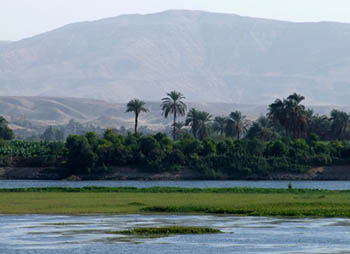
The Nile flows for over 4,000 miles from the center of Africa north to the Mediterranean Sea. Each year the Nile flooded the low-lying land along its banks, leaving a rich soil called silt. People living by the river developed farming and irrigation systems. As the people worked together to build dikes and irrigation ditches, they were able to grow surplus food to feed large populations. Egyptian civilization grew with the crops beside the Nile.
What two things jump-started Egyptian civilization along the Nile?

the annual flood that created rich soil for farming, and people working together to manage the flood water
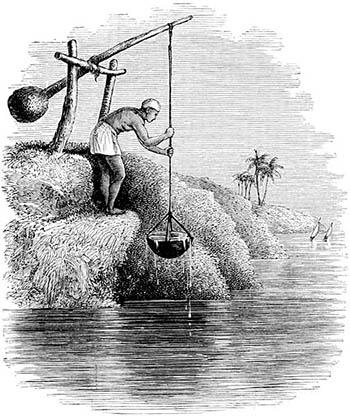
By G. Pearson [Public domain], via Wikimedia Commons
What helped the Egyptians move water from the Nile to farmland and water storage containers? The shaduf. A shaduf is a simple tool with a bucket at one end and a weight on the other. The bucket is lowered into the water and lifted up to land. A large shaduf could move large amounts of water to storage or irrigation systems. When would Egyptians need to use a shaduf?
when the river was not flooding, and they needed to take water from it to irrigate their land

Two separate kingdoms grew up on the Nile: Lower Egypt in the north, and Upper Egypt in the south. In about 3100 BCE the two kingdoms united. They were connected by the Nile, which was like a highway for trade and communication between cities in the two regions. Gold, ivory, ebony, and furs went down the river to the north, carried on sailboats and barges made of papyrus, a riverbank reed. Papyrus was also turned into a kind of paper. The world’s first unified state was rich in agriculture, trade, and art. Where would the great cities of Egypt have been built?
They would have been built along the Nile River, in both Upper and Lower Egypt. Southern Egypt is called “Upper” Egypt because it has a higher elevation than northern Egypt, which lies closer to sea level.
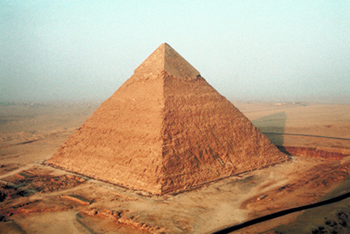
The pyramids are the greatest monumental architecture of Ancient Egypt. They too depended on the Nile for their existence. The pyramids were built in the off-season, when farmers’ lands were flooded by the Nile and they could not work in the fields. Farmers became builders who used bricks made out of mud from the Nile to build the pyramids.
Could the pyramids have been built if the Nile had not had an annual flood?
No; the pyramids were built by farmers who had an off-season because of the flood. If there had been no flood, people would have had to be farming all year long to raise enough food to feed the population.
How did the Nile River help humans build one of the world's first and most successful civilizations? Answer these questions to check your understanding.
What role did the Nile River floods play in the success of agriculture in that region?
- The floods forced farmers to rest.
- The floods washed old crops away.
- The floods prevented pests from destroying crops.
- The floods left behind silt that enriched the soil.
When the Nile River flooded, the areas far around the river were covered with water. When the water receded, it left a thick deposit of silt, or river mud, which made the soil very nutrient-rich and good for farming.
When the Nile River flooded, the areas far around the river were covered with water. When the water receded, it left a thick deposit of silt, or river mud, which made the soil very nutrient-rich and good for farming.
When the Nile River flooded, the areas far around the river were covered with water. When the water receded, it left a thick deposit of silt, or river mud, which made the soil very nutrient-rich and good for farming.
When the Nile River flooded, the areas far around the river were covered with water. When the water receded, it left a thick deposit of silt, or river mud, which made the soil very nutrient-rich and good for farming.
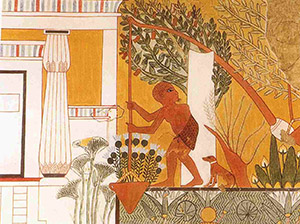
This image, taken from Tomb of Ipuy at Deir-el-Medina, on the west bank of Thebes, shows a gardener using a shaduf. How did the shaduf and inventions like it increase the usefulness of the Nile River?
- by preventing destructive floods
- by making widespread irrigation possible
- by making more drinking water available
- by providing water for bathing and cleaning clothes
The shaduf and inventions like it allowed ancient Egyptians to irrigate their farms--to move water from the Nile to crops planted on land that was some distance from the river.
The shaduf and inventions like it allowed ancient Egyptians to irrigate their farms--to move water from the Nile to crops planted on land that was some distance from the river.
The shaduf and inventions like it allowed ancient Egyptians to irrigate their farms--to move water from the Nile to crops planted on land that was some distance from the river.
The shaduf and inventions like it allowed ancient Egyptians to irrigate their farms--to move water from the Nile to crops planted on land that was some distance from the river.
In what ways did the Nile River help build the ancient Egyptian civilization?
- It transported food, people, and ideas.
- It helped people increase crop production, and thus food supplies.
- It provided fresh water for people, plants, and livestock.
- It did all of these things.
A river valley is a perfect place to start a civilization--it has everything a group of people needs to increase their numbers and organize a way of life that allows for technological and cultural changes.
A river valley is a perfect place to start a civilization--it has everything a group of people needs to increase their numbers and organize a way of life that allows for technological and cultural changes.
A river valley is a perfect place to start a civilization--it has everything a group of people needs to increase their numbers and organize a way of life that allows for technological and cultural changes.
A river valley is a perfect place to start a civilization--it has everything a group of people needs to increase their numbers and organize a way of life that allows for technological and cultural changes.
Summary
 Questions answered correctly:
 Questions answered incorrectly:
