Whether writing or speaking, you need to organize your ideas if you expect to make your point. An organizational pattern can help you do that. Organizational patterns are ways in which ideas are typically organized. One of the four patterns described on this page should work for most presentations. Click each tab to learn about each organizational pattern.
Chronological
Spatial
General to Specific
Specific to General
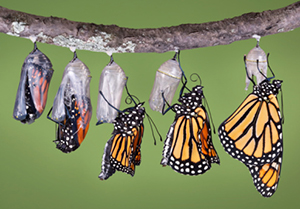 Chronological order is arranged like a timeline: It starts with the first event in a sequence, and continues to the last. (This pattern is also called sequential order.) Chronological order is typically used to describe a sequence of events or steps in a process.
You try it. Drag these presentation details into chronological order.
Larvae spend all of their time looking for food.
Adult butterflies emerge from cocoons and wait for their wings to dry.
Pupae become adult butterflies through metamorphosis.
Butterfly larvae, or caterpillars,
emerge from eggs. Butterflies lay eggs on the
surface of plants. Larvae transform into pupae and form a cocoon, or chrysalis. |
|
Spatial order organizes details according to location or size. It is used to describe places or things.
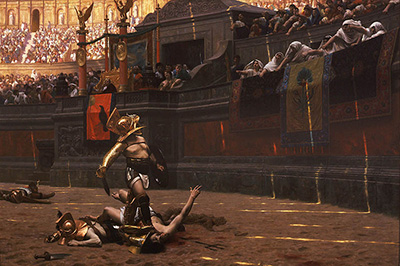
What does spatial order look like? See if you can organize these details about the painting above, starting with the key area of focus--the center. The details are out of order right now. In your notebook or on a scrap of paper, list the letters in the order that they should appear, if you started with what appears in the center of the painting. (That means that the list should start with Sentence B.) First write your own list of letters. Then, click Show Me to see if you arranged them correctly.
A. Most of these spectators have their thumbs pointed down, a bad sign.
B. In the center, the victorious gladiator stands over his opponent.
C. The most visible spectators are women in the front row.
D. In the stands above, Roman throngs scream their approval.
E. In his decorated box, the leader offers no sign regarding the defeated man's fate.
F. To the left of these women, a Roman leader gazes at the crowd.

B. In the center, the victorious gladiator stands over his opponent.
D. In the stands above, Roman throngs scream their approval.
A. Most of these spectators have their thumbs pointed down, a bad sign.
C. The most visible spectators are women in the front row.
F. To the left of these women, a Roman leader gazes at the crowd.
E. In his decorated box, the leader offers no sign regarding the defeated man's fate.
The general-to-specific organizational pattern usually starts with a big idea, and then describes details related to that big idea. This pattern is commonly used to describe a category and its members, examples, or types.
Suppose you had this list of ideas for a speech or presentation.

- Women and girls--females--have certain characteristics in common.
- Girls are portrayed in movies and TV as being interested in fashion.
- Some girls are more interested in sports or technology than in fashion.
- The human race is made up of two groups: males and females.
- Female athletes must work very hard to do well in sports like soccer.
- Female soccer players sometimes become professional athletes.
- The United States women's national soccer team wins most of its games.
- Mia Hamm was a member of the U.S. Women's National Soccer Team.
If you organized the ideas from general to specific, which idea would appear at the beginning or your speech?
The human race is made up of two groups: males and females. (This is the most general idea in the list.)
The specific-to-general pattern of organization starts with details and ends with a description of a category. This pattern is often used to tell stories that illustrate a point or to grab a reader's attention at the very beginning of a presentation.
How do speakers use a specific-to-general organization pattern? Read this list of ideas for a speech about circus performers who are children. Then answer the question beneath the list.
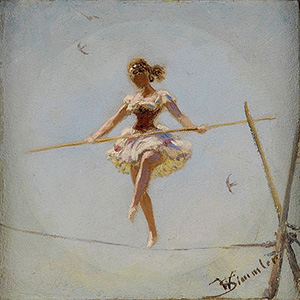
- Bird Millman began work as a tightrope walker at age 6.
- Millman started performing with ponies but quickly moved to the trapeze.
- Like Millman, Ella Bradna started as a circus rider before learning the trapeze.
- Bradna started performing at age 11 when her older sister was injured.
- Bird and Ella both came from circus families, who taught them early.
- Most circus performers, past and present, begin training as children.
Suppose a speaker wants to add an idea--without changing the organizational pattern of the speech. Where should the speaker place the new detail?
- at the beginning of the speech
- at the end of the speech
- before the next most general idea
- before the idea about how Ella Bradna got her start
Where the new idea belongs depends on how general it is, compared to the other ideas in the speech.
Where the new idea belongs depends on how general it is, compared to the other ideas in the speech.
Where the new idea belongs depends on how general it is, compared to the other ideas in the speech.
Where the new idea belongs depends on how general it is, compared to the other ideas in the speech.
Summary
 Questions answered correctly:
 Questions answered incorrectly:
