In previous lessons, you learned about the many organelles that are important to your cells. In this lesson, you'll focus on the structure and function of just one very important organelle. The nucleus typically appears near the middle of a cell; it holds the cell's DNA and controls the major functions and activities of the cell. For these reasons, the nucleus is sometimes considered a cell's "control center."
Not all living cells have a nucleus. The ones that do are called eukaryotic. The word eukaryote comes from the Greek roots eu, which means "true," and karyon, which means "kernel." Early scientists noticed the similarity between the shape of a cell's nucleus and kernels of corn or grain. Thus, the literal meaning of the word eukaryote is "true kernel" or "true nucleus." Each of the cells in a eukaryote contains a true nucleus.
In this lesson you will learn more about eukaryotic cells, including the benefits of having a nucleus. As you watch the video below, decide whether you, a human, are a eukaryotic organism.
 What do eukaryotic cells have in common? All eukaryotic cells have a nucleus. The nucleus is important for organizing the hereditary information in the cell and controlling the expression of genes. These animals are all eukaryotes: a dog, a bird, a giraffe. As well as these plants: a dandelion, an oak tree, and poison ivy. All these organisms have a nucleus. Are you a eukaryotic organism?
What Do All Of These Have In Common?
 |
 |
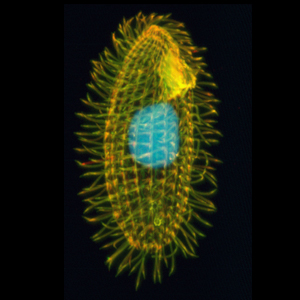 |
| Thyme | Rottweiler | Single-celled Ciliate |
All of these organisms are eukaryotic.
Question
Are you a eukaryotic organism?
