So far, you have learned that animal and plant cells have many structures in common, including the nucleus. Now take a look at some of the structures that are unique to animal or plant cells. Many of the organelles labeled in these images were described in the previous lesson. For now, pay close attention to the new organelles you see labeled in these images.
Animal Cell
Plant Cell

The cytoskeleton is a system of protein filaments that provide structure for the cell and help it move. A lysosome is an organelle that contains enzymes that break down lipids, proteins, and carbohydrates. Lysosomes can also break down old organelles that no longer function. A vacuole is a sac-like structure that stores materials for the cell. Animal cells can have multiple lysosomes and vacuoles. A centriole is a structure located near the nucleus that helps organize cell division. Animal cells have centrioles, but plant cells do not.
Click on the image to expand.
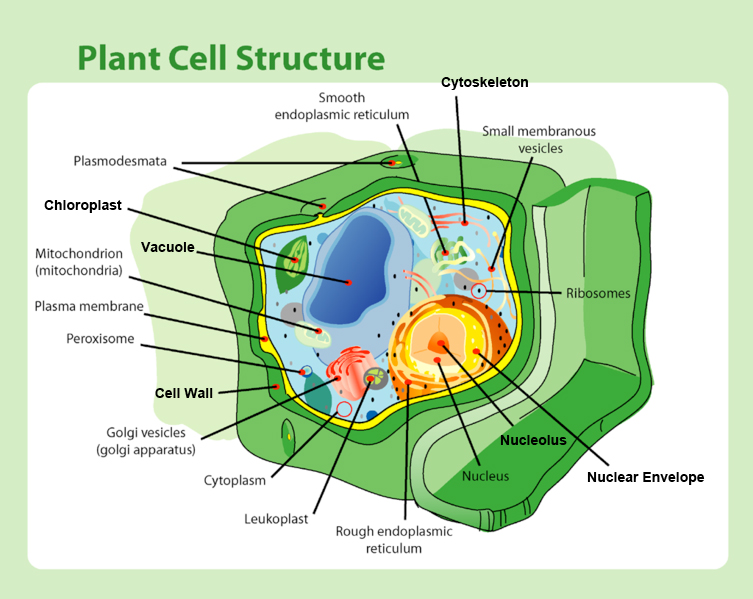
Like the animal cell on the other tab, a plant cell has a cytoskeleton. While the animal cell may have many vacuoles, a plant cell often has one large, centrally located vacuole. Plant cells do not have lysosomes at all. Two structures in plant cells that do not appear in animal cells are the cell wall and chloroplasts. The cell wall is a rigid structure outside the cell membrane that provides additional protection and support for the cell. A chloroplast is capable of converting light energy from the sun into chemical energy that fuels the activity of the cell.
Click on the image to expand.
Question
How does the structural support of the cell differ in plant and animal cells?
