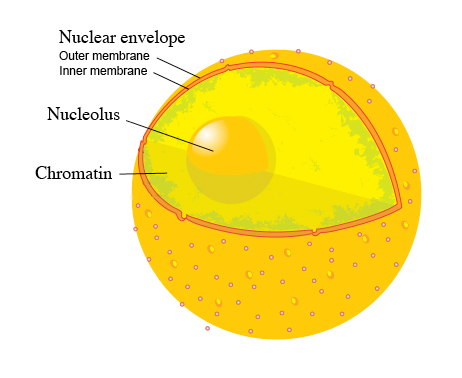
Animals, plants, fungi, and protists have eukaryotic cells, and the structure of the nucleus in animal and plant cells is quite similar. The nucleus is surrounded by a nuclear envelope--a two-layer membrane that protects and contains the hereditary information (DNA) for the cell. The nuclear envelope controls what materials go into or out of the nucleus, which is very important for regulating gene expression.
The denser region inside the nucleus is called the nucleolus. Since the assembly of ribosomes begins in the nucleolus, this region plays a key role in translating the code contained by the DNA into the proteins the cell needs for structure and function. Between the nuclear envelope and the nucleolus, there is chromatin--DNA bound to proteins. When it is time for a cell to divide, the DNA is organized into chromosomes. The rest of the time, the DNA floats loosely in the nucleus in the form of chromatin.
Question
Why is the nucleus important to the cell?
