If every cell in a eukaryote contains a nucleus, the part must be not just important, but also very useful. As soon as scientists were able to use powerful microscopes to study how cells behave, they set out to understand how a cell's parts help it perform its daily tasks. Use this slide show to learn some of the main advantages of having a nucleus.
More Accessible DNA
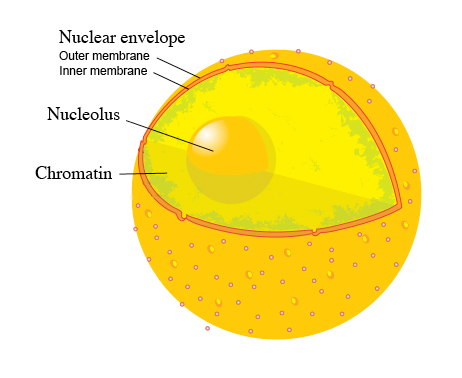
Inside the nucleus, DNA does not take the form of chromosomes unless the cell is in the process of dividing. The rest of the time, the DNA binds with protein to form chromatin, which is a lot looser in structure than chromosomes and needs the structure of the nuclear envelope to contain it. Why would the more open structure of chromatin offer an advantage to a cell? When the DNA is more loosely arranged in the form of chromatin, it is more accessible to the parts of the nucleus that will translate it into the proteins needed for cell structure and function. Gene Regulation
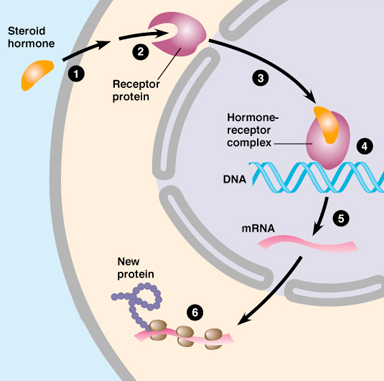
This image illustrates one way in which a gene can be turned on. A steroid enters the cell and binds a receptor, then travels to the nucleus. The steroid and receptor are transported into the nucleus to turn on specific genes, which then make specific proteins in the cell. What role does the nuclear envelope play in this process? The nuclear envelope keeps the DNA in one central location so that it can be located and accessed by the steroid. The nuclear envelope then allows the steroid and receptor to enter the nucleus so that the appropriate gene can be turned on by the presence of the steroid. A Standardized Nucleolus
The nucleolus is a dense region of the nucleus made up of DNA, RNA, and proteins. The main function of the nucleolus is to combine RNA and protein to form incomplete ribosomes. The nucleolus always forms around specific regions of the DNA to allow this process. What is the advantage of having the nucleolus form around the same areas of DNA for all cells in an organism? If all the cells in an organism have a uniform way of organizing DNA, the processes for regulating and translating DNA can be the same across all cells of an organism. Each cell does not have to "reinvent the wheel" or figure out its own way of organizing the DNA of the cell. |
 |