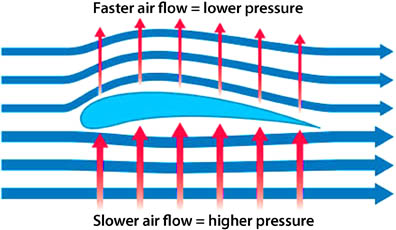
 Birds and planes stay in the air partly due to the shape of their wing. Most airplane and bird wings are in the shape of an airfoil. An airfoil is shaped so that the top surface is more curved than the bottom surface. When air hits an object, it tends to flow over the surfaces of the object, coming together at the back of the object.
The assumption used to be that the air particles above and below the airfoil want to reunite at the back of it, and this causes the air over the top of the airfoil to be moving faster in order to get to the back at the same time as the air going under the airfoil. And what did you just learn about faster moving air? It has a lower pressure! Therefore, the air going under the airfoil has greater pressure than the air flowing over it, and the net force is an upward one. This force is called lift. This is what gets planes in the air and keeps them there. This assumption was close, but not entirely correct, as we will explain.
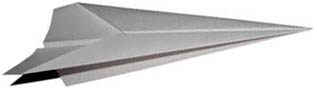 It is not only the airfoil shape of a wing and the process we just described that causes lift. If that was the case, then how would paper airplanes work? And what about those first planes that had fabric wings, such as the Wright Brother’s Flyer? There are some stunt planes and military planes that have the same curve above and below the wing, so they can fly upside down. There must be more to it.
Airfoil
Describe the shape of an airfoil.
An airfoil is the shape of a wing or blade where the top surface is curved more than the bottom surface. An airfoil-shaped body moves through a fluid producing an aerodynamic force.
